
Por ahora, esta publicación solo está disponible en inglés.
2026-10-07
Synthetic respondents vs. real consumers: what's the difference, and when should you use each?
Synthetic respondents offer speed and cost efficiency for early-stage market research tasks like screening ideas and refining surveys, but they cannot replace real consumers for high-stakes validation, measuring demand, or capturing lived experiences. Therefore, the best practice is to use synthetic methods for initial exploration and real consumers to make final, consequential business decisions.
Quick summary: Synthetic respondents are AI-generated research participants. They're good at exploring ideas fast, anticipating objections, sharpening survey questions, and cutting a long list of concepts down to a short one. Real consumers are still necessary when you need to validate demand, measure price sensitivity, understand lived experience, judge a close call between two designs, or commit budget to a product, brand, or campaign decision.
The promise of synthetic consumer research is hard to ignore. You describe a target customer to a large language model (LLM), show that simulated customer a product concept, and get a detailed reaction in seconds. No recruiting, no incentives, no waiting for a panel to fill. A synthetic panel can review a new package, business name, ad concept, or pricing page before a traditional market research project has even kicked off.
That speed is valuable. It also creates a specific temptation: confusing an answer that sounds like a customer with evidence from a customer. Synthetic respondents don't pay grocery bills, switch brands, or live with a bad purchase. They generate plausible language from their training data, your prompt, and whatever real-world data grounds the system. Real people bring the opposite mix: lived experience and actual purchase behavior, but also misread questions, polite answers, and a gap between what they say and what they do.
So the debate over synthetic respondents vs. real consumer feedback isn't efficient AI against messy humans. Both can mislead when used for the wrong job. The useful question is what kind of evidence you need at each stage of a decision. Synthetic research earns its place early, while changing your mind is cheap. Real consumer research matters more as the decision gets closer to manufacturing, campaign spend, pricing, and launch.
What happened when we asked AI models and real shoppers the same question
Rather than argue this in the abstract, we ran it twice. We put the same questions to general-purpose AI models and to real people on PickFu, a consumer insights platform that sends your questions to verified respondents in the audience you choose. Both tests are text comparisons, the format synthetic panels handle best, so neither is rigged against the models.
Test 1: two claims, one word apart
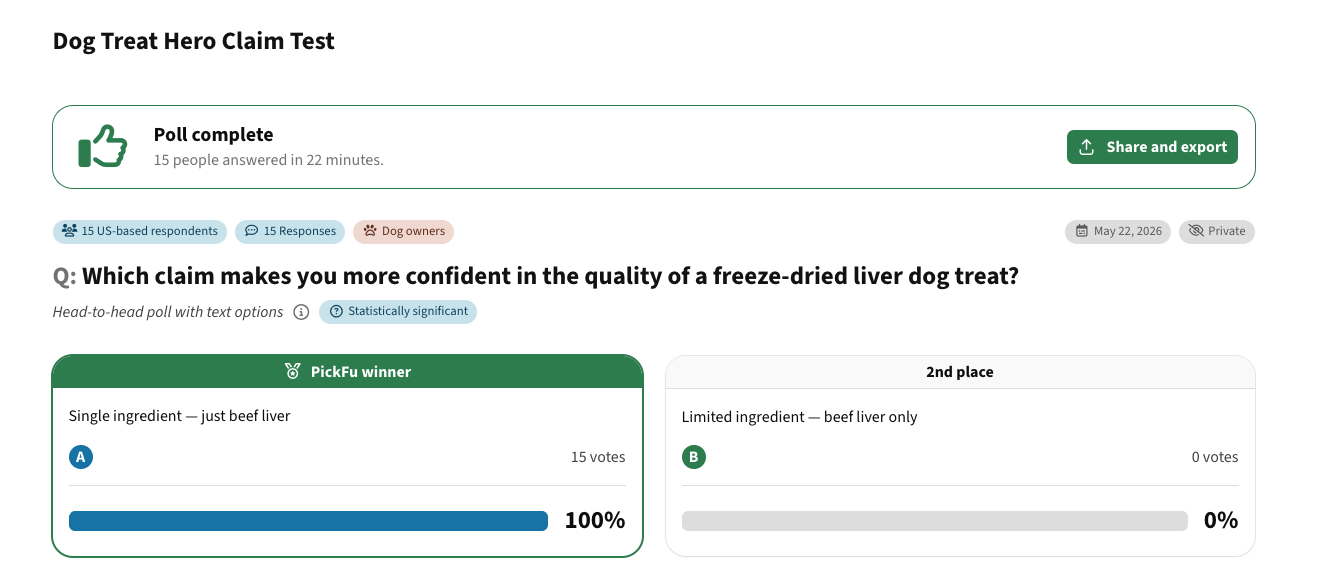
A dog treat brand is deciding how to word the hero claim on a freeze-dried beef liver treat:
- A. Single ingredient — just beef liver
- B. Limited ingredient — beef liver only
Same product, same fact, one word of difference. We asked 15 US dog owners which claim made them more confident in the treat's quality, and asked ChatGPT and Perplexity to predict how those 15 people would vote. (We ran both tests in September 2026, using GPT-5.6 Luna in ChatGPT and Perplexity's default model.)
📊 Survey example: Dog treat hero claim test — 15 US dog owners
Dog owners voted 15 to 0 for "single ingredient," and they were clear about why:
- "Limited makes it sound like there is not enough of it."
- "Option A is clearly much better - why would you use 'limited' for a single ingredient? The word itself implies otherwise."
- "It sounds a little confusing and maybe even deceptive because a limited ingredient makes me think there is more than one ingredient."
This is the easy case. The options are text, the difference is one word, the question is about comprehension rather than taste, and the answer was unanimous. Those are the conditions where a model is most likely to get it right, and both did. Both picked "single ingredient," ChatGPT for the same reason respondents gave ("limited" suggests more than one ingredient) and Perplexity because it sounded simpler and purer. Where they missed was the margin. ChatGPT predicted a 9-6 split and Perplexity 12-3, while real dog owners went 15-0. For choosing between two claims, the pick is what matters, and either model would have saved you a survey. That's the case for synthetic screening in a sentence: not that simulated feedback is as good as real feedback, but that some questions don't need real feedback yet.
Test 2: six taglines, no clear winner
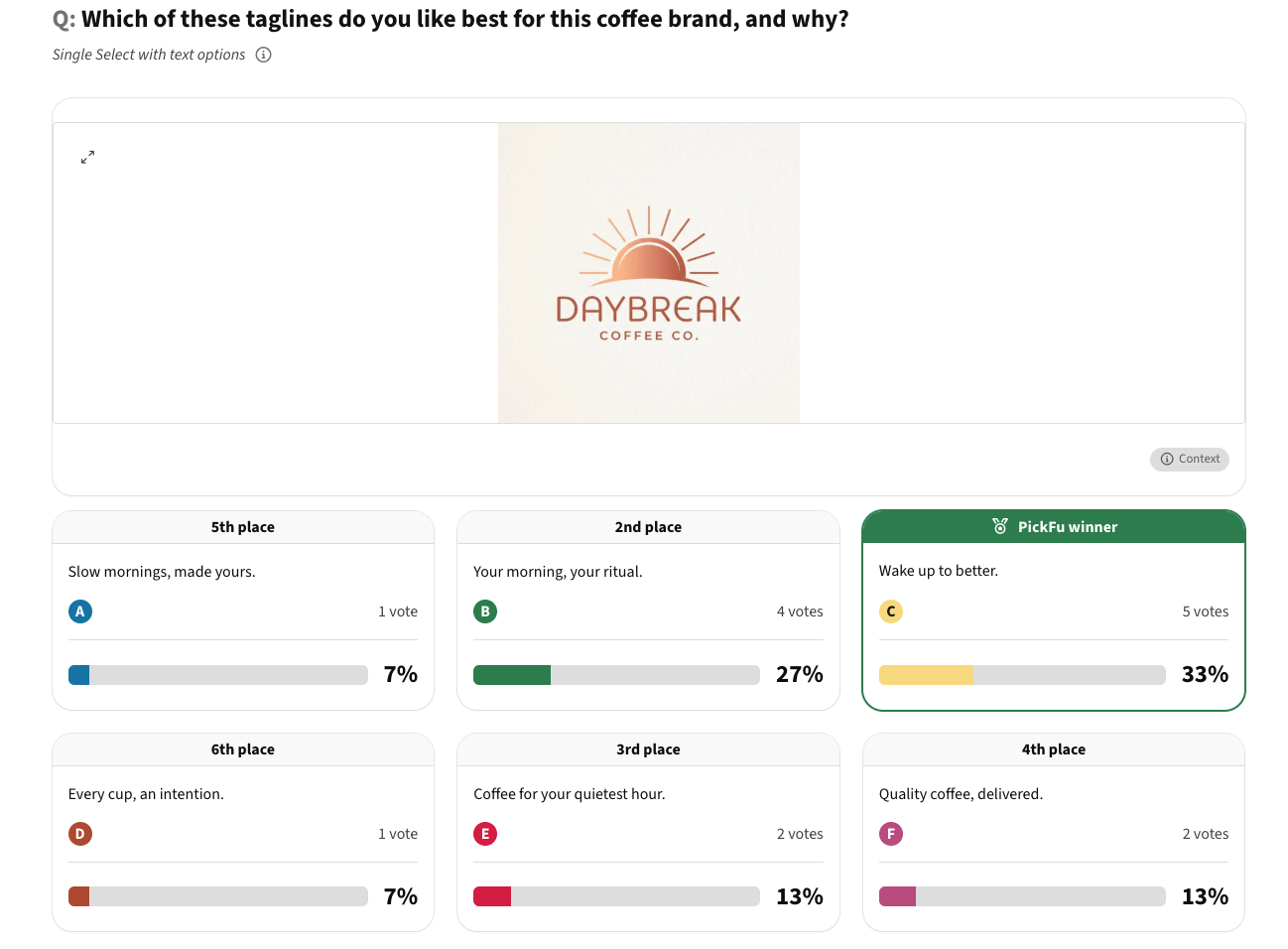
Daybreak Coffee Co. is a fictional brand we use for testing. In this scenario, Daybreak is rewriting the tagline for a specialty coffee subscription and has five candidates, tested against the line it already uses:
- A. Slow mornings, made yours.
- B. Your morning, your ritual.
- C. Wake up to better.
- D. Every cup, an intention.
- E. Coffee for your quietest hour.
- F. Quality coffee, delivered. (the current tagline)
Same setup: 15 US coffee drinkers, targeted to women, and the same six options given to both models.
📊 Survey example: Daybreak tagline resonance — 15 US coffee drinkers
What the results showed:
- "Wake up to better" won with 33%, five votes out of 15. "Your morning, your ritual" took 27%. The other four split 13%, 13%, 7%, and 7%.
- The current tagline got 13%, tying for third and landing ahead of two of the five new candidates.
- One respondent questioned the premise behind half the list: "The ones with mornings feel like you're limiting consumption of coffee just in the morning, which is odd."
- Another explained her pick, then wrote a line she liked better than anything on the list: "I think something like 'Rise to better' would be a better option and include a play on the sun rising."
What the models predicted: ChatGPT picked "Slow mornings, made yours" as the winner with five votes and put "Wake up to better" fifth with one. Real respondents flipped those two. Its counts for the other four taglines matched the real results exactly, and its reasoning leaned on the assumption one respondent pushed back on, praising the "promise of a peaceful, elevated morning." Perplexity picked "Your morning, your ritual," the real runner-up, and put "Wake up to better" second. It gave the current tagline zero votes and ranked it last. Real respondents gave it two, ahead of two of the new candidates.
What the two tests tell you
An AI model asked to pick a winner will pick a winner. On the dog treat claim, that's what you want. The question has an answer, and a model finding it saves you a survey.
On the taglines, the same behavior becomes the problem. There was no winner to find. Fifteen people produced a 33% plurality and a six-way split, the current line beat two challengers, and the two most useful responses weren't voted at all: one questioned the brief, one rewrote it. Neither model found that, and they didn't agree with each other either. ChatGPT has a tagline real people ranked near the bottom. Perplexity crowned the runner-up and wrote off a current line that beat two challengers. ChatGPT did note that 15 respondents could "substantially change the ranking," which is fair. But the real answer here is "nothing has separated yet, and your morning framing may be wrong," and a ranked list can't say that.
So the useful line isn't synthetic versus human. It's settled versus contested. Synthetic respondents are good at confirming what's already clear and bad at telling you when nothing is, and they sound the same in both cases. That's also why PickFu's own synthetic beta groups options into a stronger half and a weaker half instead of crowning a single winner.
PickFu's human surveys are built for the contested cases. You upload your options, choose the audience you want to hear from using 100+ targeting traits across 15 countries, and get feedback from real, verified people who match it, with results in hours, not weeks. Every response includes the respondent's written explanation, which is where splits like the tagline result show up instead of getting averaged away.
What are synthetic respondents?
Synthetic respondents are AI-generated research participants designed to answer questions as though they represented a particular customer, user, or audience segment.
You create one by defining characteristics: age, income, occupation, location, family status, product experience, buying habits, and other demographic or psychographic traits. An LLM then answers from that profile's perspective. More advanced systems ground the profile in real data, such as customer interviews, transaction records, past survey answers, or behavioral data. Generate many profiles at once and you have what's usually called a synthetic panel.
The key word is simulated. The system predicts what a person with those characteristics might say. It isn't collecting feedback from anyone who has those experiences.
Synthetic respondents are not the same as synthetic data
Synthetic data is a much broader category: artificially generated transactions, images, medical records, or customer profiles. A bank uses synthetic transactions to test a fraud-detection model. A manufacturer uses digital twins to simulate how equipment performs. Synthetic respondents are one narrow application, aimed at simulating people's answers and choices. That's a harder job than it sounds. A model can predict whether a bridge component fails under load. Consumer choice runs on emotion, culture, habit, social pressure, timing, and limited attention.
Synthetic users, consumers, and customers
Synthetic users, synthetic consumers, AI personas, simulated respondents: these terms get used interchangeably, and they describe very different methods. One might come from the prompt "Act like a 30-year-old software buyer." Another might be grounded in years of real survey answers and purchase behavior.
If you take one thing from this section, take this: what a synthetic respondent is built from matters more than anything else about it. A synthetic respondent built on records of what real people in a category actually chose, including what they rejected and their own words for why, predicted from evidence. One improvised from a prompt predicts from a model's general impression of a demographic. Both hand you a fluent answer with a confident rationale, so you can't tell them apart by reading the output. You have to ask what's underneath it.
Research points the same way. Researchers at Stanford built AI agents from in-depth interviews and survey answers from more than 1,000 real people, and those agents matched the participants' own later answers more closely than agents built from demographics alone.
PickFu's synthetic research product, Synthetic Audiences, is built on that kind of grounding and is currently in beta. Each synthetic respondent is modeled on a real PickFu panelist: their trait profile, plus years of choices that person made on real PickFu surveys. In our testing, it picks the same side as real people most of the time on text comparisons, and less often on images. It's meant to help you decide what's worth testing with real people, not to replace them. You can learn more and join the waitlist.
Synthetic respondents vs. real consumers: key differences
Real consumers are actual people whose opinions and purchases exist outside any model: survey respondents, interviewees, focus group members, product testers, existing customers, or shoppers observed through transaction data. The gap between what they say and what they do is central to good market research. A customer says sustainable packaging matters, then buys the cheaper product. A shopper prefers one set of product images in a survey and clicks a different one while browsing Amazon. Those contradictions aren't noise. They're human behavior, and they reflect the market you have to sell to.
Synthetic respondents win on speed, scale, and cost. None of those is statistical validity. Generating 10,000 synthetic responses doesn't give you a 10,000-person study. The model produces more rows without adding a single independent human experience. That's why sample size is misleading in synthetic research: a large simulated sample describes the model's own output precisely, which tells you nothing about whether it matches the market.
When synthetic respondents are useful
Here's where we've landed, from testing synthetic results against real PickFu surveys: synthetic is good at deciding what's worth testing, not at deciding what to do. These are the jobs it does well.
Narrowing a long list. This is the strongest use case. Generative AI made it cheap to produce dozens of names, packages, app screens, slogans, and ad concepts, so the hard part is now deciding which deserve real investment. Screening eight product names down to the two or three worth testing with real people is close to the ideal synthetic job. A wrong cut costs little, and you were never going to test all eight with humans anyway.
How much to trust the cut depends on what you're cutting. Text comparisons are where synthetic does best, so it's a good fit when you need to test slogans, test a business name, compare claims, or pressure-test price framing. It also handles clarity and trust questions well: is this claim confusing, does this feature description make sense, does this sound believable? Visual work is different. Package design testing, logo and design testing, mockup testing, and app store screenshot and icon testing are where synthetic panels are weakest, for reasons covered below. A synthetic pass can still help when the options are clearly different from each other, and it can catch the one that's illegible, off-category, or a near-duplicate. Use it to remove obvious failures, not to pick between two directions you like. If you're trying to test your company logo and two candidates are close, ask real people.
Improving survey design. A badly designed questionnaire is broken before anyone sees it: biased wording, unclear terms, overlapping answer choices, assumptions respondents don't share. Synthetic respondents can catch obvious confusion and suggest answer options the team missed. Ali Henriques, who heads market research at Qualtrics, described this as the safest use in an interview with Greenbook: "A no-risk application is pre-testing the study design with synthetic. Tell me what the harm is." As Pew Research Center explains, even small changes in wording and question order can change results. The same goes for anyone asking where can I post a survey: no platform can rescue an unclear questionnaire or the wrong audience.
Generating hypotheses. A subscription software company wants to know why trial users don't convert. Synthetic customers suggest setup looks too hard, pricing is unclear, the trial doesn't show value fast enough, or the product reads as built for bigger companies. Those aren't findings. They're four hypotheses to check against customer interviews, product analytics, and real survey responses. The same works across audiences: a financial app comparing simulated reactions from first-time investors, retirees, and self-employed workers might spot a version that assumes too much financial knowledge. That shapes later research. It doesn't prove those groups hold the opinions the model generated.
Preparing qualitative research, and making low-stakes calls. A model can simulate likely objections, flag confusing terms, and suggest follow-up questions, which makes for a better moderator guide. That's preparation, not qualitative research. A synthetic focus group can't simulate a participant getting uncomfortable, changing her mind after hearing someone else, or challenging the premise of the discussion. Cheap, reversible internal calls are fair game too, like picking which headline direction to explore first. The danger is drift: a method chosen for brainstorming quietly becomes the basis for a brand or pricing decision.
When real consumers are essential
Our rule of thumb: synthetic decides what to test, and real people decide what to do. That means real people for these jobs.
Measuring demand. A synthetic respondent can describe why a product sounds appealing. It can't buy it, join a waitlist with real intent, renew a subscription, or recommend it to a friend. Demand validation requires behavior from people facing real constraints: paid pilots, preorders, trial conversion, retention. Synthetic respondents can help improve the offer before those tests. They can't establish product-market fit.
Pricing and willingness to pay. Comparing how a price is framed ("$29 a month" vs. "under $1 a day") is a text comparison, and synthetic handles it reasonably well. Asking what people would actually pay is a different question. Price sensitivity is shaped by income, urgency, alternatives, and the plain discomfort of spending money, and a synthetic buyer never has to enter a credit card. When Strat7 compared synthetic and human respondents against a nationally representative sample of 3,000, purely synthetic respondents broke the logical order of a standard price-sensitivity exercise 68% of the time (32.8% when blended with real data), and their prices ran about 16% higher than real people's. Real consumers are necessary when pricing drives revenue forecasts or market entry. Even then, check real survey answers against behavior, because people overstate what they'd pay.
High-stakes launches. A major inventory order, national campaign, redesign, or rebrand shouldn't rest on synthetic research. Getting it wrong means unsold inventory, wasted media spend, and expensive rework. Let synthetic respondents narrow the options, and let real people in your target audience validate the finalists.
Emotionally loaded questions. Research touching health, discrimination, disability, financial hardship, or identity requires real people and careful practice. A model can produce the language of those experiences without having any of them. Synthetic tends to under-read fear and over-index on efficiency and price, and the Navy Federal pilot below shows what that looks like. Personas can also make things worse: a 2026 study found that adding demographic personas to prompts didn't reliably bring model answers closer to human survey responses, and distorted results most for some underrepresented subgroups.
The failure can hide inside an accurate-looking average. Navy Federal Credit Union ran a synthetic data pilot with Qualtrics and found mean scores between its human and synthetic groups within 0.25% across all questions. Then the emotional questions came apart. Asked whether fear of rejection made them reluctant to apply for a credit card, 41% of humans agreed but only 21% of synthetic responses did. On cybercrime as a top concern, synthetic came in at 24% against 6% for humans. Kathleen Myers, Navy Federal's assistant vice president of research strategy, put it this way: "We saw that the synths are very good at making rational judgments, answering very functional-oriented questions. When it gets into emotion, then it gets a little trickier."
Niche or emerging markets. LLMs are strongest where lots of historical information exists. A synthetic respondent gets much less dependable when the audience is highly specialized, local, recently formed, or buying a new kind of product. Synthetic enterprise buyers will describe familiar concerns about cost, security, and integrations. Real interviews may reveal that the deciding factor is whether one executive will champion the purchase internally, which never appears in the prompt or the training data. Synthetic data also ages: it can't pick up real-time shifts in culture or the market without fresh human data.
Claims that require statistical confidence. Synthetic responses should never be presented as a representative sample of US consumers. Real survey research needs careful sampling too: Pew's comparison of probability-based and opt-in online samples found opt-in samples had about twice the error on average, with bigger gaps for some subgroups. If you plan to claim "68% of consumers prefer this design," you need a defensible human sample and a clear methodology. A model-generated percentage is not a consumer statistic.
Evidence for someone else. If a result is going in front of a stakeholder, investor, or retail buyer as proof, it needs to come from real people. Pew Research Center, about as careful as survey research gets, states its own policy plainly: "Real people, not machines, answer our surveys."
Can synthetic respondents predict real consumer behavior?
Sometimes they reproduce broad human patterns. That's not the same as reliably predicting what people will do. LLMs learn from enormous amounts of human-written content, so they reproduce familiar consumer reasoning convincingly. Fluency isn't predictive validity.
Plausible answers can still be wrong
A synthetic consumer explains that she prefers eco-friendly packaging because sustainability matches her values. Perfectly sensible. The real shopper in a store reaches for the familiar brand, the cheaper option, or whatever sits at eye level. The model predicts a coherent story. The actual purchase involves attention, money, habit, and tradeoffs.
Common patterns are easier than surprising findings
Synthetic respondents do best when the question has a conventional, well-documented answer. They do worse when the research is valuable because the result is unexpected. Everything a synthetic respondent knows comes from what people already did, so a genuinely new concept gives it nothing to predict from. Greenbook calls a version of this the flattening problem: synthetic research favors broad patterns over outliers and anomalies. When researchers tested five leading AI models against a human survey of 420 Silicon Valley developers, the models produced technically plausible results, but none captured the counterintuitive findings that made the human survey worth running. Even BCG, which reported synthetic panels predicting real consumers' choices for a new beverage with 92% accuracy, says they're "less effective for testing radically innovative products" and "can't replace traditional market research."
The practical boundary: synthetic respondents help when the range of likely answers is familiar, and get less dependable exactly when you need to discover something you don't already know.
Visual and aesthetic choices are the weak spot
Both tests at the top of this post were text, on purpose. Ask a synthetic panel to judge a design and accuracy drops, for two reasons. The first is structural. A system reasoning about how people responded to past images is often working from text descriptions of those images, so the visual detail is gone before the model starts. The second is that taste is harder to predict from past behavior, especially when the options are similar.
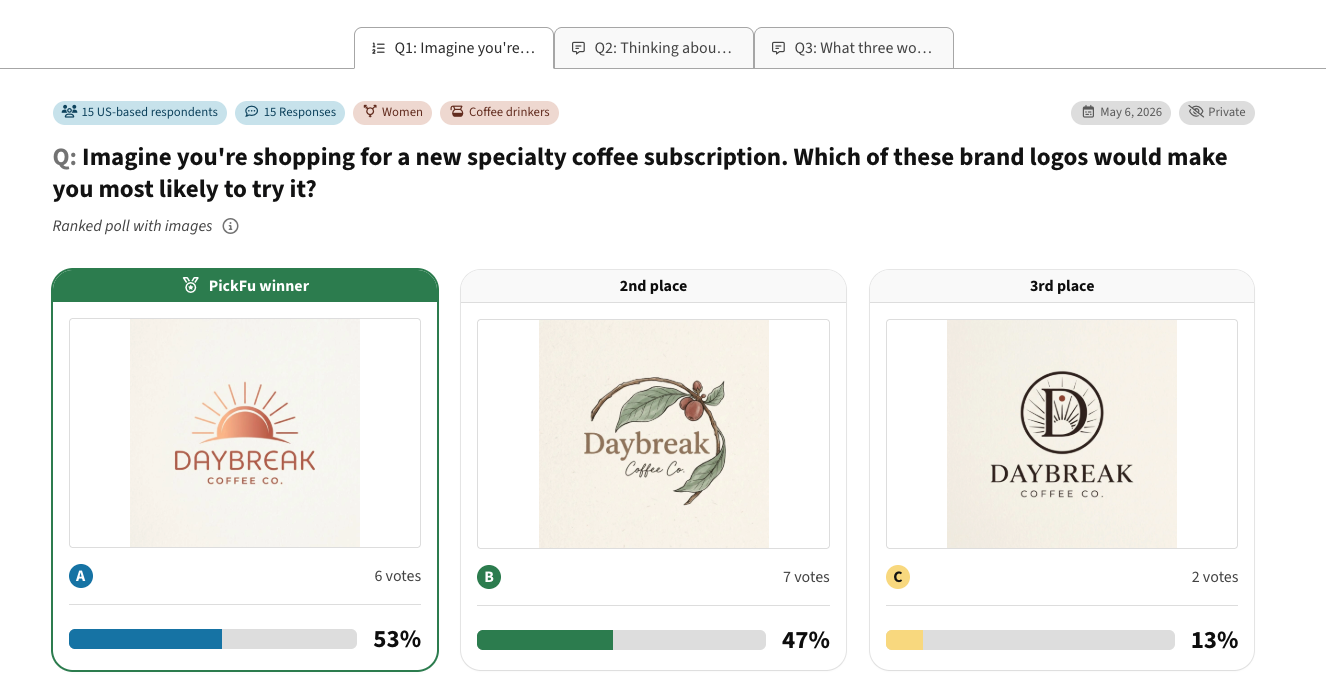
Daybreak also needed a logo, with three directions: a sunrise, a botanical leaf, and a monogram. We asked a separate group of 15 US coffee drinkers to rank them.
📊 Survey example: Daybreak logo concept test — 15 US coffee drinkers
The sunrise won at 53%, the botanical took 47%, and the monogram finished at 13%. But the botanical actually got more first-place votes, seven to six. The sunrise only won on second choices once the monogram dropped out. Underneath that near-tie was a real disagreement about what a logo is for: "It needs to be more simple, and so Option A is my 1st pick even if it looks generic," versus "The B logo seems the most original to me, a different take on the product." Some people wanted the mark instantly readable and forgave it for being generic. Others wanted it distinctive and forgave it for being busy. That split is the finding, and it's a far better designer brief than "the sunrise won."
The next step is a tiebreaker: the two finalists head-to-head, plus a question on which reads as the more expensive coffee. It's a human test, because at this point in a design decision, that's the kind worth running.
Read the winner, not the gap
This is the most practical rule we can give you. Real groups disagree. Two people with the same age, income, and job title decide differently because of history and context no profile captures. Synthetic panels tend toward agreement instead: a large study of digital twins found simulated answers varied less than the real people's answers in 154 of 164 comparisons. In practice, a close human split can come back from a synthetic panel as a lopsided one. The error can run the other way, too. Asked to predict our dog treat vote, ChatGPT said 9-6 and Perplexity said 12-3. Real dog owners went 15-0. Either way, the size of the gap is the least reliable part of a synthetic result.
So read a synthetic result as an ordering, not a measurement. "A beat B" is usable. "A beat B by 48 points" is not, and neither is any decision that depends on the size of the gap, like pricing tiers, forecast inputs, or whether a redesign is worth the cost. The same study found twins were better at capturing how people differ from one another than at predicting any one person's actual answer. If you need the real margin, or how a specific segment responded, ask real respondents.
Sycophancy shapes synthetic responses
Sycophancy is when a model gives the answer the prompt implies. Compare "Why would busy parents appreciate this convenient meal product?" with "What, if anything, would make this meal product useful or unappealing to busy parents?" The first assumes appreciation, and a model will often follow that framing and generate reasons to support it. It's leading-question bias, and models can be even more responsive to it than people. Use neutral wording, try the reverse framing, and run the same question across multiple prompts and models.
Where each method breaks down
The biggest risk with synthetic respondents isn't that they're always wrong. It's that they're plausible enough to trust without checking. Their output reads like interview material, but it's qualitative-style data: what a model predicts someone could say, not what a participant experienced. Four failure modes matter most:
- Model and source-data bias. Synthetic responses reflect the data and design of the underlying system. Where communities or behaviors are underrepresented, the model fills gaps with generalizations. Where stereotypes are common in the data, they show up in the output. NIST's AI Risk Management Framework describes AI systems as socio-technical, shaped by social dynamics and human behavior, and emphasizes managing that risk rather than assuming outputs are neutral.
- Prompt sensitivity. Persona wording, question order, framing, model version, and grounding data all move the output. You're measuring the simulated customer and the setup you built at the same time.
- Hallucinated experience. "I bought a similar snack last month" is generated narrative, not memory. The detail makes a response feel authentic without making it a customer anecdote.
- Blurred data sources. Reports need to separate real human responses, synthetic responses, AI-supplemented human responses, and blended datasets. Mixing them up damages data integrity and data quality at once.
Real consumer research earns its keep on contradiction, language, and behavior. A customer says convenience matters, then rejects a convenient product because the package looks wasteful. That contradiction may be the insight, and it's the kind synthetic respondents smooth into a tidy explanation. Open-ended answers also show how customers describe their needs in their own words. That's the real answer to how to create original content for GEO and SEO: AI can summarize public information for everyone, but first-party surveys give you evidence competitors can't pull from the same search results. And real research can move past opinion into action, such as clicks, purchases, sign-ups, and retention, where behavioral data beats stated intent because it records what actually happened.
Real research has its own failure modes, and they deserve the same honesty. Some participants misrepresent themselves, rush, or answer purely for the incentive. Pew's work on bogus respondents shows they can shift opt-in poll estimates by several points, and AI makes them harder to catch, since a low-effort participant can now paste in a convincing open-ended answer. That's why respondent verification matters as much as sample size. Beyond fraud, a respondent can sincerely believe she'll buy a product and then ignore it at launch, 10 interviews can surface a theme without telling you how common it is, and no number of real people will rescue a leading question.
Best practice: use both, in sequence
Synthetic respondents help you widen and organize the problem, which makes them a natural first pass in AI creative testing. Real consumers tell you which ideas survive contact with the market.
Start with synthetic exploration. Generate possible objections, compare rough positioning directions, review survey wording, and find gaps in the concept. The goal is breadth, not proof.
Apply human expert review. A researcher, PM, marketer, or subject-matter expert reads the output before anything moves forward. This keeps model bias and leading questions out of the human study.
Test refined concepts with real consumers. Survey people who match your target audience and ask questions tied to the business decision. For creative and product work, that means package design testing, product images, logo and design testing, app store screenshot and icon testing, slogan and brand name test work, and early prototype market validation: the finalists, in front of the people who'd buy.
For example, we tested four packaging claims for a sample cold brew brand we'll call Oakmore, ranked by which would most make people buy.
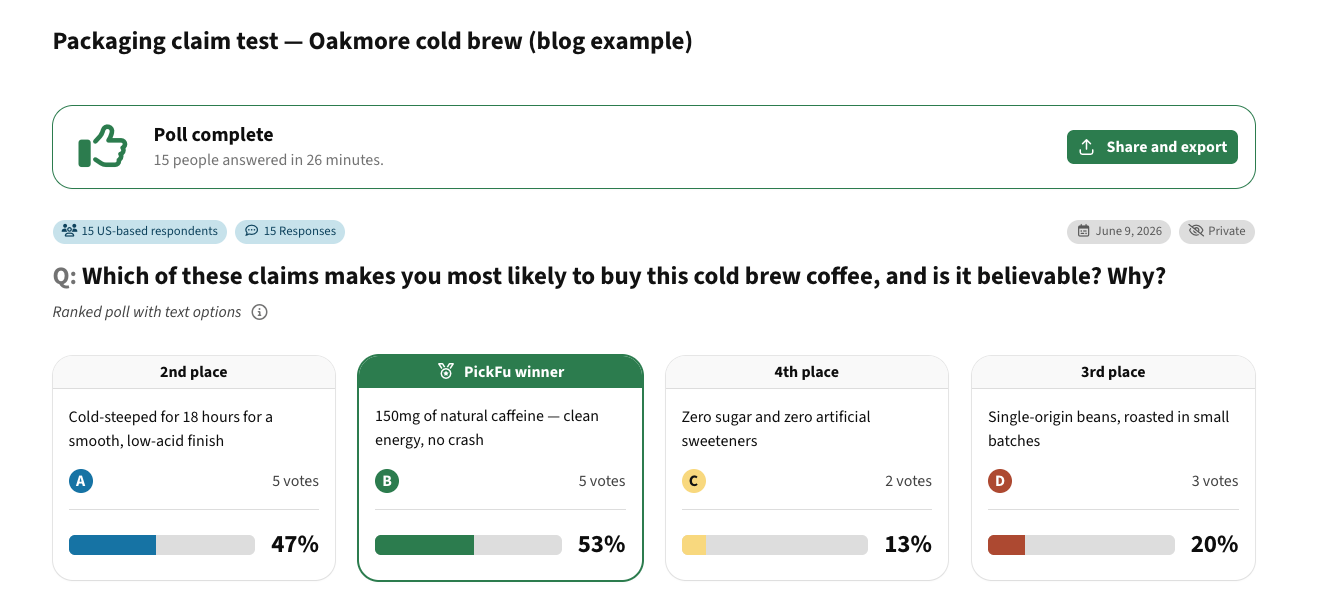
📊 Survey example: Oakmore cold brew packaging claim test — 15 US respondents
What the results showed:
- "150mg of natural caffeine — clean energy, no crash" won at 53%, edging out "Cold-steeped for 18 hours for a smooth, low-acid finish" at 47%. Another near-tie, with the two leaders meeting different needs.
- Predictable energy drove the winner: "I want to know my dosage so I can plan for how it's going to make me feel."
- For some, low acid was about comfort, not taste: "I don't like most coffees and I find them too acidic or hurts my stomach," and "Low acid is the most important feature when I look for a cold brew. I love coffee but it can upset my GERD pretty badly if it is high acid."
- "Single-origin beans, roasted in small batches" finished third at 20%, with real but narrow appeal.
A synthetic panel asked to rank these claims might well surface all four themes. It's much less likely to tell you that the low-acid claim is essential for a specific group of buyers with a physical reason, or that the winning claim wins on planning rather than taste. Those details change the packaging hierarchy.
Compare the predictions. Record where synthetic matched real consumers and where it didn't. Over time you build a record of your system's strengths and blind spots. One team finds synthetic good at catching clarity problems and bad at predicting which concept wins. Another finds it fine in familiar categories and useless in technical ones. You won't know which you are until you keep score.
Add real behavior where you can. A winning package can go into a paid campaign. A selected image can enter Amazon split testing. An app screenshot can be judged on install data. Human feedback explains the choice, and behavior shows what happened. Run this way, it's a practical form of human-in-the-loop product research for AI: AI creates and screens the options, and people stay responsible for validating meaning and market fit.
How to validate synthetic respondents
Treat synthetic respondents as a research tool whose usefulness has to be tested for your audience and your question.
Benchmark against completed human studies. Start with a past study whose results you already know. Give the synthetic system the same questions without revealing the answers, then compare the direction of preference, the spread of answers, segment differences, open-ended themes, and any surprises. That's a far better test than asking whether the output sounds human. Pick one question you're confident about and one you aren't, like the two tests at the top of this post. The pair shows you where your system's judgment stops being trustworthy.
Ask identical questions of both groups, and compare more than the winner. A synthetic panel can pick the same winner while exaggerating consensus or erasing an important minority view. In our tagline test, even a model that named "Wake up to better" the winner would have missed what mattered: the win was a 33% plurality, and the current line beat two of its replacements.
Compare patterns, and test more than one setup. It's easy to find one synthetic response that resembles one real response. The question is whether the system reproduces patterns across studies, segments, and question types. Change the model, persona wording, and question framing too. If results move a lot, you're measuring your setup, not a stable consumer preference.
Validate by use case, and document it. A synthetic system can be good at checking message clarity and bad at estimating price sensitivity, so don't call it "accurate" in general. Say accurately for which task, against which human benchmark, for which audience, using which model. A credible report names the model and version, the prompt approach, the grounding data, the quality controls, the human review process, and the known limitations. Then recheck it periodically, because a method that matched your customers a year ago may behave differently after a model update.
Ethical considerations
Don't present synthetic responses as human feedback. A generated quote shouldn't be formatted as a customer testimonial, and a synthetic percentage shouldn't be described as a survey of US consumers. Label simulated responses clearly and consistently.
Disclose blended datasets. If a study mixes human and synthetic records, explain how many came from each source, how the synthetic records were generated, whether they affected weighting, and how results changed without them.
Don't simulate representation instead of recruiting it. A synthetic persona from an underrepresented group doesn't deliver the perspective that made representation matter. A model-generated identity doesn't substitute for including real people in research that affects them.
Protect source data. Synthetic systems may be grounded in customer interviews, support conversations, or purchase histories. You need to know how that information is collected, stored, and used. The FTC has warned AI companies to honor their privacy and confidentiality commitments when customer data is used to build AI products.
Disclose commercial incentives. Every vendor in this space has a reason to frame the tradeoffs the way it does, and that includes us. PickFu runs a human research panel and is testing a synthetic product in beta, so read our framing with that in mind and check it against the sources linked throughout. A commercial interest doesn't make anyone's research invalid. It's why transparent methods, independent benchmarks, and stated limitations matter more than anyone's stance, ours included.
Synthetic respondents vs. real consumers: summary table
Synthetic respondents should speed up research, not imitate evidence
Synthetic respondents are valuable because they make early questions cheap to ask. They help a founder pressure-test a concept before it becomes a product, help a marketing team compare more creative directions, and help a researcher fix a survey before recruiting anyone.
Their limitation comes from the same place as their convenience: the system will produce an answer even when no real consumer evidence exists. That answer may sound thoughtful and specific, with emotion, buying logic, and a confident recommendation. None of that makes it a real consumer response.
Markets are made by people deciding things under real constraints, and the surprises are usually the point. Nobody needed 15 people to settle the dog treat claim. It took 15 people to find out that half the tagline list rested on an assumption about mornings that at least one buyer thought was wrong.
Create your free PickFu account to test your assumptions with real people in your target audience.
Frequently asked questions
What is a synthetic respondent, and what are synthetic consumers?
A synthetic respondent is an AI-generated research participant that answers questions as though it represented a particular customer, user, or audience segment. "Synthetic consumers" is the same idea by another name: simulated customer profiles built from demographic traits, customer data, prior research, or a general-purpose LLM. Either way, the answer comes from a model, not a person. Synthetic respondents can support hypothesis generation, survey prep, and early concept screening, but their output shouldn't be described as real customer feedback, and important findings should be checked against real consumers.
Is synthetic data better than real data, and can we trust it?
Neither is always better. Synthetic data is faster, easier to scale, and useful for testing systems or exploring scenarios. Real data is necessary when you need evidence of actual experience, behavior, demand, or market conditions. Synthetic data can be trusted for a defined purpose, and only after it's been validated for that purpose against human survey results, behavioral outcomes, or another credible benchmark. A synthetic answer shouldn't be trusted just because it sounds plausible.
What types of synthetics are researchers using for market research?
Synthetic survey responses, AI personas, simulated interviews and focus groups, synthetic panels, model-imputed answers, and digital twins of real respondents or customer segments. Some rely on general-purpose LLMs. Others are grounded in proprietary survey data, customer records, or behavioral data. These methods aren't equivalent, and they shouldn't be evaluated as though they were.
Can LLMs replace human survey respondents?
LLMs can replace some early research tasks. They aren't a general replacement. They may reproduce common attitudes or give directional feedback, but they don't have lived experience, real behavior, or a representative sample of a population. High-stakes decisions, public consumer claims, pricing studies, and sensitive research generally require real participants.
Are synthetic focus groups ever valid for real customer research?
They're useful for preparing interview guides, brainstorming objections, testing discussion questions, and exploring scenarios. They aren't equivalent to focus groups with real people, because they can't reproduce group dynamics, emotional stakes, social pressure, or lived experience. Use them as focus group alternatives during prep, not as a substitute for qualitative research.
How do synthetic respondents compare to real consumers on accuracy?
They align best on text comparisons like names, taglines, and claims, and on functional or factual questions. Accuracy drops for visual and aesthetic choices, niche audiences, emotional and socially sensitive topics, new behavior, minority opinions, and counterintuitive findings. Research also shows two patterns worth knowing: systems grounded in real people's answers match humans better than ones built from demographics alone, and predicted margins are unreliable, often too lopsided but sometimes too close. Read the winner, not the gap.
Does PickFu use synthetic respondents?
PickFu surveys go to real, verified people. Every respondent is identity-verified through our panel partners and agrees to an NDA before seeing any survey. Separately, we're testing Synthetic Audiences, a beta product that predicts how real PickFu panelists would choose based on their past survey answers. It runs apart from human surveys, and we recommend confirming anything important with real people. You can learn more about Synthetic Audiences and join the waitlist.