
Beta
Synthetic research, grounded in real people
Test a concept against synthetic panelists built from years of real PickFu panelists' past choices. Get a read in a few minutes, then confirm the decision with real people. Free during the beta, rolling out to selected accounts from late September.

- 300+
- synthetic audiences
- Years
- of real survey choices behind every answer
- Free
- during the beta
- Minutes
- from question to results
Built from real choices, not imagination
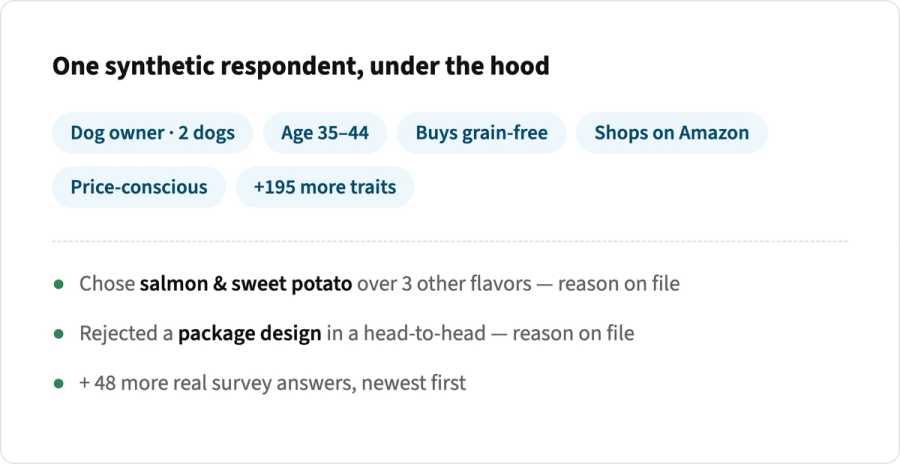
Ask a general AI to act like a dog owner and it'll make one up. Ours starts with real people on our panel. Each synthetic panelist is a digital twin, built from real PickFu panelists' demographic profiles and years' worth of choices they made on real PickFu surveys, including what they turned down and why. So it isn't guessing what a person might do. It's predicting what a specific kind of real person would do, based on what people like them have chosen before.
Two ways to run it
Synthetic Audiences runs two ways, both through the PickFu Agent and MCP. Generate options, test them, refine, and retest in one loop, from the tools you already use.
Comparison
Give it a question and 2–10 options, text or images. You'll get a breakdown of the strongest and weakest options, the themes behind the split, and a one-line reason from the synthetic panelists.
Single concept
Share one idea and one open question. Every synthetic panelist answers. You get a summary, the themes, where segments disagreed, and the follow-up questions worth asking.
Why should you trust the results?
We've put a lot of care into building our synthetic panelists from real consumer data — and we're just as honest about the weak points.
Benchmarked against real people
We replay past surveys where we already know what real people picked, and score the synthetic against them. We can do that because we run a human panel — most synthetic-only tools can't.
A vote, not one opinion
Every result is dozens of separate predictions counted into a vote, benchmarked against hundreds of past surveys where we already know what real people chose. That's different from asking one model what it thinks people think.
Clear about where the data comes from
We tell you where the respondent data comes from, how recent it is, and how the method was validated. And every result comes labeled synthetic in the summary, so it's never mistaken for human feedback.
Honest about limits
Synthetic is strong at some jobs and weak at others, and we'll tell you which is which. Gaps between options run wider than they would with people, which is why results show a stronger and weaker half instead of exact percentages.
The synthetic-to-human decision loop
AI made it effortless to create options. Knowing which one your customers will choose is the hard part. Screen with synthetic, then confirm with real people.
- 1
Generate
Forty images, sixty titles, a dozen names — your agent can make options faster than you can read them.
- 2
Pre-test with synthetic
Screen the whole list in minutes. Weak ideas die here, before they cost you anything.
- 3
Improve
Drop the weaker half, refine the survivors, retest. Run as many rounds as you want.
- 4
Validate with real people
A prediction doesn't have a dog with a sensitive stomach, a budget, or a cart to abandon. Real respondents do. After your synthetic tests, run a survey with PickFu's human panel to validate your strongest options. You'll get written feedback from every person.
- 5
Decide
Ship your strongest concept with the evidence to back it up. Run this loop again on your next idea.
When to use it — and when we'll point you to people
Synthetic is genuinely good at some jobs, but not everything. For its weak points, lean on real consumers. Synthetic audiences are US-only today, a test runs against one audience at a time, and we can't build custom audiences on request.
Great fit: narrowing a long list
Eight product names, budget to test two? Screen all eight in minutes and spend your money on the finalists. This is the single best use.
Great fit: text head-to-heads
Names, titles, taglines, claims, price framing. Text comparisons are where synthetic measures strongest.
Use real people: purely aesthetic calls
Taste is hard to predict from past behavior, and synthetic panelists remember past image surveys as text, so the visual detail is gone before the model sees it. Clearly different images test fine. Subtle visual calls belong with people who can actually see them.
Use real people: new territory and high stakes
Synthetic predicts from precedent, and a truly new concept has none. If real money rides on it — final packaging, launch creative, a trademark — it deserves real people.
Use real people: emotionally loaded questions
Money worries, health fears, anything tied to identity. Synthetic under-reads fear and over-weights price and convenience, so the prediction misses what's actually driving the choice.
Frequently asked questions
Is this replacing PickFu's human panel?
No. Our human respondents aren't going anywhere, and our synthetic panelists are built from them. Synthetic helps you decide what to test. Real people help you decide what to do. Our confidence in synthetic comes from the human panel, because that's what we score it against.
How is this different from just asking ChatGPT?
Ask ChatGPT to be a dog owner and it imagines one. A PickFu synthetic panelist carries the real choices real dog owners made on real surveys, including what they turned down. Every result is dozens of separate predictions counted together, not one model's summary of what it thinks people think. And because we run a human panel, we can measure the difference instead of asserting it.
How accurate is it?
We benchmark it against hundreds of past PickFu surveys where we already know what real people chose. It picks the same side as real people most of the time on text comparisons, and less often on images. It's in beta, and we keep testing and adjusting the models.
Two things matter when you read a result. Margins run wider than human ones, so if you ask for the exact split, trust the direction more than the size of the gap. And accuracy for any single audience isn't validated yet, so we won't quote a number for one.
What does it cost?
Nothing during the beta. Synthetic tests are free while we're rolling out. If you go on to run a human survey on the stronger option, that's priced like any other PickFu survey, and you'll see the price and confirm it before anything runs.
How many synthetic panelists should I use?
Thirty to 50 for most tests. Past about 50, each extra synthetic panelist adds very little, because synthetic responses converge.
What you get back is themes and patterns rather than individual variance, which is why a bigger sample doesn't buy you much here.
Why did I get different numbers when I ran the same test twice?
Each run draws a fresh set of synthetic panelists at random, and the model behind them isn't deterministic. The grouping into stronger and weaker options should hold, along with the themes. The exact split will move. Treat the split as direction, not measurement.
Which audiences are available?
Over 300 synthetic audiences. Coverage is deepest in supplements, health and household, beauty, books, and grocery. Each category is sliced by trait and demographic — dog owners in pet food, people who read 4+ books a month, daily supplement takers — rather than a generic consumer.
A few limits. Audiences are US-only today, there are no geographic slices within the US, a test runs against one audience rather than a combination, and we can't build custom audiences on request. If the audience you need isn't there, tell us when you join the waitlist. That's how we're prioritizing what to add.
When does the beta start?
We're rolling out to selected accounts from late September 2026. Join the waitlist and we'll be in touch as we open it up.
How is a synthetic panelist built?
Each synthetic panelist is a digital twin, built from real PickFu panelists like the people you want to reach: their demographic and interest profiles, and their real choices on past PickFu surveys, including what they turned down and why. The model isn't inventing a person. It's predicting what a specific kind of real person, whose past behavior we have years of data for, would choose.
We check those predictions by re-running past surveys where we already know what real people picked. We can do that because we run a human panel; most synthetic-only vendors can't.
How does PickFu handle my data?
See our Terms of Service and Privacy Policy. For questions about Synthetic Audiences and your data, contact support@pickfu.com.
When should I use synthetic panelists instead of real people?
Use synthetic to narrow, and real people to decide. Synthetic feedback is fast, and free during the beta, which makes it ideal for screening a long list — eight names down to the two worth testing — or getting an early read on a rough concept.
When the decision is expensive or hard to reverse, purely aesthetic, emotionally loaded, or genuinely new territory, run it with real respondents. Same when you need the actual margin rather than just the direction.