
Synthetic research, grounded in real people
Test concepts with synthetic respondents built from 14 years of real human choices. Results in seconds — then confirm the winner with actual people. Launching in beta soon.
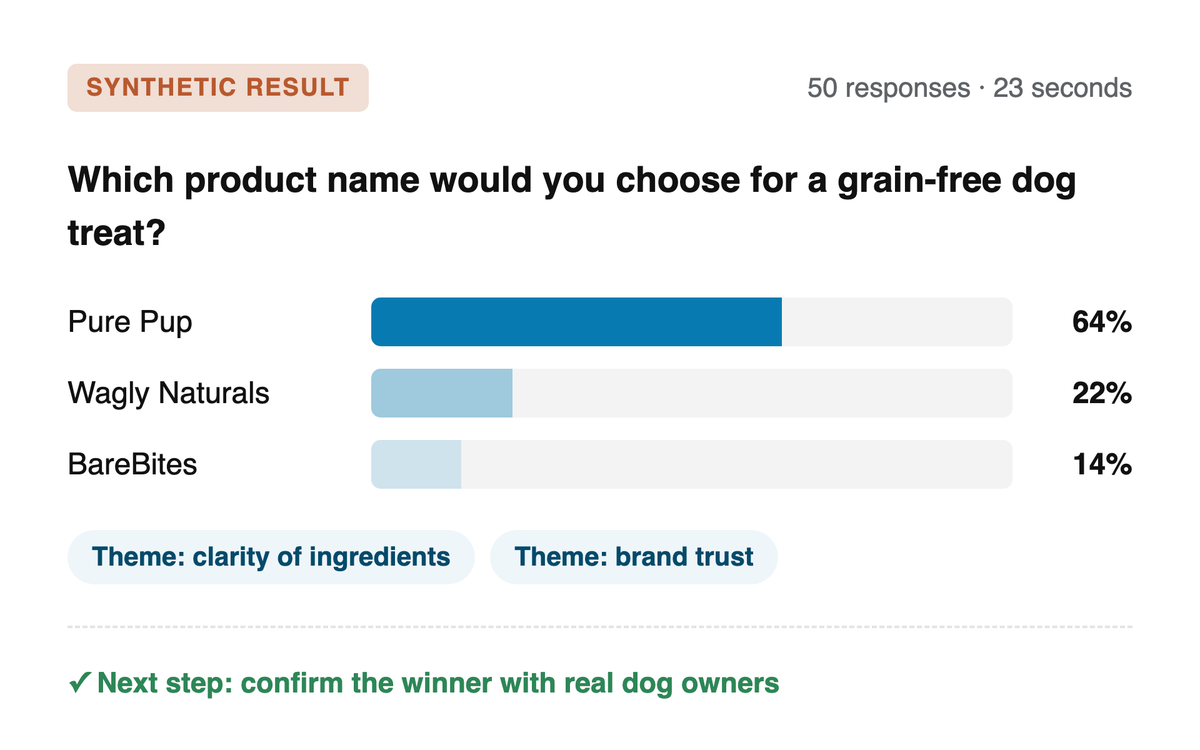
- < 1 min
- from question to results
- 200+
- traits behind every respondent
- Years
- of real purchase choices behind every answer
- 14 yrs
- of survey responses underneath it all
Built from real choices, not imagination
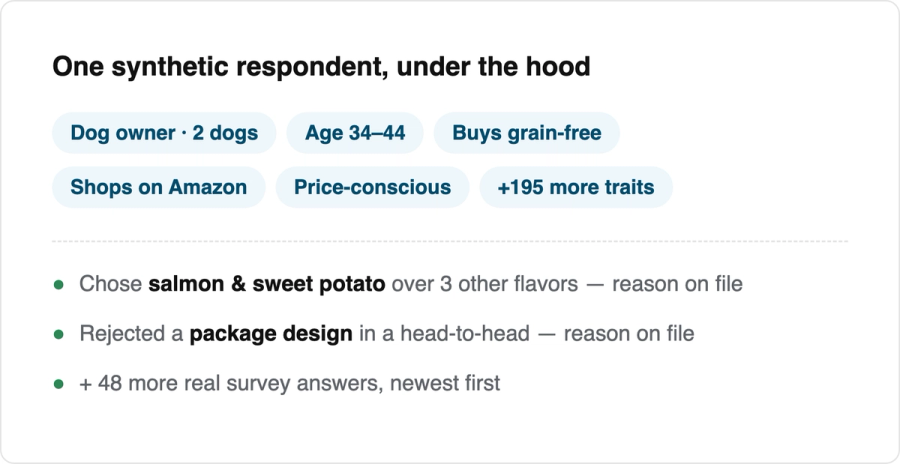
Ask a general AI to act like a dog owner and it'll make one up. Ours starts with an actual person on our panel — 200 traits, plus years' worth of choices they made on real surveys, including what they rejected and why. So it isn't guessing what a person might do. It's predicting what a specific kind of real person — someone whose past behavior we have years of data for — would do. Most synthetic tools can't.
Two ways to test
Both run through the PickFu Agent or MCP — generate options, test them, refine, and retest in one loop, from your existing tools and workflows.
Synthetic Audiences
The quantitative one. Ask a question, show 2–10 options — text or images — and get a winner, the vote split, and a one-line reason from every respondent.
Synthetic Focus Group
The qualitative one. Give it a concept and it plans the research, interviews a panel of synthetic respondents in depth, and hands back an executive summary: themes, where segments split, and what to ask next.
Why should you trust the results?
We've put a lot of care into modeling our synthetic respondents on real consumer data — and we're just as honest about the weak points.
Benchmarked against real people
We replay past surveys where we already know what real people picked, and score the synthetic against them. We can do that because we run a human panel — most synthetic-only tools can't.
A vote, not one opinion
Every result is dozens of separate predictions counted into a vote, benchmarked against hundreds of past surveys where we already know what real people chose. That's different from asking one model what it thinks people think.
Provenance up front
We tell you where the respondent data comes from, how recent it is, and how the method was validated. Survey and respondent IDs are hashed before anything reaches a model. And every result is labeled synthetic wherever it travels — exports and shared links included.
Honest about limits
Synthetic is strong at some jobs and weak at others, and we'll let you know which is which. One example: synthetic margins run wider than human ones, so use the winner, not the gap.
The synthetic-to-human decision loop
AI made it effortless to create options. Knowing which one your customers will choose is the hard part. Use synthetic as a guide, not a final verdict.
- 1
Generate
Forty images, sixty titles, a dozen names — your agent can make options faster than you can read them.
- 2
Pre-test with synthetic
Screen the whole list in seconds. Weak ideas die here, before they cost you anything.
- 3
Improve
Drop the losers, refine the survivors, retest. Run as many rounds as you want.
- 4
Validate with real people
A prediction doesn't have a dog with a sensitive stomach, a budget, or a cart to abandon. Real respondents do. Put the winner in front of them — every vote comes with a written reason.
- 5
Decide
Ship the option with evidence behind it, not just plausibility.
When to use it — and when we'll point you to people
Synthetic is genuinely good at some jobs, but not everything. For its weak points, lean on real consumers. Synthetic audiences are US-only today.
Great fit: narrowing a long list
Eight product names, budget to test two? Screen all eight in seconds and spend your money on the finalists. This is the single best use.
Great fit: text head-to-heads
Names, titles, taglines, claims, price framing. Text comparisons are where synthetic measures strongest.
Use real people: purely aesthetic calls
Taste is hard to predict from past behavior. Clearly different images test fine — subtle visual calls belong with people who can actually see them.
Use real people: new territory and high stakes
Synthetic predicts from precedent, and a truly new concept has none. If real money rides on it — final packaging, launch creative, a trademark — it deserves real people.
Frequently asked questions
Is this replacing PickFu's human panel?
No. Our human respondents will never go away, and our synthetic respondents are modeled after them. We believe that authentic feedback from real people and predictive data from synthetic respondents both have a key role in the research process.
How is this different from just asking ChatGPT?
Ask ChatGPT to be a dog owner and it imagines one. Our respondents carry the actual choices real people made in your category — and every result is dozens of separate predictions counted into a vote, not one model's take. Because we run a human panel, we can measure the difference instead of asserting it.
How accurate is it?
Accurate enough to kill weak options before you pay to test them. Not accurate enough to be the final word on a bet-the-launch decision. We benchmark against real human results and share what we find, caveats included — like synthetic margins running wider than human ones.
Which audiences are available?
Over 300 audiences across 25 product categories. Coverage is deepest in supplements, health & household, beauty, books and grocery. Each category is sliced by trait and demographic — dog owners in pet food, people who read 4+ books a month, daily supplement takers — rather than a generic consumer.
Audiences are US-only today. Every one is built from real PickFu panelists with deep history in that category. If the audience you need isn't there, tell us when you join the waitlist – that's how we're prioritizing what to add.
When does the beta start?
Soon, with a small group of customers. Join the waitlist and we'll be in touch as we open it up.
How is a synthetic respondent built?
Each synthetic respondent is based on a real PickFu panelist: their trait profile plus real choices that person made on past PickFu surveys, including what they rejected and why. The model isn't inventing a person — it's predicting what a specific kind of real person, whose past behavior we have years' worth of data for, would choose.
We check those predictions by re-running past surveys where we already know what real people picked. We can do that because we run a human panel; most synthetic-only vendors can't.
Is my survey data used to build synthetic respondents?
Not in any identifiable form. Synthetic respondents are built from panelists' answer histories, and survey and respondent IDs are hashed before anything reaches the model — so nothing in a synthetic respondent's history can be traced back to your surveys, and one customer's data never surfaces for another.
When should I use synthetic respondents instead of real people?
Use synthetic to narrow, and real people to decide. Synthetic feedback is fast and cheap, which makes it ideal for screening a long list — eight names down to the two worth testing — or getting an early read on a rough concept.
When the decision is expensive or hard to reverse, purely aesthetic, or genuinely new territory, run it with real respondents. Synthetic results are predictions, and they're always labeled so they can't be mistaken for human feedback.