
When to use this playbook
Audience targeting. These surveys target mobile gamers (
mobileyes) aged 25–44 and report by
age and gender. Adjust to your game’s actual target players. Use
list_available_targeting for options.The sequence
1
Competitive research
Learn what players love and hate about existing games in your genre, and what would make them
play daily.
2
Validate core mechanics
Rank gameplay scenarios to find the mechanic players find most fun.
3
Choose art direction
Rank visual style references to find the look that most attracts your players.
4
Prioritize features
Rank candidate features so you build the highest-impact ones first.
5
Validate the overall concept
A star-rating question on the assembled concept confirms download intent before you build.
Sample size and cost. Defaults to 100 respondents per step for reliable ranking signal on
pre-development decisions (these inform expensive build choices, so the extra confidence is worth
it). On a tighter budget, 50 per step gives directional results. See
sample size guidance.
Run this playbook with an AI agent
Copy prompt for AI
Paste this prompt into Claude, ChatGPT, Cursor, or any AI agent connected to the
PickFu MCP server, CLI,
or REST API. The agent will run the entire loop on your behalf —
creating polls, reading responses, and iterating until a winning variation emerges.
Where AI fits in this playbook. Two places: (1) synthesis — the agent turns the open-ended
competitive research (step 1) into a structured map of player desires, frustrations, and
must-haves that shapes every later step; and (2) creative generation — the agent renders the
art-direction candidates (step 3) with
generate_image, including styles that address the
frustrations surfaced in step 1. The final concept validation (step 5) stays a single one-shot
gate — it’s a go/no-go decision, not a loop, so re-testing it repeatedly just burns budget on a
decision you’ve already made.Step-by-step (human operator view)
1. Competitive research
What you’ll get: the player desires, frustrations, and daily-play hooks that should shape every
later decision.
See an example research survey →
2. Validate core mechanics
See an example mechanics survey →
3. Choose art direction
See an example art-style survey →
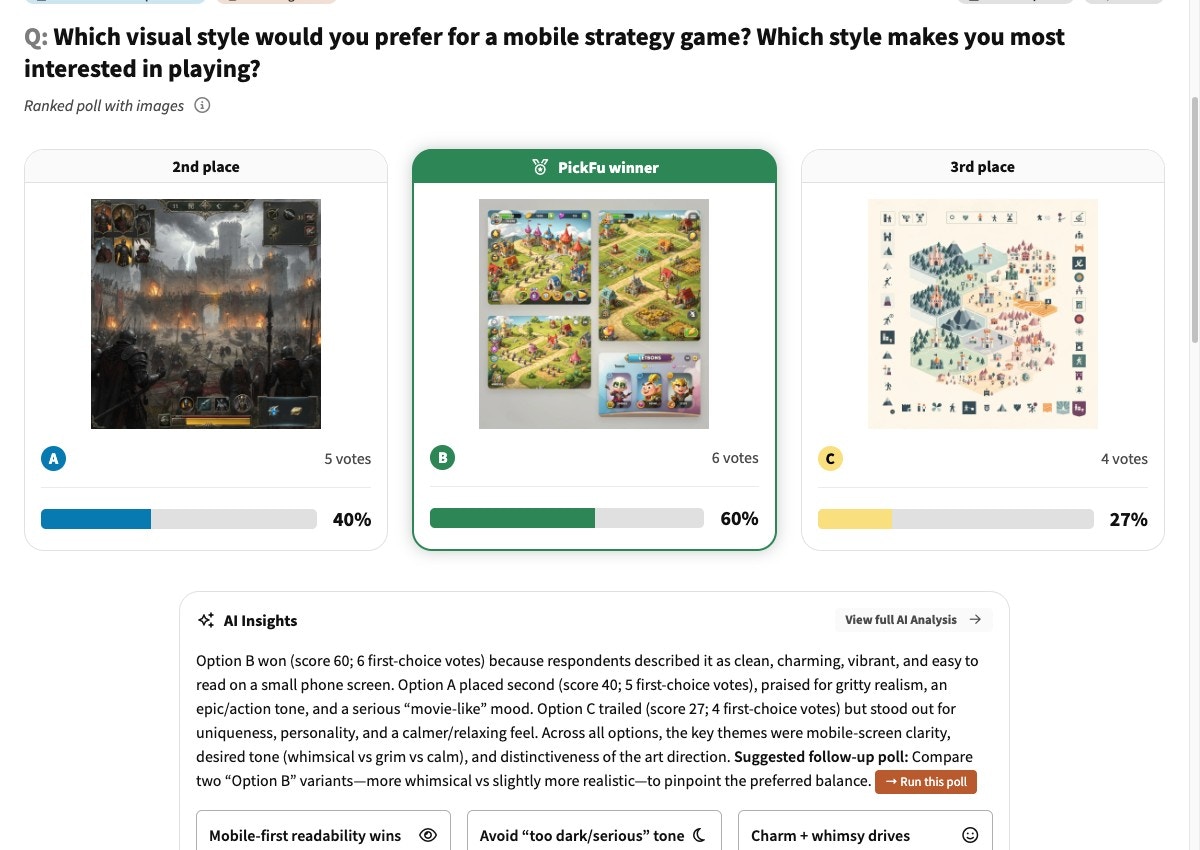
An art-direction test: the same game concept rendered in different visual styles, ranked by player preference with an AI summary of the mood each style conveys.
4. Prioritize features
See an example feature-ranking survey →
5. Validate the overall concept
Success criteria: a confirmed core mechanic (step 2), validated art direction (step 3), a
player-prioritized feature list (steps 1 & 4), and an overall concept averaging 4.0+ stars
(step 5) — ready to inform your game design document.
See an example concept-validation survey →
Troubleshooting
My concept scored below 4.0 stars. Should I abandon it?
My concept scored below 4.0 stars. Should I abandon it?
Not necessarily — diagnose first. Cross-reference the step-5 dislikes against your earlier
results. If the mechanic (step 2) and art (step 3) scored well but the concept didn’t, the
problem is usually how they’re combined or communicated, not the parts themselves. Re-pitch with
a sharper description before abandoning.
Players ranked a mechanic I didn't want to build first.
Players ranked a mechanic I didn't want to build first.
That’s the playbook doing its job — it surfaces demand before you’ve sunk cost. Either build
toward what players want, or understand the gap (sometimes the appealing mechanic is a hook and
your intended one is the retention driver). Run a follow-up ranked question if you need to
disambiguate.
How is this different from the ASO playbook?
How is this different from the ASO playbook?
This validates the concept before development. The
ASO playbook optimizes the store listing once the game exists.
Run this one first; run ASO when you’re preparing to launch.
Related
- Game concept advanced tests & FAQs (help center) — willingness-to-pay, IP validation, world/theme, character-design tests, and common questions
- App store listing optimization — optimize the listing once the game is built
- Best practices for survey design
- MCP server reference
- PickFu CLI