
Пока эта статья доступна только на английском.
Best Pollfish alternatives for consumer surveys and market research (2026)
The best Pollfish alternative depends on who needs to answer your question and what kind of evidence you need from them. A use-case comparison of PickFu, SurveyMonkey Audience, QuestionPro, Prolific, CloudResearch Connect, Respondent, User Interviews, Maze, and the enterprise panels.
Pollfish is a self-service survey and market research platform. You build a questionnaire, target consumers from its panel, and analyze results in one place. It works well when you need consumer responses fast and don't have your own audience to survey. It isn't the right fit for every study, though, and that's usually why people go looking for Pollfish alternatives.
The short answer: the best Pollfish alternative depends on who needs to answer your question and what kind of evidence you need from them. PickFu is the pick when a product, e-commerce, or marketing team wants fast consumer feedback with a written explanation behind every answer. SurveyMonkey Audience and QuestionPro combine survey software with paid respondents. Prolific and CloudResearch Connect fit academic and behavioral research. Respondent and User Interviews are for recruiting verified professionals. Toluna, Dynata, Qualtrics, Alchemer, Forsta, and the other large market research platforms make sense for ongoing programs where sampling and research operations matter as much as the answers.
Vendor pricing and panel details in this post were checked in September 2026. They change often, so confirm with each vendor before you launch.
Best Pollfish alternatives at a glance
Why look for a Pollfish alternative?
"Pollfish alternatives" sounds like a software comparison. In practice, teams start searching because part of the research model stopped fitting.
Sometimes the problem is scope. A founder wants reactions to three packaging concepts and doesn't need a long questionnaire, advanced survey programming, or 500 respondents. A full research workflow adds more work than the decision deserves.
Sometimes it's audience fit. A consumer panel is great for asking grocery shoppers about a new flavor. It's much less useful when you need CFOs at manufacturing companies running a specific ERP. Better screening questions won't get you there. Professional verification has to be part of the method.
And sometimes the team is bigger than the tool. Large research teams want skip logic, quotas, conditional logic, weighting, crosstabs, significance testing, SPSS exports, data visualization, and methods like MaxDiff. To be fair, Pollfish offers most of that, including MaxDiff, NPS (Net Promoter Score), A/B testing, logic, crosstabs, SPSS exports, and its Insights Builder analysis tool. So "I need more features" is rarely the real reason to switch.
The reason that holds up is that something in the process is causing friction. Usually it's one of three things.
You need a different audience
Audience fit is the first dividing line. A skincare brand testing a new moisturizer box needs women in a certain age range who buy skincare. A SaaS company evaluating enterprise onboarding needs operations directors who have bought software. A university lab studying decision-making cares more about participation history and repeat-study rules than purchasing habits. All three collect survey responses. They shouldn't all use the same respondent source.
Pollfish's panel comes from its parent company Prodege's first-party rewards panel, and it lists B2B professionals as a targeting option. When the study is fundamentally about verified professionals, Respondent or User Interviews is the more natural model. When it's academic, Prolific or CloudResearch Connect fits the workflow better.
PickFu sits in between for business audiences. Its targeting traits include household income, work industry, job department, and small business owners, which is enough for a lot of concept and messaging work. One example from our own account:
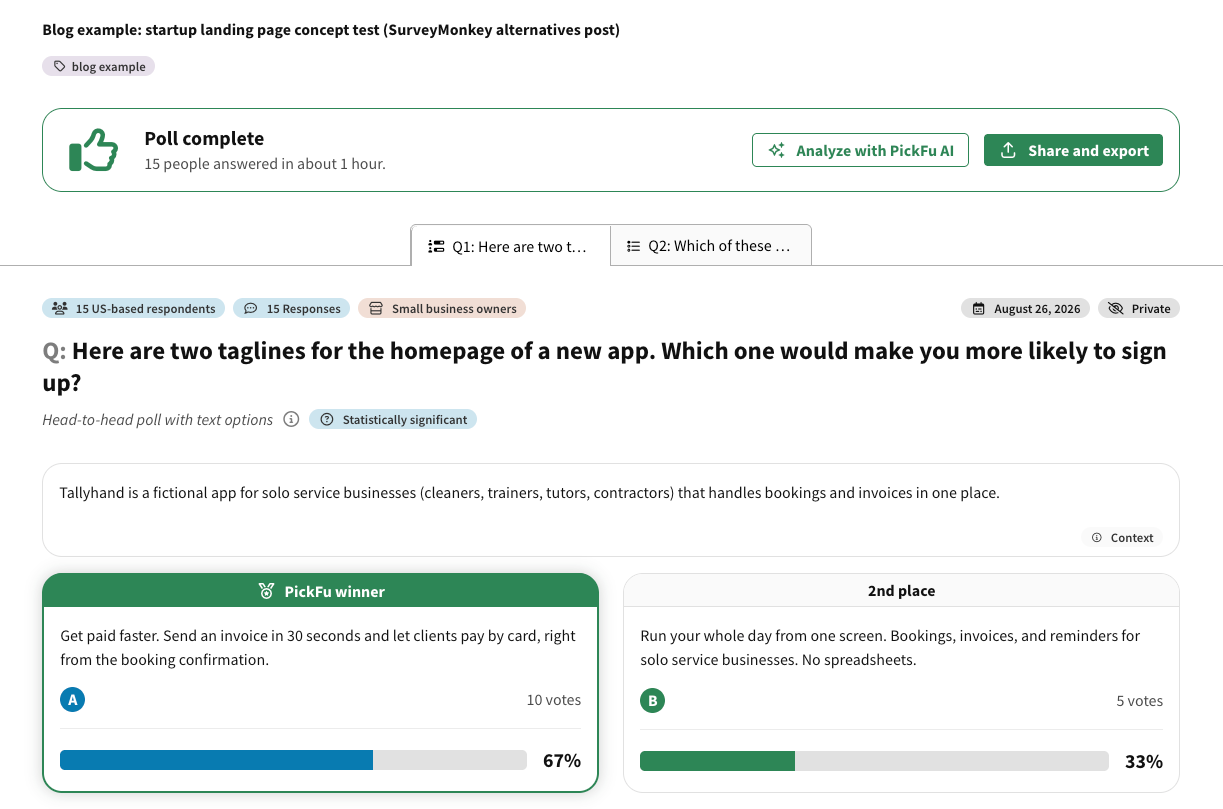
📊 Survey example: Startup landing page concept test, 15 U.S. small business owners. Two homepage taglines for a fictional booking-and-invoicing app went head-to-head. "Get paid faster. Send an invoice in 30 seconds" beat the all-in-one pitch 10 to 5, and a follow-up question found that replacing two or three existing tools mattered most to 40% of them.
What the results showed:
- The specific promise won. "I like that this one puts a discrete number on how fast it is," one respondent wrote.
- The losing line wasn't wrong, just less urgent. One respondent who picked it said it "gives me confidence that I'm not gonna need extra software."
- Price sensitivity showed up unprompted: "I cannot keep paying for more things. ESPECIALLY SUBSCRIPTIONS."
That's the point of targeting a business trait on a consumer panel. You're not surveying procurement leads at Fortune 500s. You're getting real small business owners to react to copy before anything gets built.
You need different data quality controls
Sample size is easy to understand. Data quality is harder. Bad research can still produce a nice dashboard and 500 completed responses.
The usual culprits are bots, duplicate participants, people racing through, respondents misrepresenting themselves to qualify, thin open-ended answers, or a sample that simply doesn't resemble the people the study claims to represent.
Pollfish says it verifies respondents "in 11 ways," runs multi-layered fraud prevention, is ISO 27001 certified, and aligns with ESOMAR standards. Other platforms solve the problem differently. CloudResearch Connect keeps approval ratings on every participant. Prolific pairs a verified pool with researcher-set pay. Cint documents controls across respondent, supplier, buyer, operational, and product quality, plus fraud detection. PickFu's respondents are identity-verified by its panel partners, sign an NDA before seeing any survey, and go through a mix of AI and human quality review, with low performers removed from the panel.
None of that removes your own responsibility. Weak targeting and leading questions still produce weak evidence.
You need to know why, not just what
A 500-person survey can tell you 62% picked Option A. It can't tell you what to fix about Option B.
That's where open-ended feedback, interviews, and conversational surveys come in. Some platforms are adding AI follow-up questions, sentiment analysis, and automated theming to turn text into something structured. SurveySparrow has built around conversational feedback. Toluna Start uses AI theme and sentiment coding. CloudResearch sells a separate conversational research product, Engage, alongside Connect.
PickFu takes a simpler route: every response includes a written explanation, so the "why" arrives with the vote instead of needing a second study.
Sometimes Pollfish is already good enough
This gets skipped in competitor roundups. If your needs are consumer surveys, self-service fielding, integrated audience access, flexible targeting, and fast results, Pollfish is still a reasonable choice. Its DIY pricing starts at $0.95 per response with no subscription, and it also sells managed and enterprise projects. Switching because another product has a nicer dashboard adds complexity without improving the decision.
Survey builders and respondent panels are not the same thing
A lot of confusion comes from lumping everything under "survey software."
Google Forms, Microsoft Forms, Typeform, Cognito Forms, and SurveySparrow help you build questionnaires and collect answers from people you can already reach. SurveyMonkey and QuestionPro combine a builder with paid audience access. Prolific and CloudResearch Connect supply participants for studies hosted elsewhere. Respondent and User Interviews are recruitment first. Those are different jobs.
Google Forms, for example, supports question logic and real-time response summaries. What it doesn't come with is a market research audience. That distinction is what people are really asking when they search "Where can I post a survey?" If you have customers, an email list, a community, or site traffic, a form and a link may be enough. If you need 300 consumers you've never met, the respondent source matters as much as the questionnaire. PickFu covers both: you can survey your own audience for free with a shareable link, or pay per response for the panel.
The same applies to nearby searches like SurveyMonkey alternatives, Typeform alternatives, Google Surveys alternatives, Prolific alternatives, UserTesting alternatives, Maze alternatives, and focus group alternatives. They look similar in a keyword tool. They're often completely different research problems.
How we evaluated these Pollfish competitors
We compared how well each platform fits a real research job, not how many features its website lists, using current public product pages and documentation. The factors that mattered most: audience fit, screening and quotas, incidence rate, cost per complete, question types, open-ended response quality, exports, research support, participant compensation, and fraud prevention. For international work, GDPR, consent, and data location get evaluated against the specific study, not treated as a checkbox.
Good data analysis starts before responses arrive. If the sample or questions are wrong, better data analytics just helps you examine bad evidence in more detail.
Best Pollfish alternatives by use case
Best Pollfish alternative for fast consumer feedback: PickFu
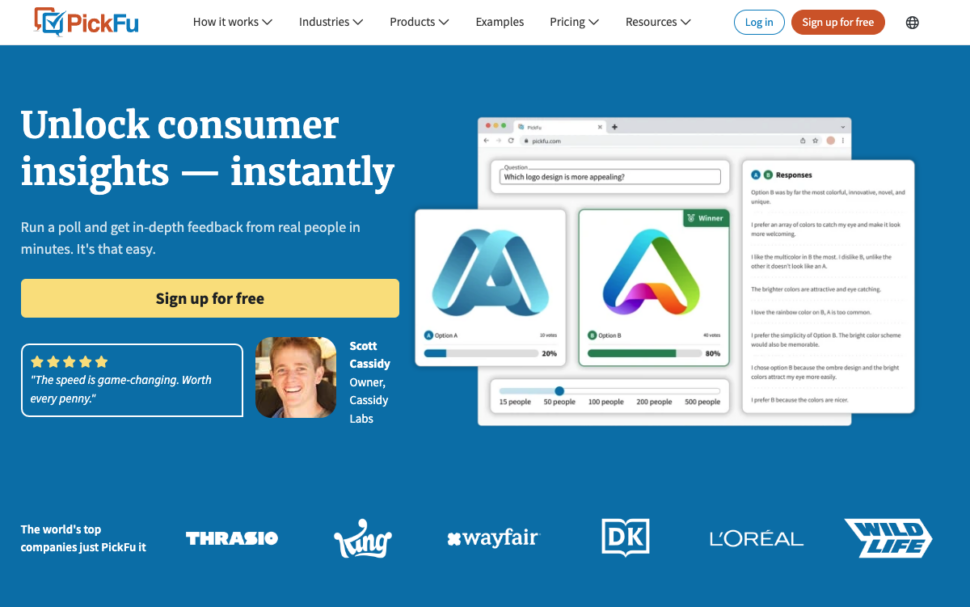
PickFu is a consumer insights platform built for a specific kind of decision. You upload your options, choose the audience you want to hear from, and get written feedback from real people who match it, typically 15 to 100 respondents, with results back in hours instead of weeks. PickFu has been running consumer research since 2008.
Question types include head-to-head, ranked, single and multi select, open-ended, star and emoji ratings, click tests, 5-second tests, and screen recordings, and you can chain them into a multi-question survey. Every response comes with a required written explanation, so the qualitative reasoning sits next to the vote.
That makes it useful when the business question is concrete. Say an e-commerce company is about to order 30,000 units of a new snack. The team has three packages. The founder likes one, the agency likes another, and the retail buyer thinks the third explains the product best. A long market survey could work, but the immediate question is narrower: which design communicates the product to the shoppers we care about, and why?
That's package design testing. Show each concept to shoppers before printing. If respondents prefer one package but keep saying another explains the product more clearly, you don't have to declare a winner blindly. You use the explanations to build a stronger fourth version. We ran that loop ourselves with a sample brand.
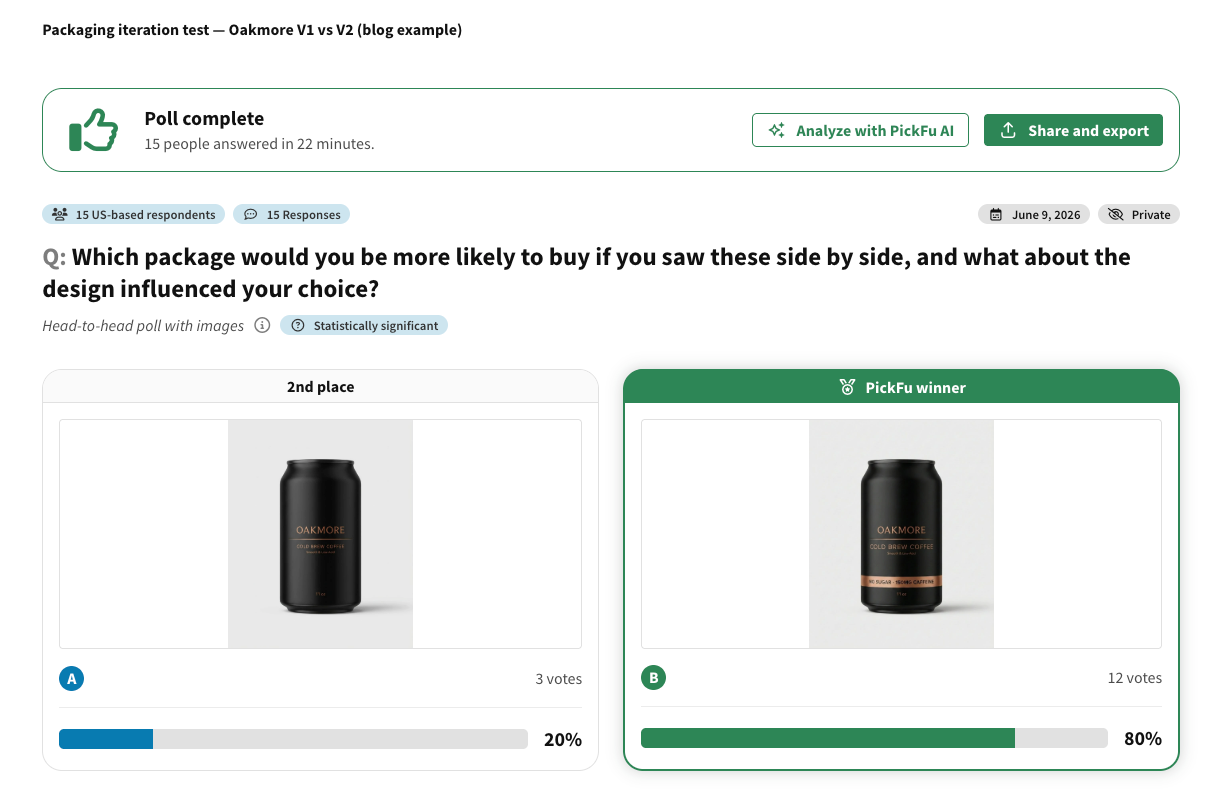
📊 Survey example: Packaging iteration test, Oakmore V1 vs V2, 15 U.S. respondents. A sample cold brew brand we'll call Oakmore tested its original can against a revision that added a copper band with "no sugar" and caffeine callouts. V2 won 12 to 3.
What the results showed:
- The band did two jobs at once. "The copper strip that shows that there's no sugar and 150mg caffeine looks nicer."
- Information beat mystery for most people: "Choice A leaves you wanting more and is dull looking in comparison."
- The minority still matters. Three respondents preferred the plain can, one calling it "a lot more luxurious and confident looking." If premium-minimal is the brand strategy, that's the segment to dig into.
The same workflow covers logo and design testing when you need to test a company logo, and mockup testing before a product is fully built. Internal stakeholders carry months of context that new customers don't have. Outside feedback surfaces associations, misreadings, and visual cues the team has stopped noticing.
PickFu's panel has millions of verified respondents across 15 countries, with 100+ targeting traits. Pricing starts at $1 per response, or $15 for the smallest survey, with no subscription required.
Best fit: e-commerce and CPG teams, app and game studios, agencies, and product and marketing teams making specific consumer-facing decisions.
Skip it when: you need a large tracking study, rare professional recruitment, hands-on physical product testing, or long moderated interviews. PickFu is digital only. Respondents can't download an app, create an account, or handle a sample.
Best Pollfish alternative for consumer surveys: SurveyMonkey Audience
SurveyMonkey is the clearest alternative when you want a familiar survey builder and paid respondents in the same place.
SurveyMonkey Audience sells responses as a one-time add-on starting at $1 each. You set audience criteria, add custom screening questions, choose how many completes you want, and analyze inside SurveyMonkey. Survey length, targeting, balancing, and qualification rate all move the final price.
This matters most for teams already living in SurveyMonkey. Suppose a company runs quarterly satisfaction research, has dozens of survey templates, and everyone knows the tool. A new concept study comes up, but there aren't enough non-customers to survey. Audience extends the existing workflow to paid respondents instead of rebuilding elsewhere.
SurveyMonkey also has advanced logic, crosstabs, A/B questions, and a set of AI features (survey generation, answer suggestions, a response-quality filter, sentiment analysis) that it used to market as SurveyMonkey Genius and now labels SurveyMonkey AI.
The downside is paying for software and the audience separately. Teams that mostly need quick external consumer decisions rather than a permanent survey environment may find that heavy.
Best Pollfish alternative for growing research needs: QuestionPro
QuestionPro sits between basic survey software and a full research suite. Its free Essentials plan allows 200 responses per survey; the Advanced plan is $99 per user per month billed annually. Its Research Suite adds audience access, qualitative tools, and services, and QuestionPro Audience claims 22 million panelists.
That's relevant when the need might grow. A startup starts with a simple questionnaire; a year later it wants tracking studies, communities, or managed research. The risk is buying for the future instead of the present. If all you need is 50 reactions to a new homepage, a research suite adds process, not insight.
Best Pollfish alternative for large-scale sample: Cint
Cint is research infrastructure more than a survey tool. Cint Exchange connects buyers with respondents from 800+ integrated supply partners across 130+ countries. That suits research organizations that need programmatic sample. It also means you need to understand how participants across all those sources are recruited, deduplicated, and screened. Marketplace scale is a feature, not a substitute for sampling discipline.
Best Pollfish alternatives for academic and behavioral research: Prolific and CloudResearch Connect
Both are participant platforms, not survey builders. You usually build the study elsewhere and recruit here.
Prolific offers 300,000+ active participants, 300+ audience filters, representative and quota samples, and researcher-set pay. Its coverage is strongest in the U.S., U.K., and Europe. Pricing is participant rewards plus a platform fee, usually 42.8% for corporate customers and 33.3% for academic and nonprofit. Minimum pay is $8 per hour, with $12 recommended.
CloudResearch Connect works the same way, with a 25% platform fee for academic and nonprofit researchers and 40% for everyone else, and a $7.50-per-hour minimum. Its participant approval ratings and guidance on attention checks are the reason many labs pick it.
A university researcher studying how people evaluate risk might build the experiment in another tool, recruit on either platform, and pay by study duration. That's a different workflow from launching a consumer survey inside Pollfish. If you're researching Prolific alternatives, decide first whether you need a participant marketplace, a consumer insights platform, or a survey builder. They're not interchangeable.
Best Pollfish alternatives for B2B and UX recruitment: Respondent and User Interviews
Consumer targeting and professional verification are different problems. A consumer panel can find 500 small business owners. Finding 25 heads of procurement at 500-person manufacturers who bought logistics software last year is harder.
Respondent is built for that. It advertises 4.3M+ verified participants across 150+ countries, with pay-as-you-go recruitment at $40 per completed B2C session and $80 per B2B session, incentives separate. The expensive participant can be the cheaper research decision: eight interviews with finance leaders who own the problem may beat a 1,000-person general survey when you're pricing an accounts-payable product.
User Interviews solves the same recruiting bottleneck for UX teams: targeting, custom screeners, scheduling, and incentives, from $49 per session with B2B targeting extra. The product team runs interviews in Zoom and tests prototypes elsewhere; User Interviews just gets eight qualified people on the calendar. Note that UserTesting acquired User Interviews in January 2026, which matters if you're comparing independent UserTesting alternatives.
Best Pollfish alternative for product and usability research: Maze
Maze belongs here when the question moves from "what do people say?" to "what do people do with this design?"
Maze supports prototype testing, live website testing, moderated interviews, and recruitment. Its unmoderated panel is sourced from Prolific, Respondent, Bilendi, and Terac; moderated recruiting runs through Respondent.
Picture a SaaS founder with two dashboard concepts. A preference survey says Version A looks easier to use. Then participants attempt the workflow in a prototype and repeatedly miss a key action in Version A. Different question, different answer. Searches for Maze alternatives shouldn't land on the same tools as Pollfish competitors.
Best Pollfish alternatives for enterprise consumer insights: Toluna, Dynata, Suzy, and Attest
These fit brands that run consumer research continuously across markets, not one-off completes.
Toluna Start combines quant, qual, a panel of 81+ million consumers, analysis, and service. It also sells Toluna Synthetic Personas alongside its real panel, which raises the synthetic respondents vs. real consumer feedback question directly (more on that below). Dynata+ references 70+ million panelists with sample configuration, balancing, and pacing. Suzy puts quant, qual, and audiences in one research cloud and supports MaxDiff for prioritization. Attest covers 59 markets, offers a tracking product called Attest Measure, and prices by subscription tier and credits, with a quote required.
The value is continuity: a CPG brand moves from concept testing to packaging to pricing to messaging in one environment. The cost is subscription commitments and more process than an occasional team needs.
Best Pollfish alternatives for enterprise research operations: Alchemer, Qualtrics, and Forsta
Alchemer is survey software first, with panel services for sample, survey design, fulfillment, and quality control on top. Qualtrics spans market research plus customer and employee experience programs. Forsta supports multi-mode data collection, panel management, online interviews and focus groups, diaries, and reporting.
None of these should be judged on cost per complete. Enterprise teams are buying security controls, integrations, governance, and multi-market operations. Market research services exist on a spectrum, from building and fielding everything yourself to a partner handling methodology through reporting. A five-person startup comparing three product names doesn't need that machinery. A global research department might.
Best flexible marketplace: Amazon Mechanical Turk
MTurk remains an option for researchers who want to manage the study themselves. Requesters set worker pay; Amazon charges a 20% fee on rewards and bonuses, plus another 20% on HITs with 10 or more assignments. You get flexibility and take on every quality control: screening, repeat participation, attention checks, and whether MTurk workers fit the population. Prolific or Connect gives most teams those controls out of the box. Amazon has also closed MTurk to new customers, so confirm you can still open an account before planning a study around it.
Where PickFu fits between idea and launch
Pollfish is often used when a company already knows it wants to run a survey. PickFu can enter earlier, when the company just has a decision.
Take a founder building a consumer app. At first the uncertainty is whether the idea makes sense at all. Early prototype market validation, like the landing page tagline test above, checks whether the problem and proposition are clear before anything gets built. Founders asking how to sell app ideas usually jump to the pitch. A pitch is more credible when you can show people understood the problem and responded to the concept, so research comes first.
Next the company has to test business name options, run a brand name test, and test slogans. Those questions aren't about conversion yet. They're about what target customers understand and prefer. As launch approaches, app store screenshot / icon testing evaluates first impressions before acquisition spend starts.
📊 Survey example: Rapid App Store icon test, 15 U.S. mobile gamers. Three icons for a strategy game, ranked. Option C won with 60% of first-place votes. The explanations did the useful work: several respondents read the character's expression in A and B as drooling rather than shouting, and one wrote that C was "most energetic. Doesn't look like drool when you are screaming." That's a fix a design team can act on, and it's invisible in a vote count.
Once the app is live, behavioral experiments and analytics take over. A PickFu test tells you which icon people notice and why. A live A/B test tells you which one actually drives installs. Both pieces of evidence are useful. They answer different questions.
E-commerce follows the same pattern
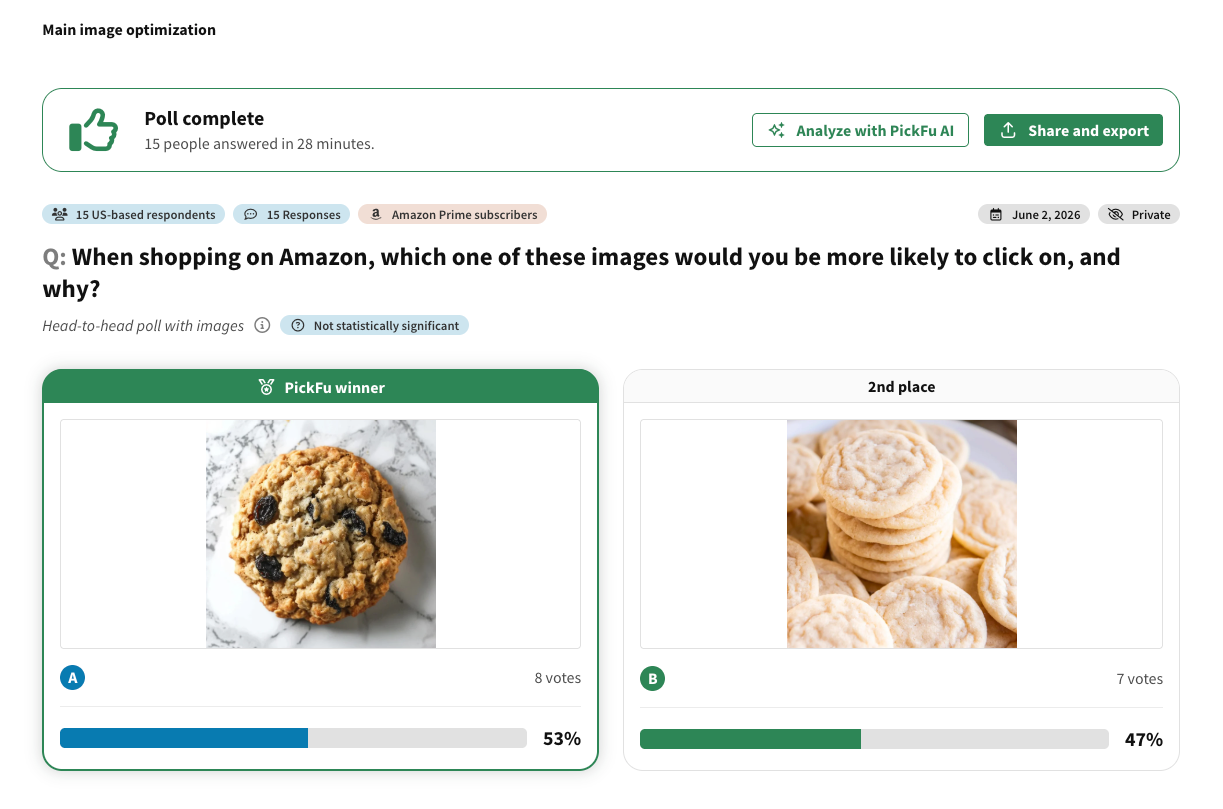
An e-commerce team might start with product images. Before sending traffic to a listing, compare image concepts and find which ones communicate the product clearly. Then narrow the field before Amazon split testing once the listing has enough traffic.
📊 Survey example: Main image optimization, 15 U.S. Amazon Prime members. Two main-image concepts for a cookie listing. Option A edged it 8 to 7, which is exactly the kind of result you want to see before you spend on a live test. Texture drove A's votes ("Cookie has better texture, deeper color; looks more delicious"). Quantity drove B's ("it feels like I'm getting better value for the money"). A near-tie plus the reasons behind it tells the team the real question is single-hero versus abundance, not A versus B.
Research before launch decides what deserves a live test. Behavioral experiments after launch tell you what actually happened. Package design testing, pricing concepts, and ad creative follow the same sequence.
AI makes evaluation the bottleneck
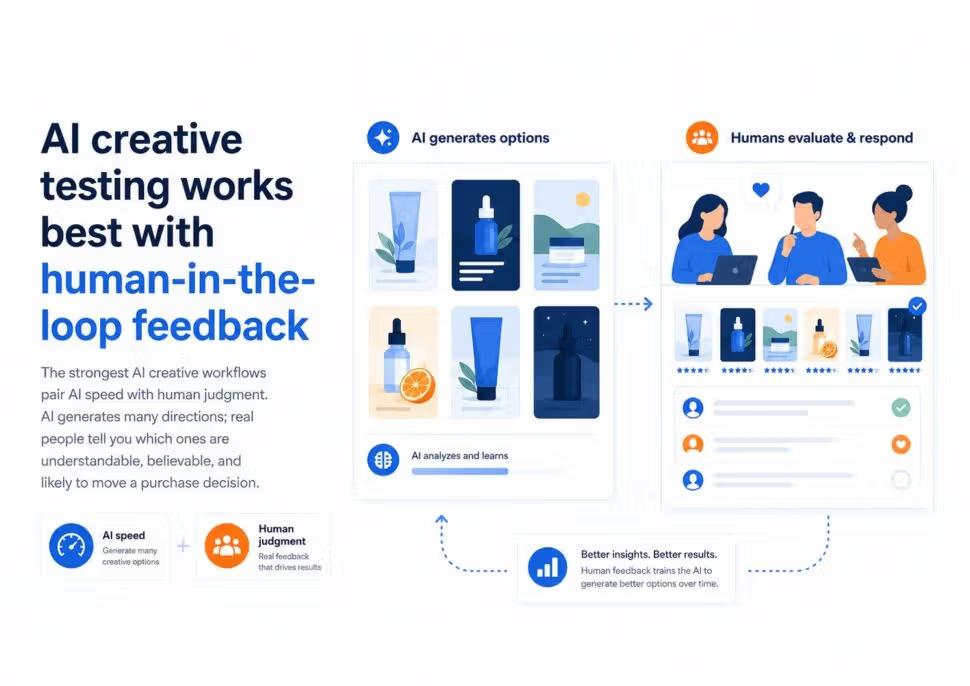
Generative AI makes options cheap. A marketing team that once developed four concepts can now generate 40. That makes AI creative testing more important, not less. The constraint moves from making alternatives to deciding which ones deserve attention.
This is where human-in-the-loop product research for AI stops being a slogan. AI can generate, summarize, and organize. Real people tell you how the output lands with the audience you actually serve.
The same applies to how to humanize AI-generated content. Editing AI prose until it sounds conversational is only part of the answer. Feedback from customers, survey respondents, and firsthand testing gives the content information no other generated summary contains. That's also a practical answer to how to create original content for GEO / SEO: original consumer research produces evidence that didn't exist before the study.
AI-generated product description credibility test, 15 U.S. respondents, head-to-head. Two AI-written descriptions of the same insulated water bottle: one benefit-heavy and vague ("Experience the ultimate hydration companion..."), one plain and specific ("Keeps drinks cold for 24 hours and hot for 12. The 3.5-inch base fits standard car cup holders."). Question: which would you trust more when deciding whether to buy, and why? Once published and complete, this section gets the real split, two or three verbatims, and a line on what the editorial team would change. If the vague version wins, we say so and rewrite the argument around it.
Pollfish alternatives pricing comparison
Pricing checked September 2026. Comparisons get misleading when products charge for different things: Pollfish, PickFu, and SurveyMonkey Audience price per response; Prolific and CloudResearch combine participant pay with platform fees; Respondent and User Interviews charge recruitment fees plus incentives; enterprise platforms sell subscriptions, credits, or contracts.
The sticker price isn't the total research cost. Add screen-outs, incentives, questionnaire design, translation, low incidence, manual quality review, data cleaning, and your own time. The cheapest cost per complete gets expensive when half the dataset has to be thrown out.
How to choose the best Pollfish alternative
Start with the respondent, not the software. General consumers: Pollfish, PickFu, SurveyMonkey Audience, QuestionPro, or one of the enterprise panels, depending on scale. Academic participants: Prolific or CloudResearch. Verified professionals: Respondent, User Interviews, or a specialist panel, rather than screening a general audience down to a tiny B2B segment.
Then decide what the participant has to do. A five-minute concept survey, a 45-minute interview, an unmoderated prototype task, and a package comparison are different research products.
Then set the quality bar. How are respondents sourced? What screening exists? What happens to low-quality responses?
Finally, calculate the real cost, which is the cost of enough trustworthy evidence to make the decision, not the cost per response.
A few mistakes that show up repeatedly:
- Choosing on cost per complete. A $1 answer from someone outside your market isn't a bargain.
- Confusing the builder with the audience. Typeform, Google Forms, Microsoft Forms, and Cognito Forms make good questionnaires. They don't answer the recruitment question.
- Writing screening questions that give the answer away. "Have you bought premium dog food in the last six months?" makes qualifying obvious. Bury the target among plausible alternatives.
- Treating synthetic feedback as human evidence. AI personas can help you brainstorm hypotheses or pressure-test a questionnaire. They should be clearly separated from feedback collected from real people, and the synthetic respondents vs. real consumer feedback question deserves a line in your methodology, not a footnote. PickFu's panel is real, verified people.
- Forgetting what happens after. Decide before launch what result would change the product, message, or campaign. Otherwise you get an interesting report nobody acts on.
Frequently asked questions about Pollfish alternatives
What is Pollfish?
Pollfish is a DIY survey and market research platform founded in 2013 and owned by Prodege since 2022. You build questionnaires, target consumers from its panel, collect responses, and analyze results with logic, quotas, advanced question types, and reporting. It started mobile-first and remains focused on fast consumer research.
How much does Pollfish cost?
Pollfish's DIY pricing starts at $0.95 per completed response, with final cost affected by survey complexity and targeting. Building surveys is free, and no subscription is required. Full-service projects start at $5,000 per market and enterprise packages at a $10,000 annual commitment.
Is Pollfish trustworthy?
Pollfish is an established platform that documents respondent verification, fraud prevention, ISO 27001 certification, and ESOMAR alignment. That doesn't make every Pollfish study valid. Trustworthiness still depends on whether the sample fits the population, the survey is well designed, and you interpret results within the study's limits.
What are the best Pollfish alternatives?
It depends on the method. PickFu for focused consumer decisions and concept testing with written explanations. SurveyMonkey Audience and QuestionPro for a survey builder plus respondents. Prolific and CloudResearch Connect for academic and behavioral studies. Respondent and User Interviews for verified professional recruitment. Maze for prototype and usability research. Toluna, Dynata, Suzy, Attest, Qualtrics, Alchemer, and Forsta for larger or ongoing research programs.
What platforms can I use instead of Pollfish for mobile surveys?
Pollfish built its reputation on mobile-first distribution, but most consumer panels now field on phones by default. PickFu, SurveyMonkey Audience, Attest, Cint, and Dynata all reach respondents on mobile devices. The more useful question is whether the audience and question types fit: a mobile respondent can compare two app icons or packaging concepts in seconds, but a 20-minute grid-heavy questionnaire will lose people on any platform.
Is there a free alternative to Pollfish or SurveyMonkey?
For building a survey and sending it to people you can already reach, Google Forms is free for personal use, and QuestionPro, SurveySparrow, and SurveyMonkey all have free entry plans with limits. PickFu's own-audience surveys are also free. What no free plan includes is a representative research audience. If you need paid consumer respondents, a free builder doesn't make the sample free.
Is Prolific a Pollfish alternative?
For some projects, yes, but the model is different. Prolific is primarily a participant recruitment platform; researchers usually host the study in another tool. Pollfish is closer to an integrated survey-and-sample environment. Pick Prolific when participant controls and fair, transparent pay are the priority, and Pollfish or PickFu when you want the survey and the audience in one place.
Use the research tool that matches the decision
The most useful Pollfish alternative is rarely the one with the longest feature page. It's the one that puts the right method in front of the right people while the evidence can still change the decision. For focused consumer decisions, that's a consumer insights platform built around fast validation, and that category is PickFu. Teams use it for product images, package design testing, logo and design testing, app store screenshot / icon testing, brand name tests, slogans, and ad creative, wherever knowing which option people prefer and why can stop a weak idea from reaching production.
Create your free PickFu account and test your next product, creative, or marketing decision with real people in your target audience. If you'd rather work inside your AI tools, the PickFu Agent builds surveys and analyzes results in the app, and the PickFu MCP connects PickFu to Claude, ChatGPT, and other assistants so you can run research where you already work.