
Summary
Animal, a sports nutrition supplement brand, plateaued on Amazon with creative that had aged behind newer entrants. Mindful Goods rebuilt every Amazon creative asset for the brand — main images, A+ content, brand story — and validated the iterations with PickFu’s consumer panel before pushing them live. The relaunched listings hit these numbers within six weeks:
- 719% sales lift
- 11% CVR boost
- 707% more views
The challenge
Animal is one of sports nutrition's longest-running brands. Owned by Universal Nutrition, the line has been a fixture in serious bodybuilding circles since the 1980s.
But in 2025, Animal's creative team needed help. Amazon performance had flattened, the listings looked dated compared to newer category leaders, and the brand was working to expand into broader health and wellness – without losing its hardcore lifter base.
They brought in Mindful Goods, a creative agency led by Daniela Bolzmann, and the team went to work rebuilding the brand's presence on Amazon. Mindful Goods runs a full split-testing optimization process for each client to pre-validate main images, product image stacks, A+ content, and Amazon storefronts.
In this case study, we’ll break down their main image testing process. To understand which creative direction would actually convert, the agency leaned on PickFu.
The process
Every Mindful Goods engagement follows the same four-step playbook:
- Audit the data first. Keyword reports, Amazon Search Query Performance, customer psychographics, and competitor benchmarks.
- Translate the data into a brief. Selling points, pain points, and keyword gaps mapped to how shoppers actually talk.
- Design variations, then test in PickFu. Each new direction or image variation gets validated against a panel of real shoppers.
- Confirm with live traffic. Once new listings ship, real traffic data shows the team where to keep tuning.
Step 3 increasingly starts with AI. Mindful Goods built an internal tool trained on their best-performing main images that generates 15-20 distinct format variations tailored to the brand and product. The team narrows to the strongest concepts, makes light edits to combine or refine ideas, and lands on a handful of formats worth testing.
That’s where PickFu comes in. Instead of just pushing one of the final options live and hoping it converts, Mindful Goods runs each image candidate past PickFu’s built-in consumer panel. They add targeting to ensure the feedback is relevant – for example, Amazon Prime subscribers, daily supplement users, or men aged 35-44.
Each round typically tests two pools: a clean series with no textual badges, and a series with callouts, badges, and other "eye candy.” Then, the team puts the top performers up against the competitive set in the same category, benchmarked back to the brand's baseline before the rebuild.
Mindful Goods analyzes the votes and qualitative feedback, iterates as needed, and moves forward with the strongest creative direction once a clear winner emerges.
This process directly translates to higher CTR and conversions – over 70% of PickFu-validated creative leads to increased Amazon sales for Mindful Goods’ clients.
The insights
We’ll highlight two rounds of main image testing for one of Animal’s listings – showcasing how Mindful Goods creates image variations, tests them with real shoppers, then iterates and repeats based on the feedback.
Round one
The first lineup tested four main image variants against each other in a Ranked survey – respondents rank the image options based on which they’d be most likely to purchase, and leave a written comment explaining their choice.
Option A (the cleanest of the four, with the product front-and-center, a grape cluster on each side, and minimal supporting graphics) took 53% of rank-one votes.
PickFu's AI Insights report surfaced "clarity" and "simplicity" as the dominant themes for A, alongside "informative content" and "visual appeal." Respondent comments backed it up:
But the same comments flagged a gap. Several A-voters wanted more product information (labels, benefits, dosage) that the cleanest composition deliberately left out. Voters who preferred Option C said the hand-model shot helped them gauge tablet size; voters who preferred Option D liked the additional callouts above the lid.
That cluster of "I want more context" feedback shaped the next round.
Round two
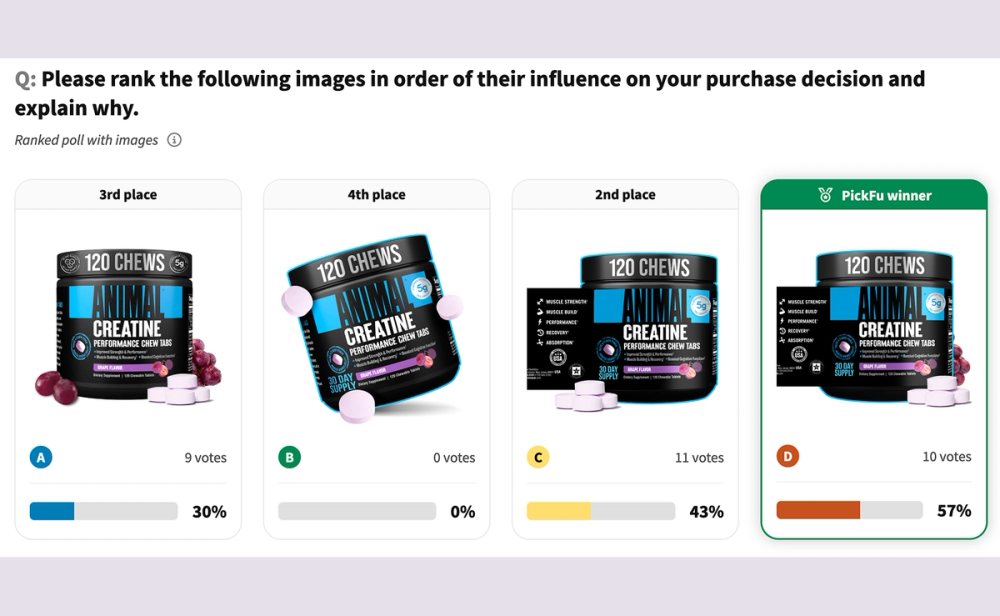
For the second iteration, Mindful Goods kept the Round 1 winner’s clean composition and layered on a left-side benefits panel, plus a 30-day-supply callout.
The new image (Option D in this test) won 57% of rank-one votes – just slightly better than the first winner’s performance.
The benefits panel was the difference, and shoppers said so directly:
The top keywords from the open-ended responses – grape, benefits, image, product – matched: shoppers wanted the flavor cue and the benefits called out in one composition.
Mindful Goods then took the top performers from these two tests and ran them against the original competitors from the benchmark to find the ultimate winner.
The results
Just six weeks after the new creative shipped across Animal's relaunched listings, Mindful Goods pulled the numbers:
- 719% boost in cumulative sales across the relaunched listings
- 707% boost in cumulative sessions
- 11.2% increase in overall conversion rate
- 85% of products posted positive growth
None of it came from a PPC push or a pricing change. The listings did the work.
