The packaging design checklist: 10 questions smart brands ask before they print
 Adrienne Van Niman · February 21, 2026
Your packaging has three seconds to make a first impression. In a crowded retail aisle or an endless scroll of search results, those seconds determine whether shoppers reach for your product or keep moving.
The stakes are high. According to an Ipsos survey, 72% of consumers say packaging design influences their purchase decisions – and that number jumps to 81% when buying gifts. Younger shoppers (ages 18-34), higher-income consumers, and parents are even more likely to be swayed by packaging.
Yet many brands treat packaging decisions as creative exercises driven by internal opinions rather than consumer evidence. They invest thousands in design, tooling, and printing, then cross their fingers and hope for the best.
There’s a smarter approach: asking the right questions before you commit to print.
This guide walks through 10 essential questions every brand should answer about their packaging design. Each question ties directly to a specific test you can run with PickFu to get real answers – not hunches.
Related guide
Packaging design testing: how to test product packaging before you print, launch, or go to retail
Quick answer Packaging design testing means putting your packaging in front of real shoppers from your target audience and getting their honest feedback before you commit to a print run, …
What is PickFu?
PickFu is a consumer research platform that helps brands get fast, actionable feedback from real people. You can launch a test or survey in a few clicks and start receiving insights, complete with written responses, within minutes.
For packaging design, PickFu lets you test everything from early concepts to final designs with their built-in, verified global consumer panel. Customizable audience targeting options let you reach your ideal customer: Amazon Prime members, parents, coffee drinkers, and over 100 other demographic traits.
The result? Data-backed confidence instead of design-by-committee guesswork.
Stage 1: Concept validation
These questions help you choose the right direction before investing in detailed design work.
1. Can shoppers identify what this product is within seconds?
Why it matters: If people can’t instantly recognize what you’re selling, nothing else on your packaging matters. Confused shoppers don’t buy; they scroll past.
This is especially critical for new product categories, innovative products, or designs that prioritize aesthetics over clarity. A beautiful package that leaves people guessing “Is this soap? A candle? Some kind of food?” has already failed its primary job.
Research confirms that consumers make purchasing decisions in 5 to 50 seconds. Your packaging needs to communicate what you’re selling within that narrow window.
How to test it:
Run a 5-Second Test in PickFu asking respondents: “What do you think this product is?” and upload an image of your design. Review their written feedback for patterns and consistency. If answers are all over the map, your packaging needs clearer visual cues. See an example test.
2. Does this packaging feel right for the price point?
Why it matters: Packaging sets price expectations before shoppers ever see the actual number. A premium product in budget-looking packaging will struggle to justify its cost. A value product in overly fancy packaging might scare away price-conscious buyers.
This disconnect between perceived value and actual price is one of the most common reasons products underperform at retail. 63% of consumers believe paper and cardboard packaging makes products seem “premium or high quality” – a reminder that material choices send strong price signals.
How to test it:
Upload an image of your packaging and ask: “How much would you expect this product to cost?” Compare the responses to your target price. If there’s a significant gap, your design may be sending the wrong signals. See an example test.

3. Which concept direction resonates more with your target audience?
Why it matters: Early-stage design decisions (minimalist vs. bold, natural vs. modern, playful vs. sophisticated) set the trajectory for everything that follows. Getting this wrong means expensive rework later.
As CPG packaging agency SmashBrand notes, “Packaging should never be an afterthought, but rather the cornerstone upon which you build your entire brand strategy.” Your packaging is the only marketing tool with 100% reach – it touches every single consumer who encounters your product.
How to test it:
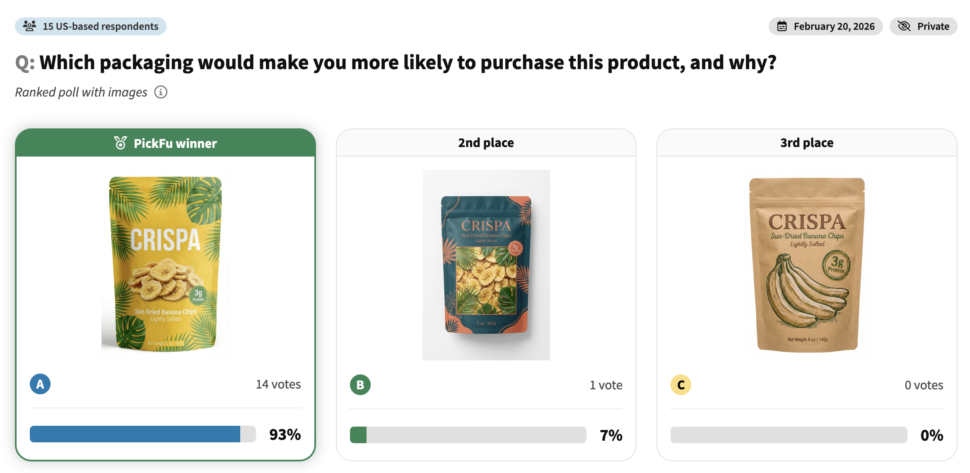
Create a few concept directions (even rough mockups work) and run a Ranked poll with PickFu asking: “Which packaging would make you more likely to purchase this product?” Your audience will rank the options, giving you a good idea of which direction resonates most. Pay close attention to the written explanations – they’ll reveal what’s driving preferences.
👉 View an example PickFu survey that runs all three of these tests against an audience of real consumers. You can click into each question to see respondent votes and comments, plus AI-powered analysis of the audience feedback.
Interested in running surveys like this? Sign up for PickFu – it’s free to get started and polls start at just $15.
Stage 2: Design refinement
Once you’ve validated your direction, these questions help you optimize the details.
4. What catches shoppers’ eyes first?
Why it matters: You can’t control what people notice, but you can design for it. If shoppers focus on the wrong element (a background pattern instead of your product name, for example), your key messages get lost.
Research published in the Journal of Business Research identifies color as the most significant packaging feature influencing purchase decisions, followed by product imagery. Understanding your visual hierarchy helps you make intentional decisions about where to place your most important information.
How to test it:
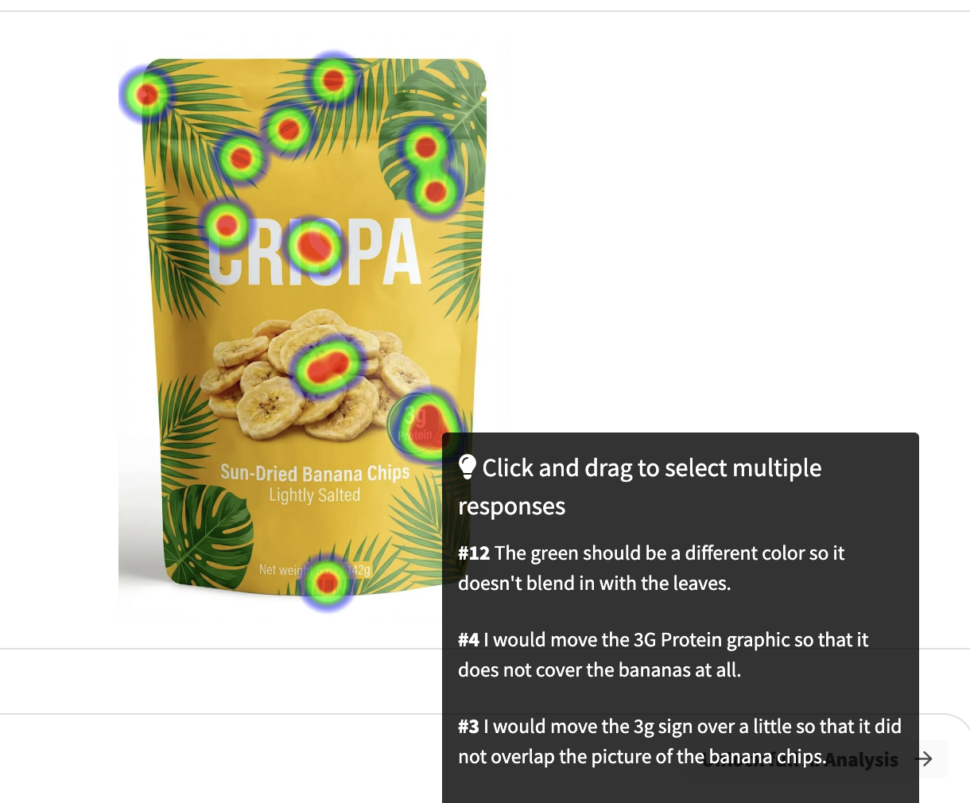
Run a Click Test asking: “Click on the first thing that catches your attention.” You’ll get a heat map showing exactly where the audience’s eyes land first. If it’s not your brand name or key benefit, consider adjusting the design to redirect attention.
Alternatively, you could consider asking something like, “Click on the area that you would improve or remove in this packaging design. What would you change about it and why?” This can help you identify problem areas. View an example PickFu test, and run your own using a pre-built template!
5. Is the primary benefit clear at a glance?
Why it matters: Shoppers don’t read; they scan. If your main selling point requires careful examination to understand, most people will never see it.
Effective CPG packaging must accomplish multiple objectives simultaneously: attract attention from three to six feet away, communicate your product’s value in three seconds, reflect brand values, and drive conversions. The packaging needs to communicate your core value proposition in the time it takes someone to glance at a shelf or scroll past a thumbnail.
How to test it:
Run a 5-Second Test: an image of your design is shown for just five seconds, then respondents answer a question such as, “What is the main benefit this product offers?” If people struggle to articulate it or cite the wrong benefit, your messaging hierarchy needs work. View an example PickFu poll.

6. Does the design feel cluttered or too sparse?
Why it matters: Both extremes hurt conversion. Overcrowded packaging overwhelms shoppers and makes nothing stand out. Overly minimal packaging can feel cheap or fail to communicate enough information to build confidence.
A common packaging mistake is overloading designs with too much information, too many fonts, and poor contrast – making packaging confusing and hard to read. The sweet spot depends on your category, audience, and competitive landscape, but the goal is always clarity.
How to test it:
Ask respondents directly: “How would you describe this packaging visually?” with multiple-choice options like “Too busy,” “Just right,” or “Too plain.” Or run an Open-Ended poll asking what they would add or remove. The feedback reveals whether you’ve struck the right balance.
7. Which specific elements most influence the purchase decision?
Why it matters: Every square inch of packaging real estate is valuable. Knowing which elements actually move the needle (the product image, a specific claim, the color scheme, the brand name) helps you prioritize what to emphasize and what to minimize.
Studies on creative packaging design show that elements triggering curiosity and relevance significantly influence purchase decisions. But assumptions about which elements matter most are often wrong – testing reveals the truth.
How to test it:
List the key elements on your packaging and ask: “Which element most influences whether you’d buy this product?” This data helps you make confident decisions about what to keep prominent and what can be scaled back.
Stage 3: Pre-launch validation
Before you commit to print, these questions reduce risk and build confidence.
8. Does the packaging build trust?
Why it matters: Trust is especially critical in categories like supplements, food, skincare, and baby products – anything people put in or on their bodies. But it matters everywhere. Shoppers make instant judgments about quality and reliability based on packaging alone.
A design that triggers skepticism (“This looks like a knockoff”) will tank conversion rates no matter how good your product actually is. According to Ipsos, 67% of consumers say packaging materials significantly affect their choices, and 71% are more likely to buy brands using paper or cardboard packaging, driven largely by perceptions of environmental responsibility and quality.
How to test it:
Ask: “Based on the packaging, how confident are you in the quality of this product?” or “How trustworthy does this brand seem based on the packaging?” Low scores signal a credibility gap you need to address.
9. Would shoppers choose this over the competition?
Why it matters: Your packaging doesn’t exist in isolation. It sits next to competitors on shelves and in search results. The real question isn’t whether people like your design – it’s whether they’d choose it over the alternatives they’ll actually encounter.
Data-driven packaging design that accounts for the competitive retail environment delivers measurable results. SmashBrand reports that their eco-driven packaging redesign for Earth Breeze delivered a 13-point lift in purchase intent, but only because they tested against the actual competitive landscape, not in isolation.
How to test it:
Create a simulated shelf or search results page showing your product alongside real competitors. Ask: “Which product would you be most likely to buy?” This reveals how your packaging performs in context, not just in isolation. View an example PickFu poll.

Note that other factors like price and reviews will likely play a role in shoppers’ decisions – not just the packaging. If you’d like your feedback in PickFu to solely focus on the packaging design, consider hiding or blurring out any pricing or review info from your shelf or search results page image.
10. Is this design ready to launch, or does it need one more round?
Why it matters: Every designer and product manager faces this tension: perfectionism that delays launch vs. rushing something that isn’t quite right. Consumer testing provides an objective answer.
Comparing your current design against a refined alternative reveals whether the improvements are worth the additional time and cost – or whether you’re already at diminishing returns. The goal is confidence backed by evidence, not endless iteration.
How to test it:
Run a Head-to-Head poll comparing your current “final” design against a variation that addresses any lingering concerns. Ask: “Which packaging would you be more likely to buy?” A close result means you’re ready. A clear winner in favor of the variation means one more iteration is worth it.
Putting it all together
The brands that win at packaging don’t rely on luck or gut instinct. They build testing into their design process from the start: validating direction early, refining based on feedback, and launching with evidence-backed confidence.
The 10 questions above give you a framework for thinking about packaging the way consumers actually experience it: in seconds, on crowded shelves, with dozens of alternatives competing for attention.
Ready to get real consumer feedback on your packaging design? Create a free PickFu account and launch your first test in minutes. See exactly what shoppers think (and why) before you print a single box.