
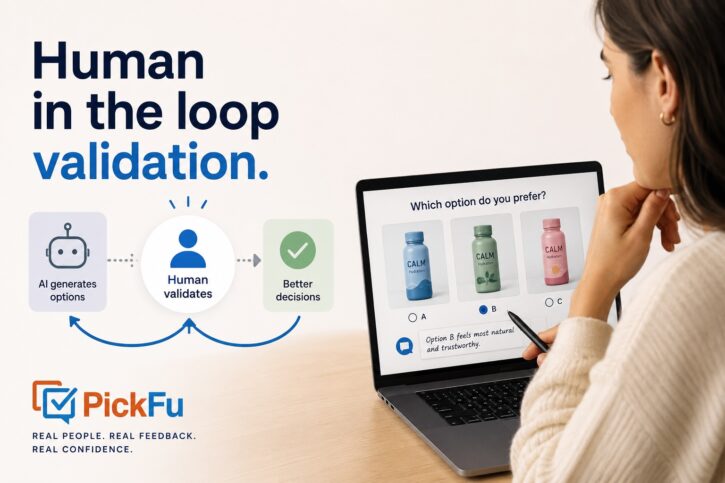
Quick answer: Human-in-the-loop validation combines automated systems with trained human judgment. People verify, correct, approve, or escalate machine outputs at the points where accuracy, context, ethics, or risk matter most. It’s used across AI, machine learning, data labeling, content moderation, and consumer research to catch errors automation misses — and, done well, to feed those corrections back into the system so it improves. For teams making product, design, and marketing calls, the human step usually means getting feedback from real people in your target audience — which is exactly what PickFu is built for.
Automation can process huge amounts of data fast, but it struggles when a case is unusual, sensitive, or high-stakes. Human review is the deliberate step that decides whether an output is good enough to act on. This guide covers what human-in-the-loop validation is, how it works, where it helps, where it doesn’t, and how it applies to everyday product and marketing decisions — not just technical AI systems.
Human-in-the-loop validation, often shortened to HITL, places human judgment at specific points in an automated process. A person might verify a model prediction, compare several creative options, correct a label, reject a misleading answer, or escalate an uncertain case to a specialist. The goal isn’t to replace automation with manual work. It’s to decide where human intelligence adds enough context, accountability, or risk reduction to justify the extra time and cost.
For cofounders and business owners, that’s a system design decision. A fully automated workflow may be faster and cheaper. A human-reviewed one may be safer and more credible. The right balance depends on what the system does, who could be affected, how easily errors show up, and what happens when the system is wrong.
That balance matters in technical AI applications, and it applies just as much to product and marketing calls. Teams use human feedback to validate AI-generated ads, test business concepts, compare packaging, evaluate app store assets, review survey responses, and decide whether machine-generated research reflects what real customers actually believe. Automation produces possibilities. Human-in-the-loop validation decides which possibilities become decisions.
That’s where PickFu fits in. PickFu is a consumer research platform that puts your options — product concepts, packaging, ad creative, names, listings — in front of verified human respondents from your target audience, with written feedback back in hours. It’s built for one specific human-in-the-loop moment: the final call on what to actually ship. Generative AI can produce a hundred variations and predict what people might like, but it can’t be the customer. People are the ones who buy the product, judge the brand, and decide whether a design earns a click. Getting real qualitative feedback from real people in your target audience is the part AI can only emulate — and an emulation isn’t evidence.
What is human-in-the-loop validation?
Human-in-the-loop validation is a process where people actively review, verify, correct, approve, reject, or escalate outputs produced by an automated system. The automated part does work that’s hard or inefficient to do by hand at scale. The human part supplies contextual judgment where rules, historical patterns, or model probabilities fall short.
Take a customer-support system that drafts answers with a large language model. When confidence is high, straightforward answers can go out automatically. An answer involving a refund dispute, legal complaint, or safety issue gets routed to an employee for approval. The system still handles most of the volume, but a person stays involved where the cost of an error is higher.
That’s different from pushing every output through generic manual review. In a well-designed workflow, human involvement has a defined purpose. Reviewers get criteria, uncertainty signals, decision options, and escalation paths, and their corrections are logged instead of vanishing into a private inbox.
Human-in-the-loop validation shows up across AI and machine learning, data annotation and data labeling, customer service, content moderation, fraud detection, synthetic data evaluation, survey response quality control, product and creative research, legal and healthcare workflows, natural language processing, and computer vision. The common thread: an automated system produces or recommends something, and a human decides whether it’s acceptable for its intended use.
Validation isn’t the same as ordinary manual review
Manual review can be informal. Someone reads an output, changes it, and moves on. Validation is more structured. The reviewer checks the output against an agreed standard, then approves, corrects, rejects, categorizes, or escalates it. Ideally the decision becomes part of an audit trail that can later support quality assurance, reporting, or model improvement.
The distinction matters because putting a person in front of an AI output doesn’t automatically make the process reliable. Without clear criteria, two reviewers reach different conclusions. A rushed reviewer approves an error. An expert quietly fixes a result without recording why it failed. The value comes from pairing human oversight with a repeatable system.
Human-in-the-loop, human-on-the-loop, and human-out-of-the-loop
Human involvement can be organized in a few ways. In a human-in-the-loop system, a person participates directly in the decision, and the system may be unable to complete certain actions without human approval. In a human-on-the-loop system (sometimes shortened to HOTL), the automation runs on its own while a person monitors it and steps in when needed. A human-over-the-loop model puts people at the governance level: they set objectives and policies, review performance, and decide when the system should change or stop. In a human-out-of-the-loop system, the automation runs without meaningful human intervention during routine use.
None of these is inherently better. A low-risk email-sorting rule doesn’t need an employee approving every classification. An automated payment-rejection system may need stronger oversight, because false positives block legitimate customers. Autonomous vehicles sit at the far end, where human-on-the-loop monitoring is continuous. A system used in medical imaging may require trained professionals to interpret results before they affect patient care. The question isn’t whether humans should always be involved. It’s where they should be involved, and what authority they should have.
Why human-in-the-loop validation matters
The strongest argument for human review isn’t that people are always more accurate than machines. They aren’t. Humans can be inconsistent, tired, biased, or overconfident. The value comes from the fact that people and automated systems fail differently. Machine learning models process large volumes consistently but stumble when a case differs from their training data. Humans are slower and less consistent, but they can recognize nuance, question assumptions, and understand why an unusual situation needs a different response. Combine the two and the workflow gets more resilient — a safety net where the two failure modes rarely overlap.
It catches plausible but wrong outputs
Modern LLMs produce polished explanations that contain unsupported claims. Image systems generate realistic details that never existed. Predictive models assign a precise score even when the evidence is weak. Because these outputs look credible, they slip through a workflow without raising suspicion.
Human review is most valuable when correctness can’t be judged from syntax or formatting. A response can be grammatically perfect and factually wrong. A product recommendation can match a shopper’s history while ignoring a key constraint. A research summary can sound insightful while overstating what the underlying survey responses support. Human-in-the-loop AI gives someone the chance to ask the question the system can’t reliably ask itself: does this conclusion make sense in context?
It surfaces edge cases
Automated systems work best when new cases resemble what they’ve seen before. Trouble shows up at the boundaries — an unusual request, a new fraud pattern, a rare image type, an ambiguous phrase. These edge cases matter because they often expose weaknesses in the wider process.
Say a fraud detection system starts blocking legitimate transactions from customers traveling internationally. Overall model performance still looks strong, because the affected transactions are a small share of volume. To the customer, though, the error is a declined purchase, damaged trust, and a support ticket. A reviewer who spots the pattern can fix individual cases and flag the underlying issue, turning isolated exceptions into something the product team can act on.
It makes risk visible
A fully automated system can look objective because the same rule runs every time. But consistency doesn’t guarantee accuracy — the system may be repeating the same error at scale. Human oversight creates chances to challenge model predictions, investigate odd outcomes, and spot systematic bias. When reviewers record why an output changed, the organization learns where the system is strong, where it’s weak, and which decisions need more control.
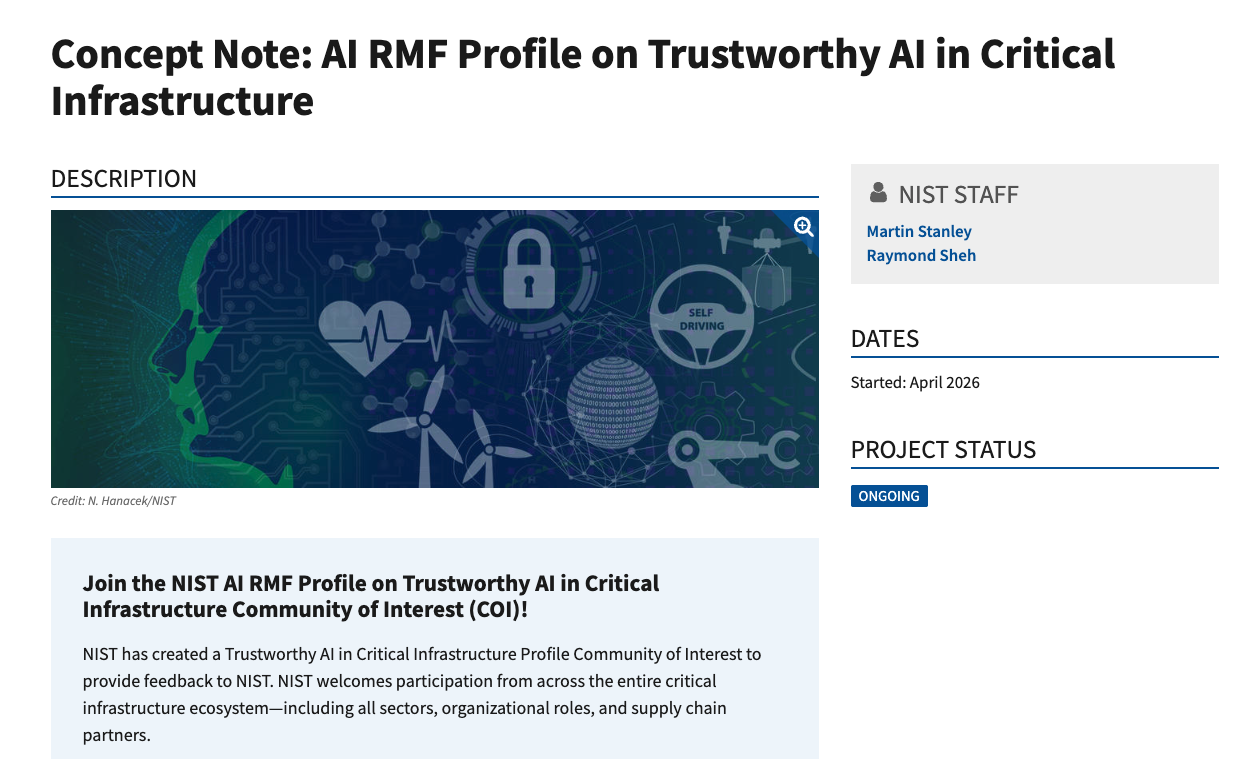
The NIST AI Risk Management Framework encourages organizations to map risks, measure system performance, manage problems, and set governance appropriate to the context. Its supporting playbook also stresses identifying where human oversight is needed and training the people responsible for it.
It supports regulatory compliance and accountability
Some regulated uses of AI require meaningful human oversight. Article 14 of the EU AI Act, for instance, requires high-risk AI systems to be designed so people can effectively oversee them — which means real authority to interpret outputs and intervene, not just an approval button at the end of an opaque workflow.
It creates feedback for improvement
A corrected output can do more than fix one mistake. When corrections are structured and recorded, they feed back into the AI lifecycle. Product teams spot recurring failure categories. Data scientists improve rules or retrain machine learning models. Operations teams revise reviewer guidance. Leaders adjust confidence thresholds or decide certain actions shouldn’t be automated at all. That’s how feedback loops connect production performance to system improvement. Without the loop, the same errors get corrected by hand hundreds of times while the root cause never changes.
How human-in-the-loop validation works
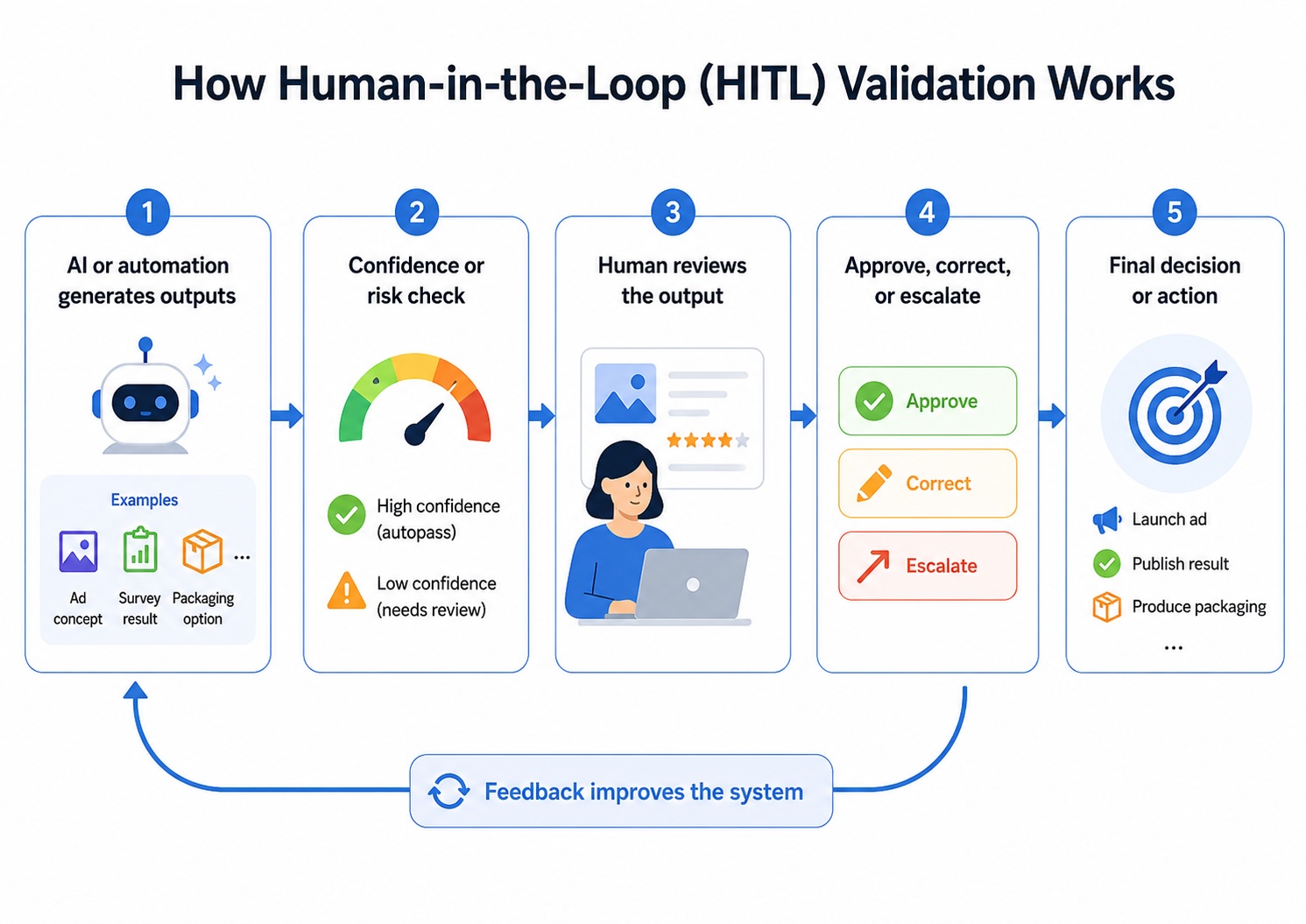
A human-in-the-loop workflow usually starts with an automated output, but the important design choices happen before that output ever reaches a reviewer. The team decides what needs validation, how cases are selected, what information the reviewer sees, what actions they can take, and how those actions affect the system.
A typical process looks like this:
- An automated system produces an output or recommended action.
- The system assigns a confidence score, risk category, or validation rule.
- Selected cases route to a human reviewer.
- The reviewer approves, edits, rejects, or escalates the result.
- The decision and rationale are recorded.
- Difficult cases go to a senior reviewer or specialist.
- Validated results feed production, reporting, QA, training, or research.
- Recurring corrections are analyzed to improve the model or process.
- Ongoing monitoring checks whether quality improves, declines, or shifts.
The sequence is simple; each step involves tradeoffs.
The system produces an output. It might be a classification, recommendation, score, image, answer, summary, or completed action. Sometimes it’s only a suggestion; sometimes it affects a customer unless it’s intercepted. A model that recommends an email subject line creates a reversible, low-cost decision. A model that declines a transaction or prioritizes a medical case affects a person immediately, and needs stronger controls even at similar measured accuracy.
The output is selected for review. Reviewing everything gives strong coverage but usually kills the speed and cost advantages of automation. Reviewing too little lets serious failures slip by. Most mature AI workflows combine risk-based routing with sampling: outputs below defined confidence thresholds go to a person, high-risk categories always get reviewed, and a random sample of “low-risk” outputs gets checked to catch silent performance decay.
A reviewer evaluates the result against clear criteria. The reviewer needs more than the generated output — often the original request, source material, relevant policy, an uncertainty score, or prior examples. This is where explainability gets operational. A confidence score without context creates false assurance; a prediction without its supporting evidence forces the reviewer to guess. Good interfaces surface exactly what the specific review task requires.
The reviewer approves, corrects, rejects, or escalates. A binary approve-or-reject is often too blunt. Reviewers may need to edit an answer, change a category, flag a policy problem, or hand the case to someone with more expertise. Escalation isn’t a failure. It’s a recognition that expertise and authority have boundaries.
The correction is recorded. A decision is far more useful when the reason is captured consistently. Standardized error categories — factually wrong, incomplete, unsafe, off-policy, insufficient evidence — make patterns easier to analyze. Those records form an audit trail that supports quality reviews, governance, and regulatory compliance, and they reveal whether the same problem keeps recurring.
Validated outcomes improve the system. Corrections can support supervised learning, active learning, prompt changes, rule revisions, or better reviewer instructions. Not every correction should be fed straight back into a model, though — reviewers can be wrong, and fast feedback loops can cement flawed assumptions. Corrections should be checked for quality before they become training data. The point is to turn human feedback into structured evidence, not disposable cleanup.
Human-in-the-loop validation examples
The idea gets clearer through real workflows, which look different depending on what’s being validated and what happens when the system fails.
AI output validation
A SaaS company rolls out an AI assistant that drafts answers to customer questions. In its pilot, the assistant handles common feature questions well but occasionally invents product capabilities when the documentation is thin — confidently enough that customers might not notice. The company’s first fix is to require agents to approve every draft. Accuracy improves, but response times barely move, because employees still read each answer top to bottom.
So the team separates requests by risk. Answers grounded in approved documentation can go out automatically above a high confidence threshold. Refunds, security questions, contractual claims, and unsourced answers require agent approval. A random sample of automated answers gets reviewed each week. What changed wasn’t simply adding a person — it was redesigning where that person entered the workflow, so review focused on uncertainty and consequence instead of volume.
Data labeling validation
A retailer wants to train a computer vision model to recognize product attributes in catalog images. The first annotation team labels garments by sleeve length, neckline, pattern, and color, and the first model performs poorly on layered outfits and partly hidden products. An audit finds labelers interpreted the rules differently — some tagged the most visible garment, others tagged every garment in the image.
A second-review process is added for disagreements and unusual examples. The guidelines gain positive examples, negative examples, and difficult edge cases, and reviewer agreement is measured before new labels are accepted. The gain didn’t come from more data labeling. It came from a sharper definition of the ground truth. It’s a common lesson in human-in-the-loop machine learning: a bigger dataset isn’t better when its labels are inconsistent.
Survey response validation
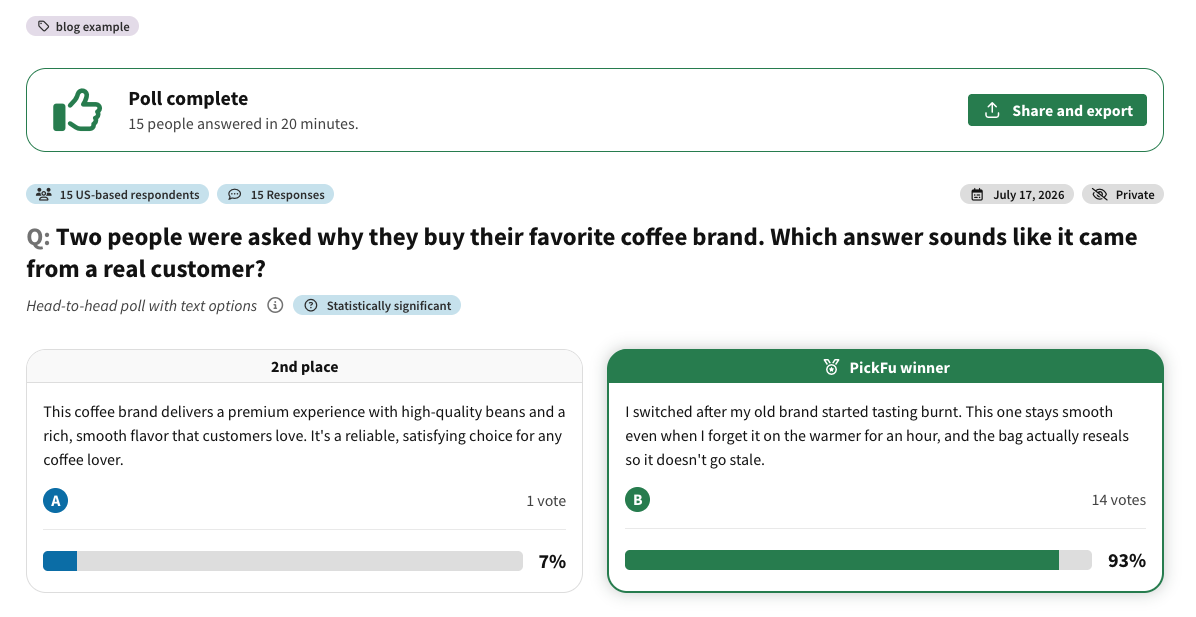
Automated survey systems can flag duplicate IP addresses, impossible completion times, repeated answers, and obvious bots. They’re weaker when a response is unusual but genuine. A respondent who finishes fast but writes thoughtful open-ended answers could be wrongly cut by a rigid speed rule, while another who lingers might submit plausible but low-effort answers generated by an AI tool. Human reviewers can examine suspicious entries in context — comparing open-ended answers, response consistency, and behavior across the survey.
This is the kind of quality control PickFu is built around. Every PickFu response comes from a verified human respondent and includes a written explanation, and quality checks pair automation with human review, because response quality — not just volume — decides whether the data is worth trusting. For teams asking “where can I post a survey?“, distribution is only the first problem. A pile of responses from the wrong audience, or from unreliable participants, won’t tell you anything true.
You can see the gap in a quick test.
📊 Survey example: We asked shoppers to spot the real customer between a generic, AI-flavored answer and a specific human one — a quick check on whether low-effort or AI-written responses give themselves away. See the test.
Content moderation
Content moderation systems quickly flag possible harassment, violence, nudity, or scams. Clear cases can be handled automatically; context-dependent ones usually need human judgment. A phrase that looks threatening in isolation may be part of a news report or a discussion of personal safety. A harmless-looking post may turn abusive alongside earlier messages. The mistake is assuming human moderation removes bias or inconsistency. Reviewers need clear policies, examples, escalation routes, wellness protections, and regular calibration — otherwise the company just swaps model uncertainty for unmeasured reviewer variation.
Fraud detection
A payment platform scores transactions on device signals, history, location, and known fraud patterns. Aggressive rules cut fraud losses but raise false positives — legitimate customers declined for an unusual purchase, a new device, or a trip abroad. Human analysts can review high-value or ambiguous cases before an irreversible action, and their decisions can reveal new fraud strategies the model missed. Here, speed is the constraint: a review finished three days later is useless to a customer standing at checkout. System design has to account for both decision quality and timing.
Medical, legal, and financial review
High-risk professional settings show why automation and validation belong together. In medical imaging, a computer vision model can highlight an area worth attention, but a clinician interprets it alongside patient history, image quality, and symptoms. The FDA, Health Canada, and the UK’s MHRA have named the performance of the human-AI team — not the algorithm alone — as a guiding principle for machine-learning-enabled medical devices. The same holds when an AI tool summarizes a contract or flags unusual financial activity: trained professionals still validate the conclusions before they affect legal rights, credit, or filings. Human review doesn’t make these systems risk-free. It adds a layer of control when the cost of an unsupported conclusion is too high for full automation.
Product and marketing validation
Human-in-the-loop validation also applies before a company launches a product, campaign, or brand asset. Generative AI can produce dozens of packaging concepts, ads, names, slogans, product images, and app screens. It optimizes for visual patterns or instructions, but it can’t reliably predict what a specific target audience will understand, trust, or prefer.
Real consumer feedback is how you check. It’s the human-in-the-loop step for decisions like package design testing, testing a company logo, AI creative testing, mockup testing, logo and design testing, app store screenshot and icon testing, test slogans, test a business name, run a brand name test, prototype market validation, and Amazon split testing.
Picture a founder who uses AI to generate six packaging directions for a new skincare product. The internal team prefers the most minimalist design because it looks premium. A consumer poll shows the same design makes the product’s purpose hard to grasp, while a less striking option communicates the benefit clearly and earns stronger purchase intent. That doesn’t prove the winning package will dominate the market. It reveals a communication problem before the company commits to a production run. AI widened the set of options; real people decided which ones work outside the team that made them.
This is the core of where PickFu fits. The people who buy your product, judge your brand, and scroll past your ad are human, so the final read on packaging, copy, names, and designs has to come from humans too. AI can widen the options and predict reactions, but a prediction isn’t a purchase decision. Qualitative feedback from real people in your target audience is the signal that actually tracks how the market will behave — and it’s the one thing a model can only imitate, never replace.
Human validation vs automated validation
Human and automated validation solve different problems. The strongest workflows use each where it has the advantage.
| Factor | Human validation | Automated validation |
| Speed | Slower, especially for complex cases | Fast, suitable for real-time processing |
| Scale | Limited by reviewer capacity | Handles high volumes |
| Context | Stronger when reviewers have relevant expertise | Limited by training data, rules, and inputs |
| Consistency | Varies between people and over time | Consistent when rules and behavior stay stable |
| Bias risk | Human bias, fatigue, and interpretation | Data, model, and rule bias at scale |
| Cost | Higher per reviewed item | Often lower per item after setup |
| Edge cases | Better for unusual or ambiguous situations | Often weaker outside familiar patterns |
| Auditability | Strong when actions and rationale are documented | Strong when inputs, outputs, and rules are logged |
| Best use | Subjective, high-risk, sensitive, or ambiguous | Repeatable, measurable, high-volume, rule-based |
The takeaway isn’t that a human should verify every output. That gets expensive, and it nudges reviewers into approving results mechanically. A better design lets automation handle predictable work and points human attention at uncertainty, impact, and novelty.
When should you use human-in-the-loop validation?
Human validation earns its cost when an error is hard to detect automatically or costly to reverse. A customer-facing AI answer deserves more scrutiny than an internal brainstorm. A model that ranks job applicants deserves more than one that sorts internal files. A synthetic research summary deserves more when it’ll be presented as market evidence than when it’s just seeding discussion questions.
Consider human review when:
- Errors can harm users, customers, patients, applicants, or employees.
- Outputs influence financial, legal, medical, employment, or safety decisions.
- The task needs interpretation, empathy, cultural context, or subject-matter expertise.
- The system handles sensitive or personal data.
- The model is new, recently changed, or working in an unfamiliar environment.
- The output will be published or shown directly to customers.
- Regulations, contracts, or internal policies require oversight.
- The system produces persuasive outputs that are hard to verify.
- You need dependable ground-truth data.
- Synthetic data or AI-generated research will drive a strategic decision.
- Unusual cases can reveal shifts in customer or adversarial behavior.
- The automated action is difficult or impossible to reverse.
Weigh consequence alongside frequency. A failure that happens once in 10,000 cases may still demand strong control if that one failure causes serious harm.
When human-in-the-loop validation may not be necessary
Human involvement adds cost, delay, and complexity. It shouldn’t be bolted on just to make a workflow sound responsible. Low-risk, repeatable tasks are usually better served by automated rules and periodic spot checks — file-format validation, duplicate detection, required-field checks, and deterministic calculations rarely need a person approving every result.
Human review adds little when the task is low risk and easily reversible, correctness follows clear rules, occasional errors are acceptable and quickly caught, the output is an internal draft that’ll get reviewed later anyway, automated testing already gives strong coverage, reviewers can’t access extra context, the delay would cause more harm than the likely errors, or a person is likely to rubber-stamp results without real evaluation. A team generating internal headline ideas doesn’t need a committee inspecting every line. The real question is whether a defined review step improves the outcome enough to justify the burden it adds.
Benefits of human-in-the-loop validation
The benefits are real, but they depend on how the workflow is designed.
Better accuracy where context matters. A reviewer can compare an output against facts, policies, and situational context the model never received. That’s especially useful with large language models, where fluent text can hide factual or logical errors.
Safer AI deployment. Human review can stop uncertain or high-impact outputs before they reach users, and it can expose failure modes during a limited pilot — when teams rarely know every failure mode in advance.
Better handling of nuance. Consumer preferences, humor, cultural references, and brand tone don’t reduce cleanly to rules. Human feedback helps interpret why an option works, not just whether it passed a technical check. AI may generate technically polished product images, for instance, that shoppers still read as unrealistic or off-brand for the price. A preference test surfaces reactions that image-quality metrics can’t.
Stronger training and evaluation data. Human-reviewed examples can become labels, benchmarks, or evaluation sets for supervised learning — as long as annotation quality holds. Poorly trained reviewers create inconsistent labels that hurt model performance, so quality control has to cover the humans too.
Continuous improvement. Well-designed feedback loops show teams where automation keeps failing, so they can change prompts, thresholds, training data, or rules based on evidence. Over time, common cases need less intervention while new or high-risk ones keep getting attention.
Greater trust and accountability. People are more willing to use an AI system when they understand its limits and know meaningful escalation exists. Trust doesn’t come from a vague “a human is involved.” It comes from explaining what the system does, which decisions get reviewed, how errors can be challenged, and who’s accountable.
Limitations and risks
Human review isn’t automatically accurate, neutral, or scalable. Poorly designed oversight adds cost without cutting risk.
Reviewer bias. Reviewers bring their own assumptions and incentives, and a human may correct one kind of model bias while introducing another. Diverse teams, clear criteria, disagreement analysis, and periodic audits reduce this, but no process removes judgment entirely.
Inconsistent decisions. Two knowledgeable people can read the same output differently, especially on tone, safety, and creative preference. Measure reviewer agreement instead of assuming consensus; low agreement often signals weak training, unclear instructions, or a genuinely ambiguous task.
Reviewer fatigue. High-volume review gets repetitive, and people start deferring to the model or approving outputs because correcting them is more work. That’s automation bias — treating the model as correct by default. Shorter queues, rotation, better interfaces, and prioritizing high-value decisions help. Asking people to review thousands of near-identical low-risk outputs is rarely a good use of human intelligence.
Slow turnaround and high cost. Review can become a bottleneck, with growing queues and delayed responses. Risk-based sampling is the fix: concentrate review where it changes outcomes.
Privacy and security. Reviewers may see personal, medical, financial, or confidential information. Limit access to what’s necessary, redact where possible, log reviewer actions, and scrutinize external annotation vendors, since sensitive data can leave your control.
Overconfidence in human judgment. Adding a person can create false reassurance. A reviewer without the right expertise may be no better placed than the model to catch an error. A human approval stamp isn’t proof of truth; teams still need evaluation sets, error analysis, and outcome monitoring.
Feedback loops that reinforce mistakes. Human corrections often get treated as ground truth, but reviewers can share the same flawed assumptions. Feeding every correction into a model can institutionalize them. Check human feedback for consistency and representation before it becomes training data.
Best practices for human-in-the-loop validation
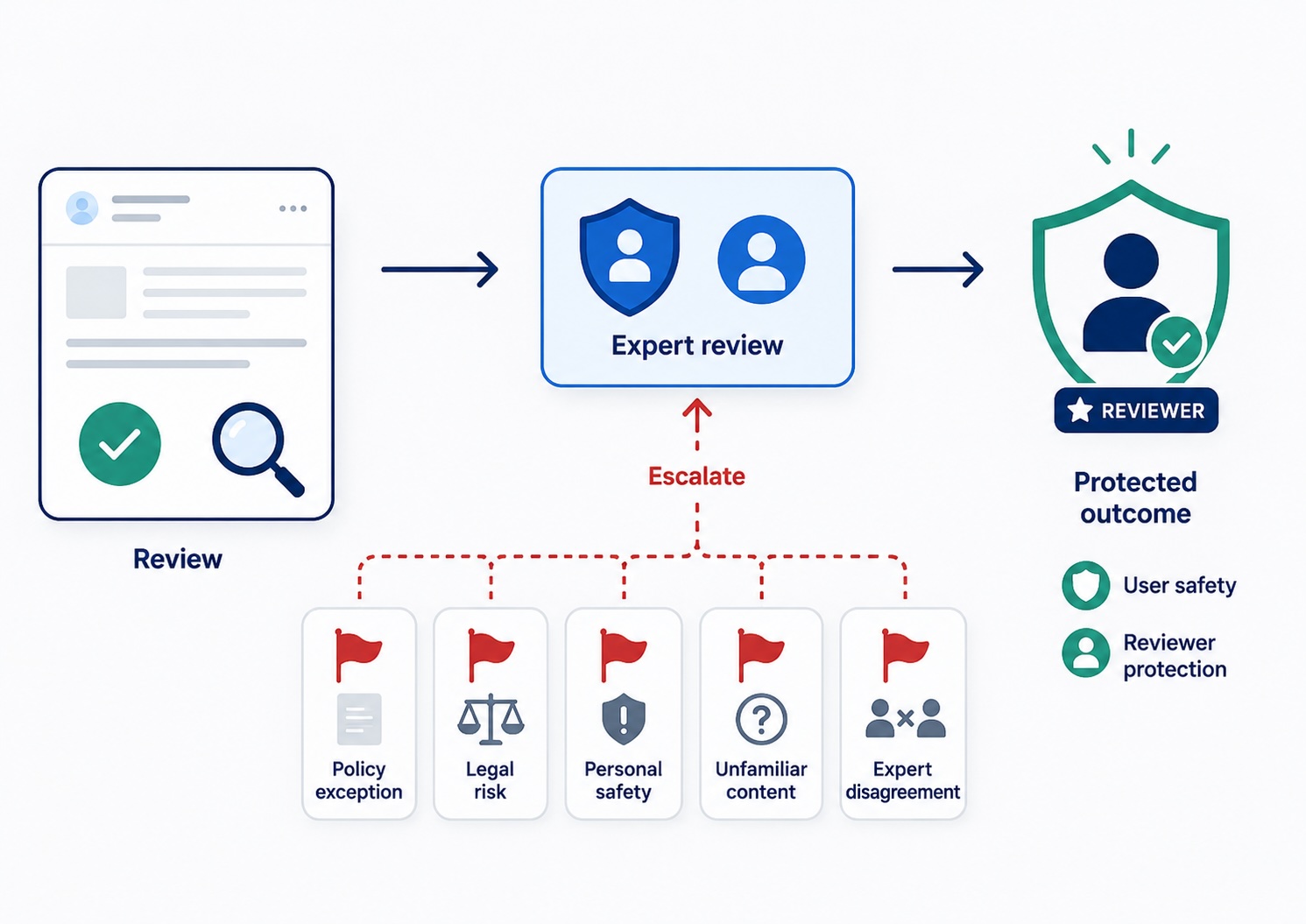
A reliable HITL workflow starts with operational clarity. Reviewers need to know what they’re validating, what counts as acceptable, and what to do when they’re unsure.
Define clear validation criteria. “Make sure the answer is good” isn’t useful. Name the dimensions: an AI answer might be reviewed for factual accuracy, relevance, completeness, safety, tone, source support, and policy. A packaging concept might be judged on clarity, credibility, distinctiveness, and purchase intent. Criteria should reflect the intended outcome — an attractive design still fails if customers misread what the product does.
Train reviewers with realistic examples. Include obvious wins, obvious failures, and ambiguous cases, and show why a decision was made, not just which button got clicked. Calibration exercises, where several reviewers score the same cases and discuss disagreements, are especially useful.
Measure reviewer agreement. Inter-rater agreement shows how consistently reviewers apply the criteria. Low agreement isn’t always poor performance — it may mean the task is subjective or the information is insufficient, which is useful product insight. Respond by clarifying definitions, adding examples, or escalating certain categories.
Use escalation rules. Reviewers should know when not to decide — policy exceptions, legal risk, personal safety, unfamiliar content, or expert disagreement. Escalation paths protect both the user and the reviewer.
Sample strategically. Review all high-impact or high-uncertainty cases, and randomly sample lower-risk outputs to catch hidden problems. Sampling should change over time: broad review at launch, lighter routine review once performance stabilizes.
Monitor quality over time. A one-time validation study doesn’t guarantee future performance. Customer behavior shifts, fraud evolves, policies update, and models drift. Track error rates, agreement, escalation patterns, and outcomes across model versions throughout the AI lifecycle.
Create meaningful audit trails. Log the input, output, model version, confidence score, reviewer decision, correction, rationale, and timestamp. A good log answers later questions: Why was this approved? Which version produced it? Did the reviewer have the right information? Is this error recurring? Logs should be built for investigation, not collected for their own sake.
Protect sensitive data. Give reviewers only what the task requires. Mask personal identifiers, keep access role-based and monitored, and set clear retention policies so review doesn’t create an indefinite archive of sensitive data.
Human-in-the-loop validation for AI systems
Human-in-the-loop AI is especially useful because AI outputs are probabilistic, persuasive, and hard to verify. Traditional software follows explicit rules — same inputs, same result. Generative AI and many machine learning models infer patterns from data and produce outputs by probability. That flexibility lets LLMs and other systems handle complex tasks, but it also makes exhaustive rule-based testing hard.
A human-in-the-loop layer can support AI workflows by reviewing model predictions, checking generated text and images, catching hallucinations, evaluating safety and policy compliance, building and validating ground-truth datasets, monitoring model drift, correcting data annotation errors, and approving consequential actions. The design should match the system: a natural language processing tool may need factual and contextual review, a computer vision model may need image specialists for uncertain classifications, and the more authority a system has, the more it matters to define intervention points.
Human-in-the-loop validation and AI agents
AI agents take multiple actions toward a goal rather than producing one isolated output. They search databases, call tools, update records, contact customers, and initiate transactions — which compounds risk, because one wrong assumption can shape several later actions. Controls for AI agents may include approval before consequential tool calls, spending limits, restricted permissions, checkpoints after major decisions, and automatic escalation when uncertainty rises. A travel-planning agent might compare flights and prepare an itinerary on its own, then require explicit approval before buying a non-refundable ticket. Speed during research, human control over the irreversible step. Oversight should be built into the agent’s permissions, not bolted on after deployment.
Confidence thresholds and selective review
Not every output needs the same intervention. A system can route low-confidence predictions to people while accepting high-confidence ones automatically — but confidence has to be validated against real outcomes, because a model can be confidently wrong. Calibrate thresholds on historical data and review them across customer groups; a single global threshold can hide weak performance on rare cases. Random sampling of high-confidence outputs still matters, since it tests whether the model’s confidence keeps matching real accuracy.
Active learning
Active learning is a machine learning approach where the system flags the examples that would be most informative for a person to label — cases where it’s uncertain, where models disagree, or where data is thin. It makes data annotation more efficient by concentrating human effort where new labels help most. The tradeoff: uncertain examples are often unusually hard, so reviewers need strong guidance, and the resulting data shouldn’t be assumed correct just because a human supplied it.
Human-in-the-loop machine learning
In human-in-the-loop machine learning, people contribute across data collection, training, evaluation, deployment, and monitoring. They define label categories, annotate examples, resolve disagreements, review model errors, validate predictions, investigate performance changes, flag harmful outcomes, and decide whether a model is ready for broader use. Human input becomes part of how the system learns, not a single approval step.
Human feedback and RLHF
Reinforcement learning from human feedback, or RLHF, is one method for using human preferences to shape model behavior. In a simplified version, people compare or rank model outputs, and those preferences train a reward model that guides further training — an approach OpenAI has described for training instruction-following models. RLHF is related to human-in-the-loop work but isn’t the same thing. HITL validation can happen during production, QA, research, or approval; RLHF is a training method. You can run HITL validation without RLHF, and you can use RLHF to train a model that still needs human validation after deployment.
Human-in-the-loop product research for AI
Human-in-the-loop product research for AI applies the same principle to product and marketing decisions: AI helps teams generate and organize options, and real consumers validate how those options land.
This matters most for early-stage companies, because generative tools have collapsed the cost of creating concepts. A founder can produce ten logo directions, five landing-page mockups, or twenty ad variations in an afternoon. The bottleneck has moved from production to selection — and internal teams are poor judges of that selection, because they know too much about the product. They fill in unclear messaging, catch subtle brand references, and overlook concerns that are obvious to a first-time customer. Human feedback brings the outside perspective back in. It’s one of the more practical focus group alternatives available to a small team: faster and cheaper than assembling a panel in a room, and pointed at your actual target audience.
From AI creative testing to market evidence
In AI creative testing, a team uses AI to generate multiple directions, then asks target consumers which version is clearest, most trustworthy, or most likely to earn a click. Define the research question before you launch — asking which design people “like” produces a winner without telling you whether it serves the business goal. Stronger questions sound like: Which ad communicates the benefit most clearly? Which package looks credible at the intended price? Which app icon reads at a small size? Which slogan matches the positioning? The feedback validates a decision criterion, not the designer’s taste.
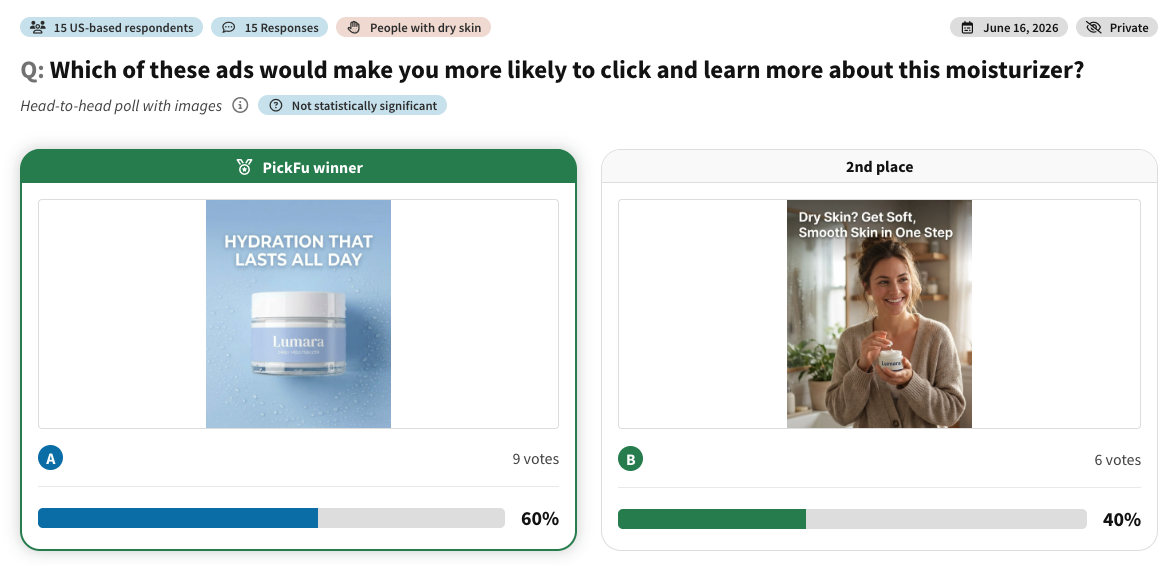
Here’s what that looks like with real data. We generated two ad concepts for a fictional moisturizer — one a polished product render, one a problem-led lifestyle shot — and tested them with dry-skin shoppers.
📊 Survey example: Two AI-generated moisturizer ads, tested with 15 US shoppers who have dry skin. See how they compared.
What the results showed:
- The polished product render won, 60% to 40%, over the lifestyle version.
- “Hydration that lasts all day” was the most-repeated reason to click — a specific benefit beat a mood.
- The 40% who chose the lifestyle ad wanted to see “actual people” and real skin results, so the losing concept still carried signal worth testing next.
A close split like that is the point. AI produced both options in minutes; real people revealed that a clear benefit claim beat an attractive scene, and that a segment still wants a human face. Neither insight was available from inside the team.
A mini-case: testing a company logo
A B2B software company uses an image model to create several logo concepts. The founders prefer a detailed symbol meant to represent connectivity, analytics, and automation. During logo and design testing, potential customers keep describing the mark as a healthcare logo. The simpler alternative means less to the founders but reads more accurately to the market, so the company changes direction before investing in a full visual identity.
What changed wasn’t just the logo — the team found a gap between intended meaning and perceived meaning. An explanation can’t rescue a symbol that has to work before the explanation is given. That’s why it pays to test company logo concepts with people who weren’t in the room when they were designed.
A mini-case: app store screenshot and icon testing
An app team preps a launch with feature-focused screenshots. The images are polished, but the first screen crams in several interface elements and a long headline. In app store screenshot and icon testing, respondents grasp the simpler, competitor-style layout faster, and they prefer an icon the design team had dismissed as too conventional. The team rebuilds the first screenshot around one core benefit and picks the more recognizable icon.
The lesson isn’t that conventional design always wins. It’s that app stores are a fast, low-attention environment where immediate comprehension often matters more than how much information you show.
Human feedback for original GEO and SEO content
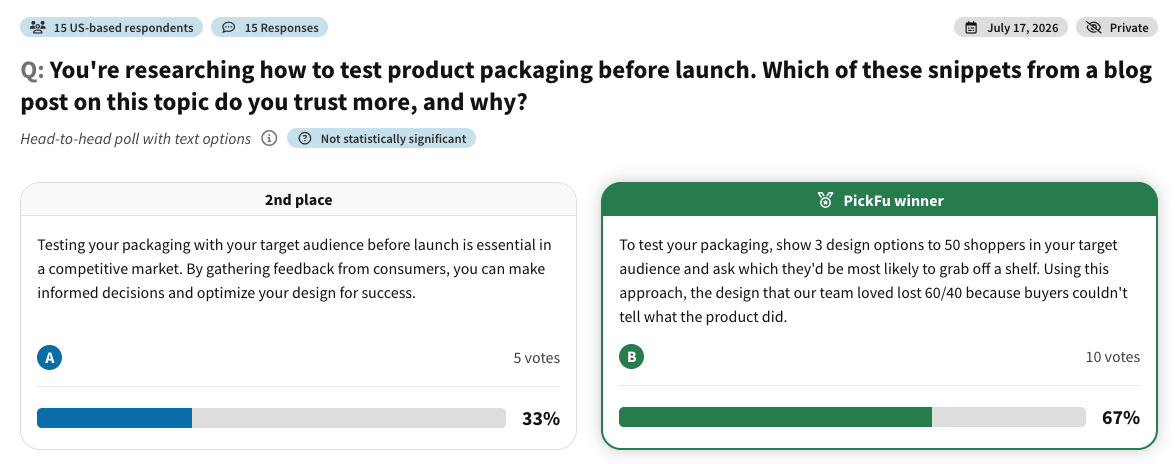
AI can accelerate topic research, drafts, FAQs, and repurposing, but it also tends to reproduce the generic language already spread across the web. Teams asking how to create original content for GEO and SEO need more than an AI-generated article — they need evidence, experience, and perspectives that competing pages can’t reproduce from the same public sources.
That’s where human-in-the-loop content research comes in: polling target customers about their decision criteria, interviewing experts, testing which explanations land, collecting original survey responses, and publishing first-party charts and findings. AI can organize and explain that material; the human evidence gives the content something original to say.
We put the claim to the test.
📊 Survey example: We tested two explanations of the same topic — one generic and AI-flavored, one edited by an expert with a first-hand result — to see which one readers trust more. See the test.
Human-in-the-loop validation for synthetic respondents and synthetic data
Synthetic research has its strengths: the data can help teams explore scenarios, test software, protect privacy, or fill gaps where real examples are scarce. Synthetic respondents can simulate possible audience reactions based on patterns an AI model has learned.
The risk shows up when simulation gets confused with observation. A synthetic persona can generate a plausible objection to a product, which might help you prepare better research questions — but it doesn’t establish how often real customers hold that objection, or how strongly it affects what they buy.
Human validation improves synthetic research by comparing synthetic responses with known customer data, spotting stereotyped or oversimplified personas, checking whether claims are supported, and separating brainstorming from evidence. This is the heart of synthetic respondents vs real consumer feedback, and it shouldn’t be framed as a contest where one replaces the other.
Synthetic outputs are fast, cheap, and genuinely useful for some jobs: broad segmentation, high-level directional reads, and generating hypotheses worth testing. They get shakier exactly where a decision turns specific — nuanced creative preference (asking someone to compare three designs and explain why one wins), detailed qualitative reactions, and forward-looking predictions about how a particular audience will actually respond.
Accuracy isn’t stable either: the same synthetic method can track human results closely on one task and miss badly on the next. That’s why a synthetic answer is best treated as a hypothesis, not evidence, until real people confirm it.
Say a team is weighing a new meal-kit subscription. They ask an LLM, acting as a synthetic persona of their target buyer, what would stop someone from signing up — a fast way to generate a hypothesis. The answer usually leads with price. That’s a reasonable starting guess, but synthetic personas tend to over-index on price while underplaying quieter frictions like “will this actually fit my routine?”
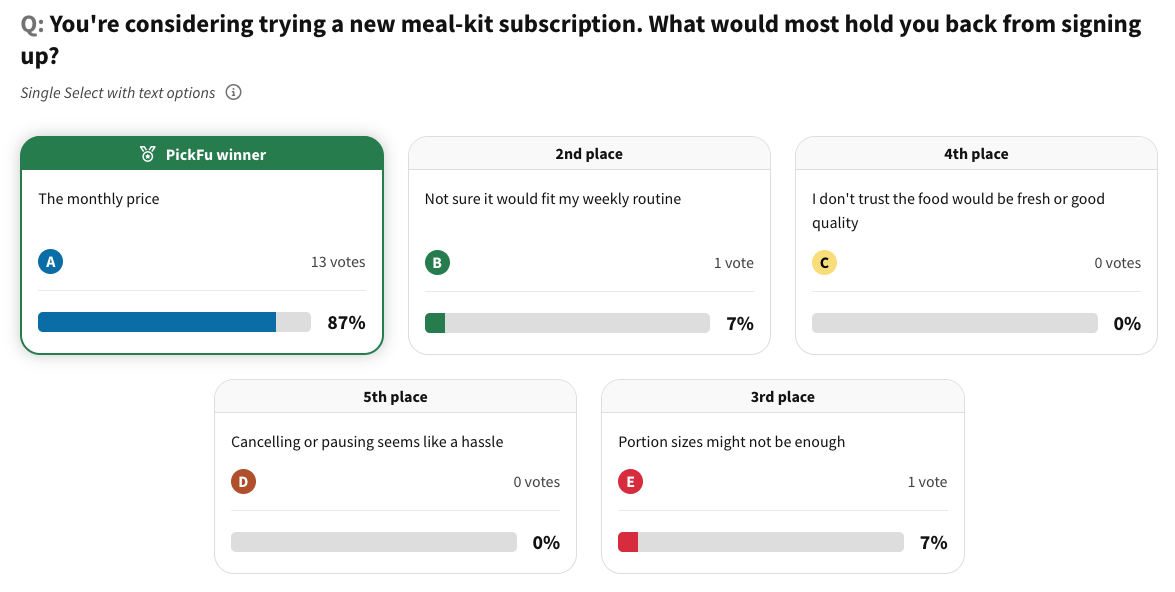
The way to find out is to put the same question to real people in your target audience — the validation step PickFu is built for. Here’s that setup as a real poll:
📊 Survey example: The same meal-kit question — what would most hold you back from signing up? — put to real consumers instead of a synthetic persona. Run it on PickFu, then compare the real answers against the synthetic guess. See the test.
To be clear about the limit: human validation can make synthetic outputs more realistic and flag unsupported conclusions, but it can’t turn simulated opinions into evidence that real people hold them. PickFu surveys go to verified human respondents — real people in your target audience, not AI-generated ones — so they’re the way to check a synthetic hypothesis against real reactions, not another simulation on top of the first.
And as AI fills every channel with more variations to sort through, that kind of real human validation matters more, not less: the audience for all that AI-generated content is still human.
How to build a human-in-the-loop validation workflow
A useful workflow starts with the decision, not the technology. Define what you’re trying to protect or improve first — factual accuracy, customer safety, creative clarity, fraud reduction, research quality, policy compliance, or better training data — then design the right level of human involvement.
- Define what needs validation. “Review AI content” is too broad. “Verify that customer-facing answers are supported by approved product documentation” is usable.
- Classify outputs by risk. Weigh the impact of an error, whether it’s reversible, who’s affected, and how easily it’s caught. A low/medium/high model works if the tiers reflect your actual business context.
- Decide which outputs need human review. High-risk may need full review; medium-risk can route on confidence or triggers; low-risk can run automatically with periodic sampling.
- Create validation guidelines. Document what to examine, what evidence to use, and what counts as approve, correct, reject, or escalate — with examples from real conditions.
- Train and calibrate reviewers. Have several assess the same pilot cases, then compare and discuss. This exposes unclear criteria before they hit production.
- Run a controlled pilot. Start with limited volume or actions. Measure where the system fails, how often reviewers intervene, and whether the workflow creates unacceptable delays.
- Measure agreement and outcomes. High approval rates alone don’t prove success — reviewers may be approving too easily, or getting cases that never needed attention.
- Add escalation paths. Specify which cases need specialists or legal review, and don’t penalize reviewers for escalating genuine uncertainty.
- Log decisions and corrections. Capture structured reasons so recurring patterns surface, with enough context to reconstruct what happened.
- Improve the model, rules, or process. Use validated findings to fix root causes — prompts, source data, thresholds, policies, retraining, or the customer experience.
- Reassess regularly. Revisit the design after model changes, new use cases, policy updates, audience shifts, or emerging failure patterns.
Human-in-the-loop validation metrics
Metrics should show whether human involvement improves decisions, not just whether reviewers are busy. Useful measures include accuracy and error rate, false-positive and false-negative rate, reviewer agreement, correction and escalation rate, reversal rate after senior review, review turnaround time, cost per reviewed item, percentage of high-risk outputs reviewed, quality drift over time, and model improvement after feedback.
The right combination depends on the workflow. A fraud system may prioritize false-positive and false-negative rates, because both customer friction and fraud loss matter. A content workflow may emphasize factual correction rate and publishing time. A creative test may focus on comprehension, preference, and purchase intent across segments.
Read metrics together, too: a falling correction rate could mean the model improved — or that reviewers stopped paying attention. Measurement itself needs interpretation, which is one more place human judgment stays necessary.
Common human-in-the-loop validation mistakes
The most common mistake is assuming any human involvement creates reliable oversight. A person without time, expertise, context, or authority is little more than a ceremonial approver. Other frequent mistakes:
- Vague instructions, or reviewing every output regardless of risk
- Reviewing too few outputs to catch systematic problems
- Treating all predictions as equally consequential
- Skipping reviewer-agreement measurement, or ignoring fatigue and automation bias
- Treating one reviewer’s judgment as unquestioned ground truth
- Collecting corrections without feeding them back into the process
- Changing models without updating review criteria
- Exposing reviewers to unnecessary sensitive data
- Using synthetic validation without real-world benchmarks
- Reporting a result as “human validated” without explaining the method
Suppose a marketing team uses an LLM to draft 100 social ads and asks one employee to approve them in an afternoon. The workflow technically contains human oversight, but the volume forces rapid scanning, the reviewer lacks target-customer data, and no reasons get recorded.
A stronger process removes duplicates and policy violations automatically, has the team shortlist strategically distinct concepts, and tests those with target consumers. Human effort goes to expert curation first, then market validation. Less review, better evidence.
Human-in-the-loop validation checklist
Use this when evaluating a new or existing workflow:
- Is the validation goal clearly defined and tied to a specific business decision?
- Are outputs categorized by risk and consequence?
- Is it clear which cases require human review, and are confidence thresholds tested against real outcomes?
- Are reviewer guidelines documented, with difficult and ambiguous examples?
- Are reviewers trained, calibrated, and given enough context to decide?
- Is reviewer agreement measured?
- Can reviewers edit, reject, and escalate, and are high-risk cases routed to specialists?
- Are decisions and corrections logged, and is sensitive data protected?
- Are random samples of automated approvals audited?
- Are recurring errors used to improve the model or process?
- Is quality monitored across model versions and customer groups?
- Are reviewer fatigue and workload measured?
- Are the limitations of the process disclosed, and is someone clearly accountable for the outcome?
The real purpose of human-in-the-loop validation
Human-in-the-loop validation is usually pitched as a technical method for improving AI accuracy. For business leaders, it’s better understood as a way to allocate judgment. Automation should handle work that benefits from speed, consistency, and scale. People should be involved where context, accountability, uncertainty, or consequence makes their judgment worth the cost.
That principle holds whether you’re reviewing an AI-generated customer answer, comparing design options, or deciding whether synthetic research reflects real consumer behavior. The goal isn’t a human behind every machine. It’s keeping efficiency from becoming an excuse for weak evidence, invisible risk, or decisions no one can explain.
If your next decision involves AI-generated creative, packaging, names, or product concepts, the human-in-the-loop step is a quick test with real people before you commit the budget.
Create a free PickFu account to run your first survey – and start collecting real human insights to back up your business decisions.
Frequently asked questions
What is the human-in-the-loop verification process?
It begins when an automated system produces an output, prediction, or recommended action. The system routes selected cases to a human based on risk, uncertainty, sampling rules, or confidence thresholds. The reviewer checks the output against defined criteria and then approves, corrects, rejects, or escalates it. The decision is recorded in an audit trail and can be used to improve future model performance, policies, training data, or AI workflows.
How does human-in-the-loop evaluation help?
It helps teams find factual errors, ambiguous outputs, unsafe recommendations, bias, hallucinations, and edge cases that automated evaluation misses. It also reveals why a model failed, so a team can improve its data, prompts, rules, interface, or machine learning models rather than correcting the same production error over and over.
What is human-in-the-loop AI?
It’s an approach where people participate in developing, evaluating, operating, or overseeing an AI system — labeling data, validating predictions, approving actions, resolving uncertain cases, giving feedback, or deciding when the system should change or stop. The level of involvement depends on the task’s complexity and risk.
What are the benefits of human-in-the-loop AI?
Better contextual accuracy, stronger handling of unusual cases, safer deployment, improved training data, greater accountability, and more useful feedback loops. These depend on reviewer expertise, clear guidelines, appropriate sampling, and quality monitoring — human review isn’t automatically reliable just because a person is involved.
How does human in the loop apply to AI agents?
Human-in-the-loop controls can require approval before an agent takes consequential actions — sending external messages, changing customer records, making purchases, moving money, or deleting data. Less consequential actions can stay automated, so the agent researches and prepares a recommendation while a person keeps authority over irreversible or high-risk steps.
What are some examples of human-in-the-loop validation in AI?
Employees checking AI-generated customer answers, analysts reviewing suspected fraud, moderators evaluating ambiguous content, clinicians interpreting medical imaging outputs, researchers validating synthetic survey responses, and consumers evaluating AI-generated ads or product mockups. The human role can be approval, correction, rejection, explanation, or escalation.
What’s the difference between human-in-the-loop and human-on-the-loop?
Human-in-the-loop usually means a person participates directly in a decision, like approving an output before it’s used. Human-on-the-loop means the system runs on its own while a person monitors it and intervenes when needed. Which fits depends on the speed, autonomy, and risk of the system.
Can human-in-the-loop validation remove AI bias?
It can help identify and reduce bias, but it can’t guarantee removing it. Reviewers can introduce their own biases, and teams may share assumptions already present in the model or data. Clear criteria, diverse evaluation, outcome analysis, and independent audits stay necessary.
How do you measure human validation quality?
Through reviewer agreement, correction and error rates, escalation rates, senior-review reversals, audit findings, turnaround time, and comparison with expert-reviewed ground truth. The most important measure is whether human involvement improves the real outcome the system was built to support.