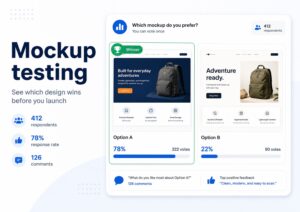
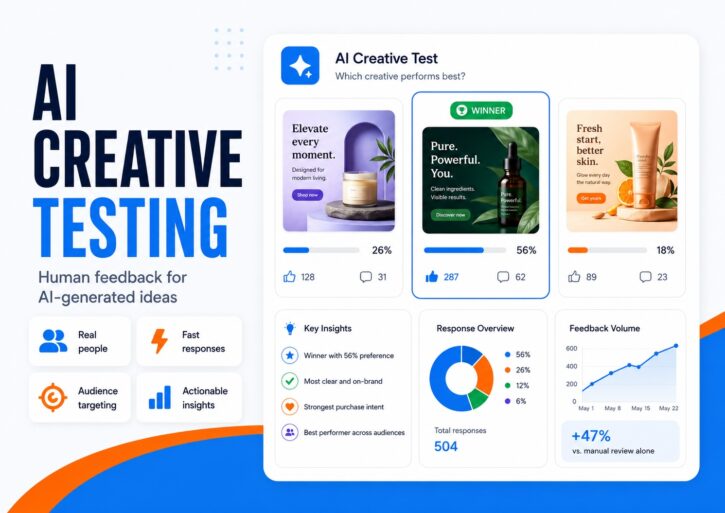
AI creative testing is the process of evaluating AI-generated content — ad copy, product images, logos, packaging concepts, emails, landing page copy, and social creative — before you publish it. PickFu helps brands compare AI-generated options with feedback from real people, so teams can pick the creative that’s clearer, more persuasive, and better matched to their target audience.
Quick summary
AI creative testing helps marketers, founders, e-commerce teams, and agencies decide which AI-generated creative is most likely to work before they spend money launching it. Instead of relying on internal opinions, a machine learning score, or a platform’s performance predictions, teams can test AI-generated images, copy, product concepts, logos, packaging, and ads with real people.
This matters because artificial intelligence can generate far more creative options than most teams can review. It can produce dozens of headlines, product images, static ads, landing page concepts, video hooks, or email subject lines in minutes. More output doesn’t mean better creative. AI creative can look polished and still feel generic, confusing, or off-brand to the people you actually want to reach.
That’s where PickFu comes in. PickFu is a consumer research platform built for exactly this kind of decision. You upload your options, choose the audience you want to hear from, and get written feedback from verified human respondents who match it — typically 50 to 100 people, with answers coming back within hours, not weeks. Used on AI creative, it adds a human feedback layer to a workflow that has otherwise gotten very fast and very untested.
The strongest AI workflow is human-in-the-loop product research for AI. Use AI to create more options, then use real people to choose and improve the right ones.
What is AI creative testing?
AI creative testing means using audience feedback to evaluate creative assets made or assisted by AI. Instead of choosing creative based on internal opinions, brand-team preferences, or how impressive the AI output looks, you test multiple versions with real people to learn which one performs best and why.
The key word is “creative.” AI creative testing isn’t limited to ads. It applies to almost any customer-facing asset that shapes attention, trust, comprehension, or action: ad copy, AI-generated product images, packaging concepts, landing page copy, social posts, app store visuals, Amazon listing content, logo concepts, brand names, slogans, video thumbnails, and product mockups.
A founder might use AI creative testing to choose between three homepage headlines before launching a SaaS product. An e-commerce team might compare AI-enhanced product images to see which one makes the product feel more useful. A marketing team might test ad creative before spending budget on Meta, Google, or TikTok. An Amazon seller might run mockup testing on main images, listing bullets, and A+ content before pushing changes live.
The goal is creative that works for the audience you care about, not output that just looks impressive.
| AI creative type | What to test |
| AI ad copy | Which headline, hook, or call-to-action is most persuasive |
| AI product images | Which image looks most realistic, useful, or appealing |
| AI packaging concepts | Which design looks most premium, clear, or trustworthy |
| AI logo concepts | Which logo best fits the brand |
| AI email subject lines | Which version people are most likely to open |
| AI landing page copy | Which message is clearest |
| AI social posts | Which post feels most engaging or authentic |
| AI product names | Which name is most memorable or relevant |
| AI Amazon listing copy | Which title, bullet, or image set is strongest |
| AI video concepts | Which storyboard, thumbnail, or hook is most compelling |
That range is why creative testing is more than a marketing chore. The creative team still brings strategy and taste. AI brings speed and variation. Real people bring the market signal that tells you which version of the work is actually landing.
Why you should test AI creative with real people
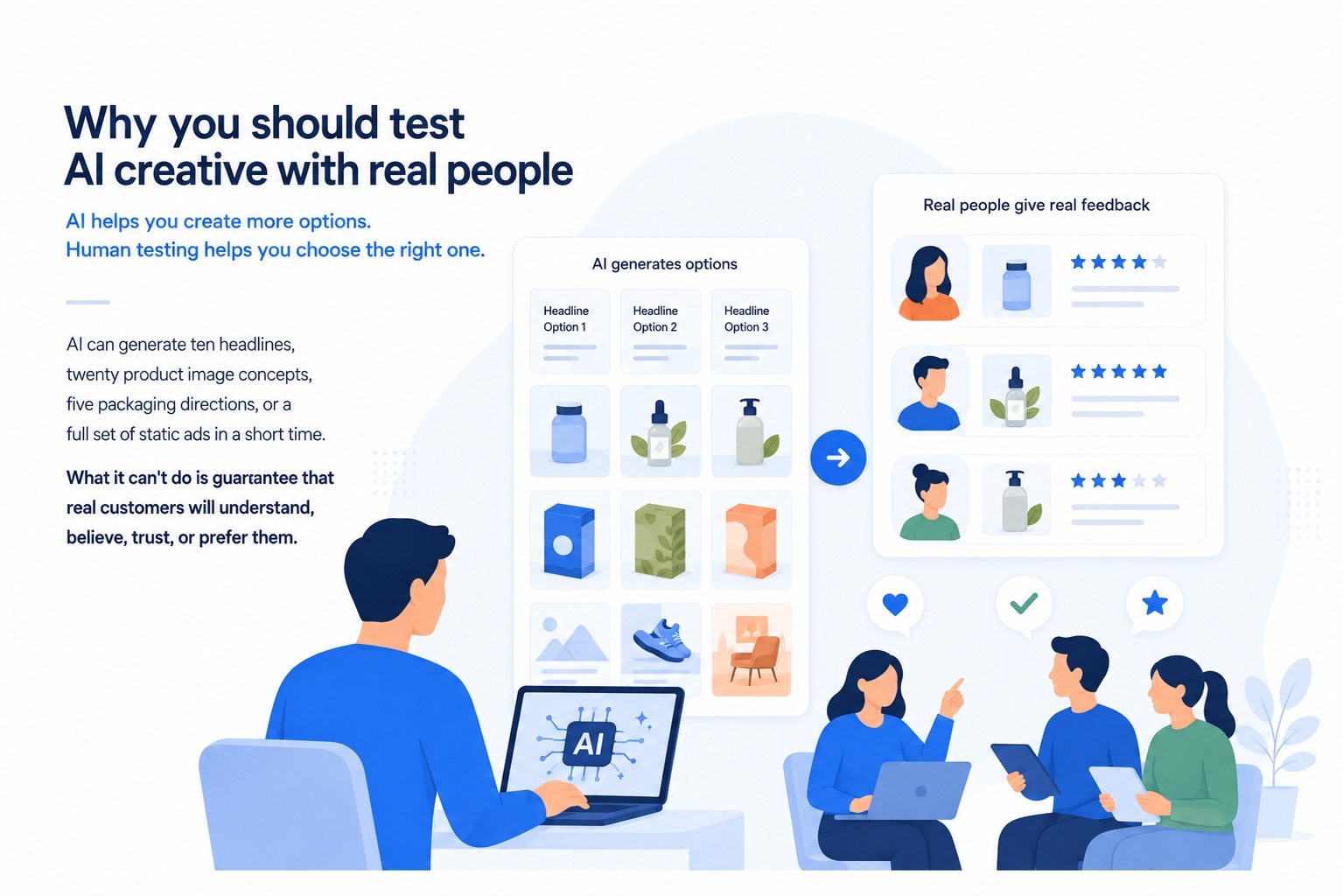
AI helps you create more options. Human testing helps you choose the right one.
AI can generate ten headlines, twenty product image concepts, five packaging directions, or a full set of static ads in a short time. What it can’t do is guarantee that real customers will understand, believe, trust, or prefer them.
The risk of AI-generated marketing is that the output looks finished before anyone has checked whether it works. A product image can look beautiful and still set unrealistic expectations. A headline can read smoothly and still fail to explain the value proposition. A logo can look modern and signal the wrong category.
The problem compounds when teams judge AI creative internally. Founders are close to the product. Marketers know the strategy. Designers understand the intent behind the visual system. Customers have none of that context — they react to what’s in front of them. Real people in your target audience can surface confusion, objections, and trust issues before the creative ships, which is exactly what internal review and friends-and-family polls miss. For teams that have leaned on slow, expensive focus groups, this is one of the more practical focus group alternatives available.
This matters more as platforms add automation. Meta’s own research shows higher-quality creative drives better ad ROI, and tools like dynamic creative and Google’s Ad Strength can assemble and grade variations for you. Those systems are useful, but they optimize around delivery and performance data after launch. PickFu is useful before launch — when you’re still deciding which AI-generated creative deserves budget, production time, or client approval.
How PickFu helps you test AI creative
PickFu lets you upload AI-generated creative options, choose a target audience, and collect votes plus written survey responses from real people. Instead of guessing which AI-generated image, headline, ad, or product concept is strongest, you see which option your audience prefers and why.
The workflow is simple, but it solves a real problem. AI has made creative generation faster than creative judgment. Teams can now produce far more concepts than they can responsibly evaluate.
Start by generating creative options with AI — ad copy, landing page headlines, lifestyle images, packaging concepts, brand names, or social variations. Then cut the obviously weak or off-brand outputs. This step matters. Testing twenty mediocre options is usually less useful than testing three strong ones.
Next, upload the strongest options to PickFu, compare two or more in a poll, and choose respondents who match your likely buyers, readers, or users. Ask a focused question: which ad would make someone click, which product image feels more trustworthy, which package looks more premium, which headline explains the product more clearly.
Finally, review both the vote split and the written feedback. The winner gives you direction. The comments tell you why it won, what people noticed, what they misread, and what they’d change. That feedback shapes your next AI prompt, creative brief, or campaign iteration. Generate, shortlist, test, analyze, revise, retest — each round sharpens the creative because the prompts are now informed by audience behavior instead of internal taste.
If your team already works inside an AI assistant, PickFu’s MCP closes that loop in one place. It’s an integration that lets you use PickFu directly inside Claude and other AI tools that support it, so you can generate image or design options with PickFu’s built-in image generation, launch a test on them, and read the results back without leaving the conversation. “Draft three packaging directions” and “tell me which one shoppers preferred, and why” become steps in the same chat. See the PickFu MCP prompt examples for setups teams are already using, or browse PickFu’s AI tools.
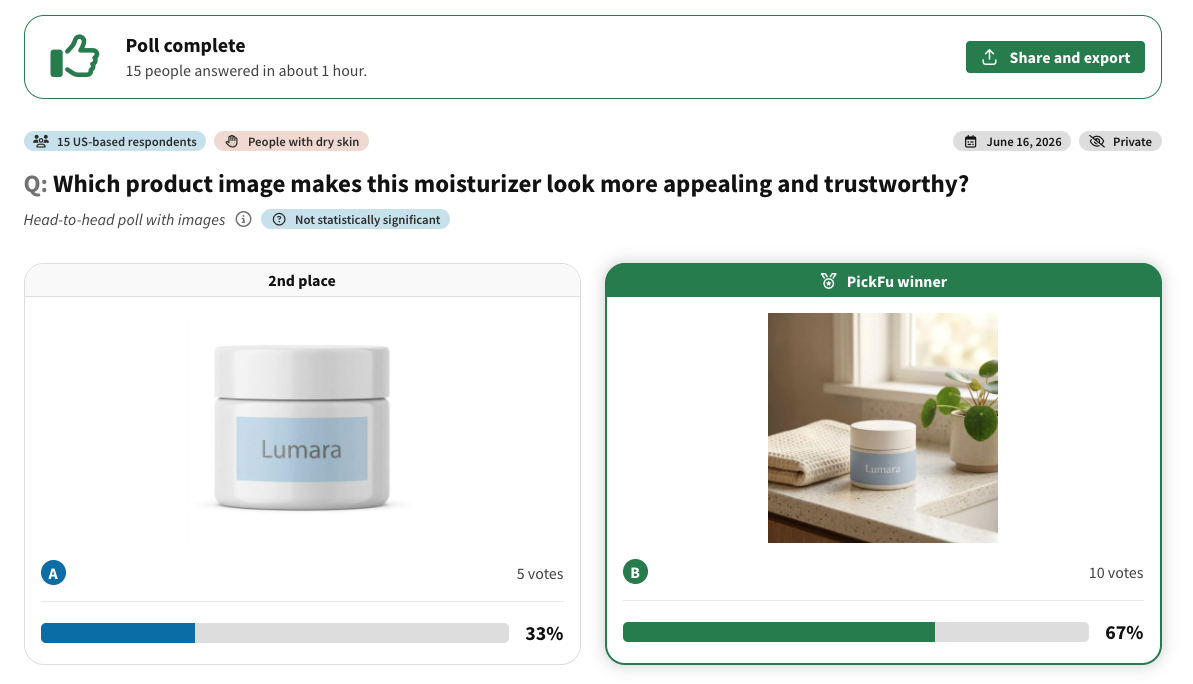
📊 Survey example: a clean studio render vs. an AI lifestyle product image, tested with 15 dry-skin shoppers. See the results.
What the results showed:
- The lifestyle shot on a bathroom counter won 67% to 33%. The setting made the product feel real and ready to use — “Being on the counter makes it appear to be more real,” and “it’s in the bathroom which makes me want to use it.”
- The five who preferred the clean studio render wanted the bottle bigger and the label easier to read (“the product is more prominent,” “easy to read”), a reminder that lifestyle context can’t come at the cost of product clarity.
What types of AI creative can you test?
AI creative testing can support almost every stage of the customer journey. At awareness, you’re testing hooks, static ads, video thumbnails, or social captions. At consideration, you’re testing landing page copy, product descriptions, comparison charts, or mockups. At conversion, you’re testing product images, Amazon listing assets, packaging, calls to action, or offer framing.
The mistake is treating AI creative testing as a paid-media-only function. It can absolutely improve ad performance, CTR, ROAS, and conversion rate. But creative also shapes trust before the click and confidence before the purchase.
AI ad creative
AI can generate headlines, primary text, image concepts, hooks, value propositions, calls to action, static ads, and video thumbnails. A team might ask, “Which ad would make you more likely to click and learn more?” An ad has to earn attention, communicate value, feel credible, and create enough curiosity to justify the click — all fast. AI produces many versions; humans tell you which feels most specific and believable. For more on this, see why you should test ad creative before you launch.
AI product images
Product images get tricky with AI. AI-enhanced images can make products look more polished, but they can also create unrealistic expectations if the scale, texture, color, or environment feels off. An e-commerce team might test a clean studio image against an AI lifestyle image. The lifestyle version may win because it helps people imagine the product in use — or lose because it looks too staged. A useful question: “Which image makes this product look more useful and trustworthy?”
AI copywriting
AI copywriting moves fast but often produces ad copy that sounds smooth without saying anything distinct. That’s why testing headlines, landing page copy, email subject lines, Amazon bullets, and social captions pays off. A founder might have three AI-written homepage headlines and privately prefer the clever one — while respondents pick the clearer one because it explains the product faster. Customers don’t reward cleverness until they understand the offer.
AI packaging and label concepts
AI can help explore packaging directions, label layouts, color palettes, claims hierarchy, and premium-versus-affordable positioning. But packaging has to work in a real buying context: it has to communicate category, quality, and trust in a glance. This is where package design testing earns its place. A beverage, supplement, or skincare brand can generate multiple AI concepts and test which one people would actually pick off a shelf: “Which package would you be more likely to pick from a store shelf?”
AI brand concepts
AI can generate early brand concepts, but brand identity shouldn’t be left to AI alone. PickFu works for logo and design testing too — to test a company logo, test slogans, run a brand name test, or test business name ideas before you commit. A wellness brand might generate several logo-and-tagline combinations; one feels elegant to the founder, another feels more trustworthy to the target market. The test doesn’t replace a designer — it gives the designer better market input before finalizing the system.
AI e-commerce content
For e-commerce teams, AI creative testing can support PDP images, product titles, bullets, comparison charts, A+ content, storefront graphics, and Amazon split testing decisions. The useful question is which one gives shoppers more confidence: “Which product page image makes you feel more confident buying this item?” If the version with clearer feature callouts wins, education matters. If the cleaner image wins, simplicity is doing the persuading.
AI creative testing examples
Good tests compare meaningful differences and ask questions tied to a business outcome.
| AI creative | What to compare | Best question to ask |
| Ad headline | Benefit-led vs. curiosity-led | Which headline would make you click? |
| Product image | Studio render vs. lifestyle image | Which image makes the product more appealing? |
| Landing page copy | Short hero vs. detailed hero | Which version explains the product more clearly? |
| Packaging | Minimal vs. colorful design | Which package looks more trustworthy? |
| Logo | Modern mark vs. classic wordmark | Which logo feels more professional? |
| Email subject line | Direct vs. playful | Which email would you be more likely to open? |
| Social post | Creator-style vs. brand-style | Which post feels more authentic? |
| Amazon image | Feature callouts vs. clean image | Which image better helps you understand the product? |
| App listing | Feature screenshot vs. benefit-led screenshot | Which app listing makes you more likely to download? |
| Product concept | Practical use case vs. aspirational story | Which product idea feels more useful? |
These work best when each option represents a real strategic choice. If one ad is clear and the other is obviously broken, the test teaches nothing. But if one ad is emotional and the other is functional, the results reveal how the audience actually thinks. That’s what good creative testing tools give you — not just a winner, but the reason behind it, which you can carry into the next campaign, landing page, or listing.
AI creative testing works best with human-in-the-loop feedback
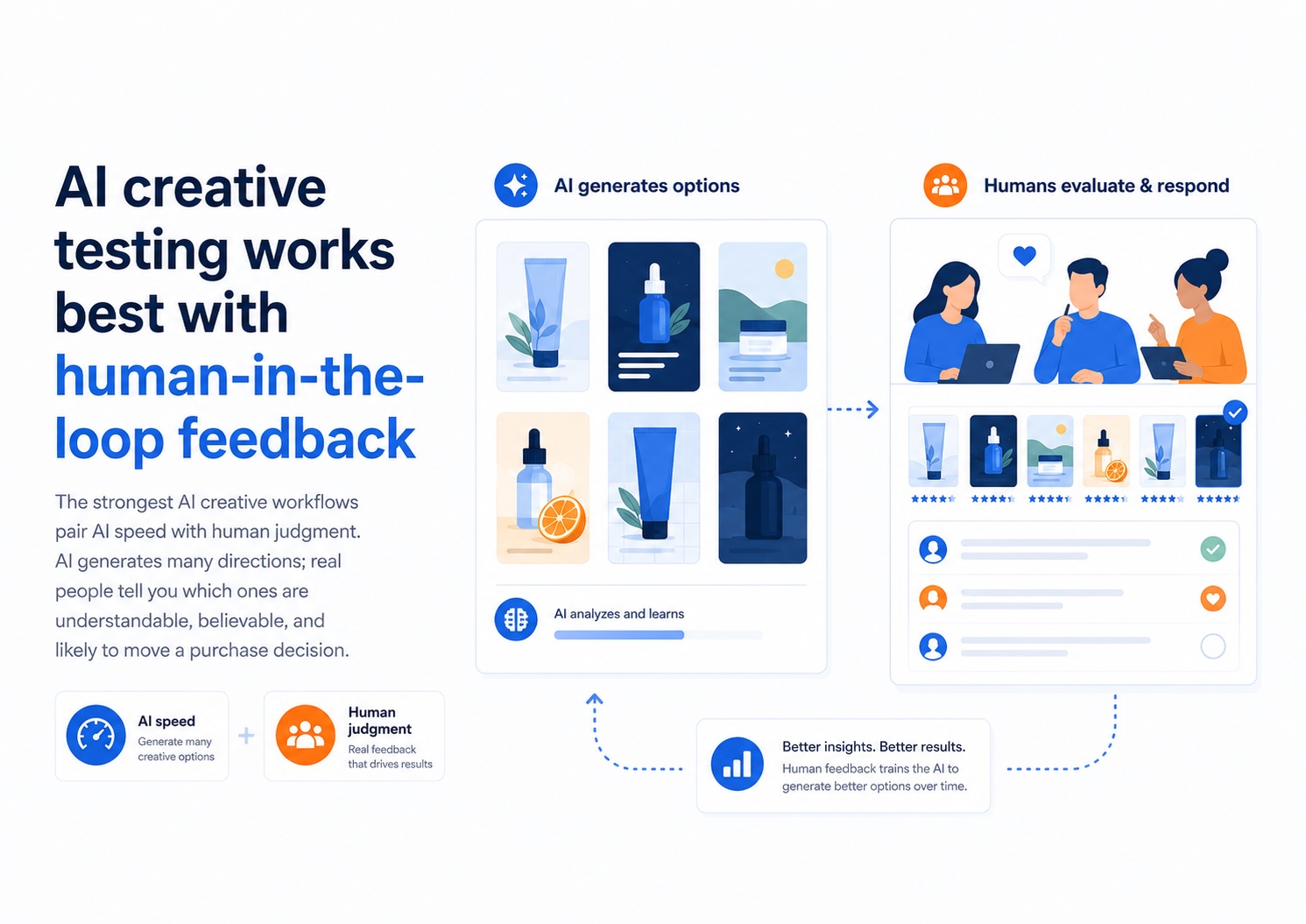
The strongest AI creative workflows pair AI speed with human judgment. AI generates many directions; real people tell you which ones are understandable, believable, and likely to move a purchase decision.
A simple human-in-the-loop product research workflow looks like this:
- Use AI to generate creative variations.
- Cut the weak, inaccurate, or off-brand outputs.
- Test the strongest options with real people.
- Read the comments for patterns.
- Improve the prompt, creative direction, or brief.
- Retest the refined creative, then launch the winner.
This matters because AI-generated creative can become self-referential. A model can produce output that resembles high-performing marketing language without knowing whether it’s true, differentiated, or relevant to your audience. Human feedback interrupts that loop and puts the creative back in contact with the customer. Running it through PickFu’s MCP keeps that loop fast, since you can generate, test, and analyze inside your AI assistant, which makes retesting cheap enough to actually do.
This is also where the question of synthetic respondents versus real consumer feedback comes in. Synthetic respondents can help you explore ideas quickly during early brainstorming. But synthetic feedback shouldn’t be treated as a full replacement for real consumer feedback when the decision affects brand trust, conversion, or paid media spend. AI can simulate patterns. Real people can surprise you — which is the entire reason to test. (PickFu uses verified human respondents, not AI-generated answers.)
Example: testing AI-generated ad creative
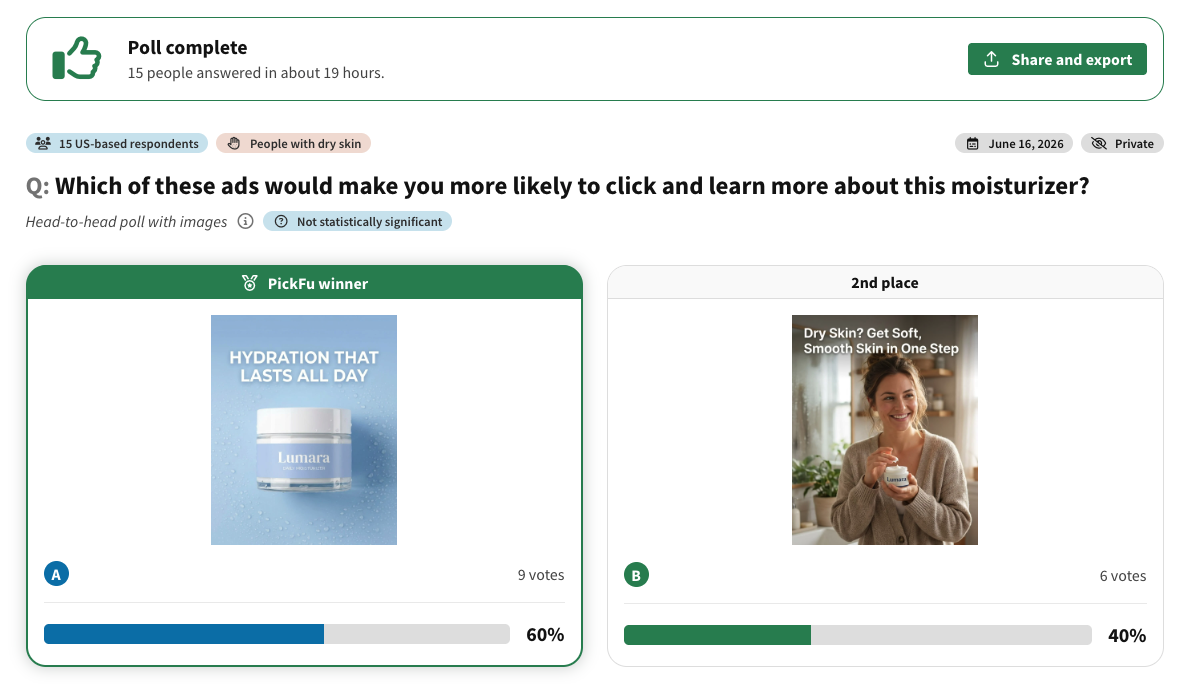
Say a skincare brand uses AI to generate two Facebook ad concepts for a new moisturizer. Option A is a polished product render with the headline “Hydration that lasts all day.” Option B is a lifestyle image of someone applying the product, headlined “Dry skin? Get soft, smooth skin in one step.” The question: which ad would make you more likely to click and learn more?
You might expect the problem-led Option B to win on relatability. We ran exactly this test on PickFu with dry-skin shoppers, and the result went the other way.
📊 Survey example: AI-generated moisturizer ad A vs. B, head-to-head, dry-skin shoppers. See the results.
What the results showed:
- The polished render with “Hydration that lasts all day” won, beating the lifestyle ad.
- The benefit headline did most of the work. “Hydration that lasts all day is the reason I chose,” one respondent said. Others liked seeing the product clearly (“the still image of the item”) and called the ad “unique and premium.”
- The shoppers who picked the lifestyle ad liked that it felt human (“gives a sense that it’s for actual people,” “more appealing to the eye than just a bottle”), a reason to keep it for a different placement or audience.
The pattern isn’t universal, which is the whole point. In a separate three-way test for workout apparel, the most relatable, action-oriented ad won instead, with 53% of the vote. See that test. Clean and benefit-led wins in one category; relatable and human wins in another.
The skincare team walked away knowing its audience wanted a clear product and a concrete benefit, not a lifestyle scene — the opposite of what it assumed. That’s the real payoff of AI creative testing. You learn not just which asset wins, but where and why it works.
AI creative testing for different teams
Different teams use AI creative testing for different decisions. The common thread is that each one is trying to reduce uncertainty before launch.
| Team | How they use it |
| E-commerce teams | Test PDP images, product copy, packaging, and ads |
| Amazon sellers | Test main images, titles, A+ content, and listing copy |
| Marketing teams | Test ad creative, hooks, CTAs, and landing page copy |
| Brand teams | Test logos, taglines, names, and positioning |
| Agencies | Validate creative before presenting to clients |
| Startups | Choose faster between AI-generated concepts |
| Product teams | Test feature messaging and product concepts |
| Content teams | Test headlines, thumbnails, and article angles |
| App teams | Run app store screenshot / icon testing |
| Founders | Test early ideas before investing in design or development |
For a startup, it’s a quick form of prototype market validation. Before committing to a full build, you can put value propositions, concept images, landing page copy, or app mockups in front of the people you hope to sell to. That won’t prove the whole business works, but it tells you whether the idea is landing.
The same logic answers “How to sell app ideas.” You don’t sell the idea in the abstract — you sell how it’s named, visualized, and explained. Testing app names, screenshots, icons, and landing copy tells you whether the concept lands before you pitch it or build it.
It even helps content teams asking “How to create original content for GEO / SEO.” Rather than publishing generic AI-written copy, teams can test article angles, titles, and examples with real readers to see which framing feels more useful and credible — which is also what makes content original enough to get cited.
Where can I post a survey to test AI-generated creative?
It depends on what you need, and it helps to separate two things: building the survey and finding people to take it. You can post a survey to your email list, customer community, LinkedIn or Reddit audience, Slack or Discord group, or a website popup, and you can build it in a tool like Google Forms or Typeform.
PickFu does that build-and-share part too. You can create a survey and share the link with your own audience for free, the same way you’d send around a Google Form, and collect written responses without paying for a panel. The difference shows up when you don’t have an audience to share with, or when your own followers aren’t your actual buyers. Then you can launch the same survey to PickFu’s built-in panel and target respondents by the traits that matter to the decision. Sharing only with friends, employees, or existing fans skews the results; reaching matched respondents is the difference between “people liked this” and “our likely buyers understood this.”
AI creative testing question templates
The quality of your test depends on the quality of your question. Vague questions get vague answers.
General preference: Which creative option do you prefer, and why? Good for an early read when you’re narrowing many AI-generated options to a few.
Purchase intent: Which version would make you more likely to buy this product? Good for e-commerce, Amazon listings, packaging, and product pages.
Click intent: Which ad would you be more likely to click? Good for ad creative, social posts, and thumbnails — it estimates attention before you spend.
Clarity: Which version more clearly explains what this product does? Good for landing pages, app store screenshots, and SaaS messaging.
Trust: Which image or message feels more trustworthy? Good for finance, health, wellness, and new brands fighting skepticism.
Brand fit: Which option feels more aligned with a premium brand? Useful for positioning, where restraint sometimes beats the loudest option.
Authenticity: Which social media post feels more authentic and less AI-generated? Useful as audiences grow more sensitive to generic AI content.
Memorability: Which product name is easier to remember? Useful for naming, a brand name test, or testing slogans.
Objection discovery: What, if anything, makes this creative confusing or unconvincing? One of the most valuable prompts, because it tells you what to fix next.
Every PickFu response already includes a written explanation, so you don’t need a separate “why” question — the reasoning comes back with every vote.
Common AI creative testing mistakes
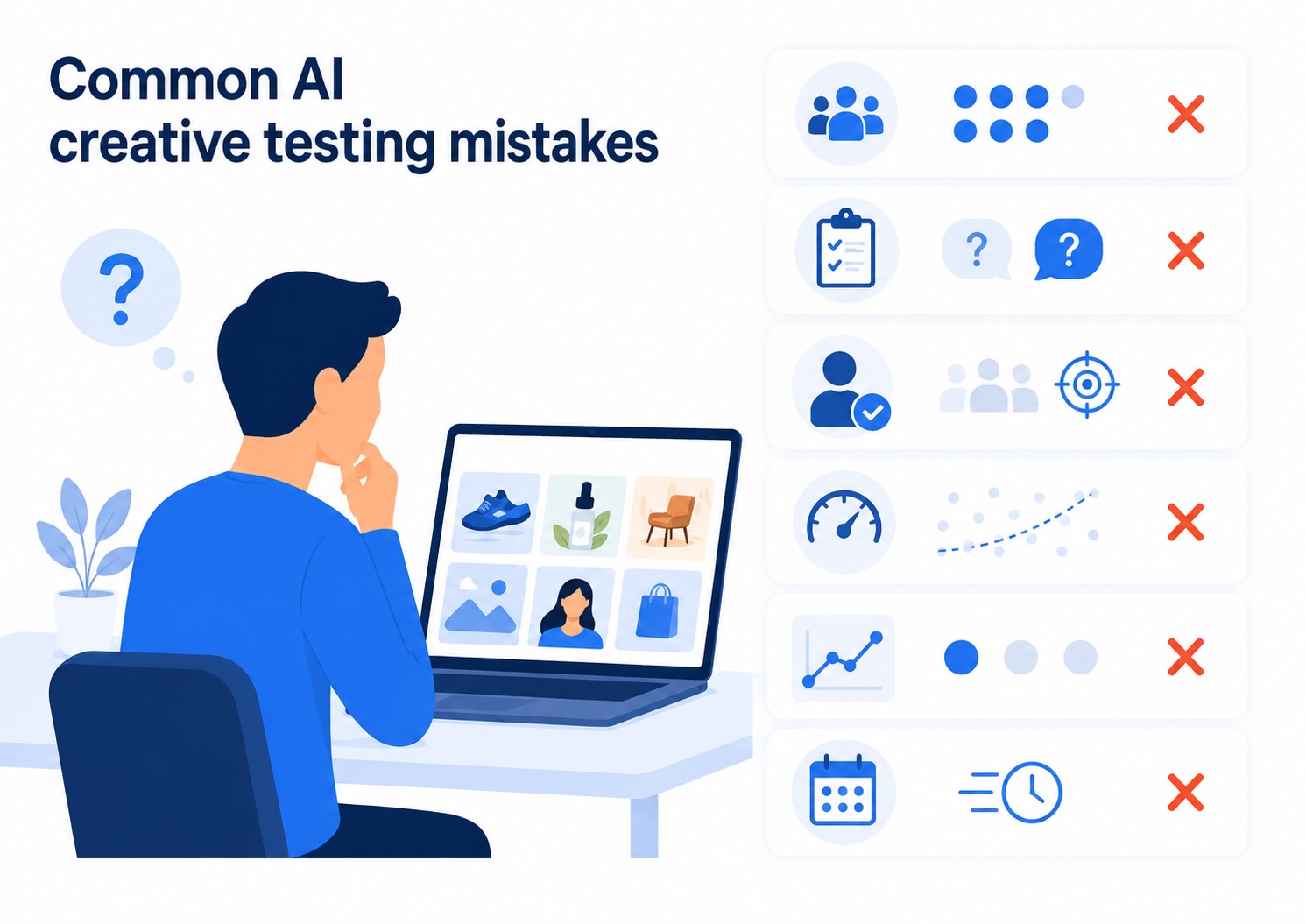
AI makes it easy to generate creative, which makes it easy to test the wrong things. A good process starts before the poll launches.
The most common mistake is testing too many weak AI outputs. If creative is obviously broken or off-brand, testing it wastes respondent attention. Shortlist first. Another is asking vague questions — “Which is better?” rarely tells you whether the winner is more trustworthy, more clickable, or more likely to lift conversion rate. Match the question to the decision.
Teams also test with the wrong audience. General-consumer feedback may suit a mass-market product but mislead for B2B software, premium goods, or niche categories. A subtler error is reading only the winner and ignoring the written feedback — the vote tells you what people preferred; the comments tell you what to fix, and the losing option often holds a usable element.
AI-specific traps include using product images that misrepresent the item, publishing ad copy with unsupported claims, choosing visuals that look good but confuse people, and forgetting brand fit. The last mistake is skipping the retest: if feedback leads to a new direction, validate the revision before launch. Iteration is where the value compounds.
Risks of publishing AI creative without testing
AI increases output, which also increases the number of untested ideas hitting the market. That’s the opportunity and the risk.
The most obvious risk is generic creative. AI is trained on existing content, so it often produces familiar patterns that look professional but feel interchangeable with every other brand in the category. When your ad or product page looks like everyone else’s, brand recall gets harder — and so does standing out as creative fatigue sets in across a category.
The second risk is false confidence. Because AI output looks finished, teams skip the messy step of asking whether people actually understand it. A polished campaign can still fail if the offer is unclear or the image feels fake. The third is trust: AI visuals can carry subtle errors, AI copy can overpromise, and AI product images can set expectations the real product can’t meet. That might lift clicks short-term and erode trust, reviews, and repeat purchase over time.
Testing helps you catch confusion before it costs you. It’s cheaper to find out a concept doesn’t land in a survey than in a launch.
How AI creative testing connects to ad performance
Creative has always been one of the biggest drivers of advertising effectiveness. Nielsen’s analysis of what drives ad effectiveness found creative to be the single largest factor, and follow-up analysis put creative at roughly 49% of a brand’s sales contribution from advertising — far more than most marketers assume.
Many teams still over-focus on targeting, bidding, and campaign structure while under-testing the creative itself. Targeting reaches the right people; the ad still has to persuade them. Budget buys reach; creative scales weakly. Dynamic creative optimization can combine assets, but it depends entirely on the quality of the inputs.
AI-powered creative testing improves those inputs before they reach the platform. Instead of launching a large batch of AI-generated ads and waiting for the algorithm to sort them out, you test the strongest options with real people first, then launch better-informed. It won’t guarantee higher ROAS or CTR, but it cuts the guessing before media spend begins.
AI creative testing, DCO, and personalization at scale
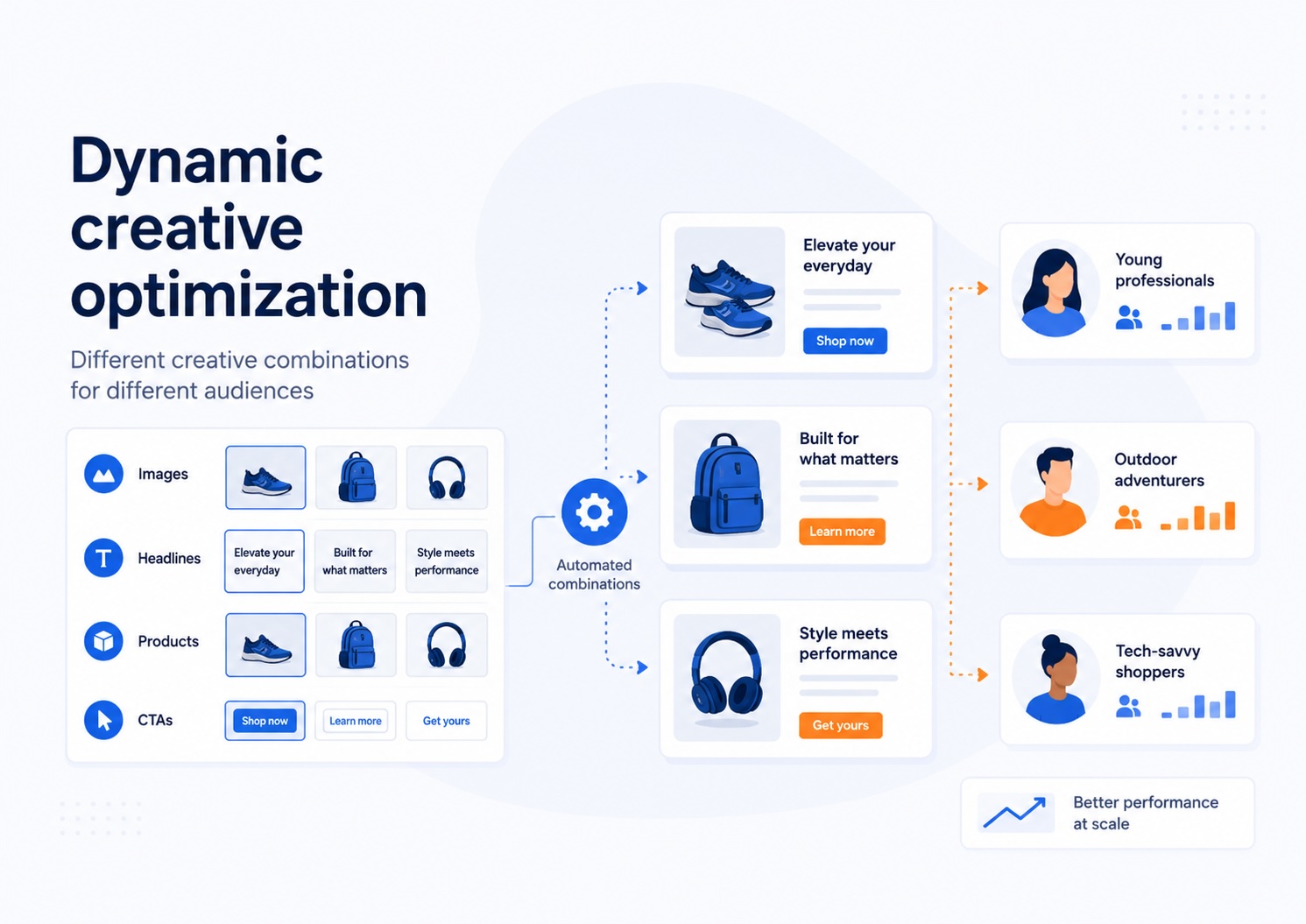
Dynamic creative optimization — often shortened to DCO — uses combinations of creative elements to serve different versions of ads to different audiences: different images, headlines, products, or calls to action. Meta’s dynamic creative and similar tools reflect the broader shift toward automation and personalization at scale.
AI-driven creative testing fits alongside these tools but plays a different role. DCO assembles and delivers variations. AI creative generation produces more inputs. Human testing tells you which inputs are strong enough to use, and why people respond to them. Feed a DCO system weak headlines and unclear images, and automation will still find a relative winner — but the best option from a weak set can be weaker than a stronger concept you’d have spotted through human feedback first. The point isn’t only to predict performance; it’s to improve the quality of what gets tested in the first place.
Predictive testing, eye tracking, and facial coding
Some creative testing tools use performance predictions, eye tracking, facial coding, or other research methods to estimate how people will respond. These can be valuable, especially for large advertisers and dedicated research teams. Eye tracking shows what people notice first. Facial coding captures moment-to-moment reactions. A/B testing shows which version wins in market. Multivariate testing compares combinations of headlines, images, and offers. Platform-level machine learning helps predict performance once campaigns run.
PickFu sits in a practical middle ground. It isn’t a lab study, and it isn’t a delivery algorithm. It’s a fast way to ask real people what they prefer, understand, trust, and would act on. For founders, business owners, and marketing teams, that’s often the missing piece.
How to use AI creative testing before live A/B testing
A/B testing is valuable, but it isn’t always the right first step. Running live ad or landing page tests requires traffic, budget, and time, and testing weak ideas in market means paying for the lesson with media spend.
AI creative testing can come before A/B testing. Use PickFu to narrow a large set of AI-generated options into a smaller set of strong candidates, then run the best ones in a live A/B test if the decision warrants it and you have the traffic. This sequence helps early-stage teams especially — a startup without enough traffic for reliable landing page tests, an Amazon seller who doesn’t want to risk conversion rate on a weak main image, a marketing team that doesn’t want to fund every AI-generated variation. It doesn’t replace performance data; it decides what deserves performance testing.
Test your AI creative with PickFu
Generated a stack of AI creative options? Use PickFu to find out which one your target audience prefers before you launch. Upload your images, copy, ads, names, logos, packaging concepts, or product ideas and get written feedback from real people who match your buyers.
Use that feedback to pick a winner, refine your AI prompts, or sharpen your next iteration. Over time it improves not just the current campaign but the way your team prompts, reviews, and approves AI-generated creative. PickFu is digital-only and doesn’t replace hands-on or compliance testing — but for deciding which creative deserves your budget, it’s hard to beat.
Create your free PickFu account to run your first AI creative test.
Want a structured starting point? Browse the PickFu playbooks or the digital ad test template, and see how other teams set up tests in the examples gallery.
FAQ
AI creative testing is the process of evaluating AI-generated or AI-assisted creative before publishing it — ad copy, product images, packaging concepts, landing page copy, logos, slogans, social posts, app screenshots, Amazon content, and product ideas. The goal is to learn which option real people find clearer, more trustworthy, more appealing, or more likely to make them act.
Because AI can produce polished options that still fail with real customers. The creative may look good internally but feel generic, confusing, or off-brand to your target audience. Testing helps you choose between AI-generated options faster and avoid launching creative that wastes budget or erodes trust.
Yes. PickFu can test AI-generated images — product images, lifestyle visuals, ad concepts, packaging mockups, app screenshots, and social graphics. A strong question might ask which image looks more realistic, which makes the product more appealing, or which one people would trust before buying.
Yes. PickFu can test AI-written ad copy, headlines, landing page copy, email subject lines, product descriptions, Amazon bullets, social captions, slogans, and brand messaging. It’s useful because AI-written content often sounds polished while lacking clarity, specificity, or emotional relevance.
Ask a question tied to the decision you need to make: which ad people would click, which product image feels more trustworthy, which headline explains the benefit more clearly, or which slogan is easier to remember. “Which version would make you more likely to buy this product?” beats “Which is better?”
No. It applies to ads, but also product images, packaging, websites, emails, app store assets, landing pages, social posts, logos, slogans, brand names, product concepts, and Amazon listings. Any AI-generated customer-facing asset can be tested before launch.
There’s no single universal 30% rule for AI. People use it loosely to suggest AI should handle a share of the work while humans keep responsibility for strategy, judgment, and final decisions. For creative teams, a practical reading: let AI accelerate the draft, but don’t let it own the decision. Human review, customer feedback, and brand judgment should still shape what gets published.
Build skills in quality assurance, prompt evaluation, product testing, data review, and AI output assessment. Depending on the role, you may also need software testing, model evaluation, or content-quality review experience. In marketing, “AI tester” can also mean someone who evaluates AI-generated content for accuracy, usefulness, brand fit, and audience response.
The 10-20-70 rule, associated with BCG’s research on AI transformation, holds that success depends less on algorithms and more on people. The split is roughly 10% algorithms, 20% technology and data, and 70% people and processes. For AI creative testing, that means the AI tool matters, but the workflow, review process, and audience feedback matter more.
It can be. Companies need people who can evaluate AI systems, test outputs, identify risks, and improve quality. In software that looks like QA, automation, model evaluation, or red teaming. In marketing it looks like reviewing AI-generated content, testing creative, and analyzing audience behavior. The strongest opportunities tend to go to people who pair technical fluency with human judgment.
A creative testing tool helps teams evaluate marketing, design, or content assets before or during launch. Creative testing tools may support surveys, preference tests, A/B testing, multivariate testing, eye tracking, or facial coding. PickFu is a creative testing tool for collecting real-person feedback on creative options before launch.
Match the tool to the decision. For quick feedback before launch, prioritize audience targeting, written responses, fast turnaround, and easy comparison. For in-market performance data, look at A/B testing or platform experiments. For deep research, consider interviews or brand studies. For AI creative testing, the most useful tool helps you understand not just which option wins, but why.
Common methods include surveys, preference tests, concept testing, A/B testing, multivariate testing, brand lift studies, conversion tracking, eye tracking, facial coding, recall studies, CTR analysis, and return on ad spend analysis. Before launch, surveys and preference tests surface stronger creative; after launch, platform data shows how it performs.
If you’re already using AI to generate creative, the next step is testing those elements before launch. AI can make more headlines, visuals, and concepts; audience feedback tells you which are clear, trustworthy, and persuasive. The real advantage is a faster learning loop between creative generation and real customer response.
By helping you choose stronger creative before you spend. It can reveal which headline is clearer, which image draws more interest, which call-to-action feels natural, and which message fits the audience — reducing wasted spend and improving the quality of creative entering paid campaigns.
AI helps teams generate more variations, summarize feedback, spot patterns, and iterate faster. It supports creative generation, performance predictions, and personalization at scale. But it works best paired with human feedback: use AI to create options and real people to validate which ones resonate.
It helps teams learn what their audience actually responds to. Over time, those insights improve brand messaging, ad creative, product positioning, landing pages, packaging, and content strategy — turning each campaign from a one-off guess into a growing understanding of audience behavior and ad effectiveness.