
Creative optimization can make or break your Amazon success. One poorly performing main image can tank your click-through rates, while the right A+ content design can boost conversions by over 1,000%.
But how do you know which creative elements will actually resonate with your target customers before you commit to expensive production or risk weeks of poor performance?
Daniela Bolzmann, founder of Mindful Goods, has cracked the code. Her agency has worked with over 500 Amazon brands over eight years, and 78% of clients who run split testing with her team see immediate sales increases. Even more impressive: they’re seeing anywhere from 20-2500% growth by focusing purely on content optimization for conversion.
The secret? A systematic approach to creative testing that uses PickFu as the foundation for data-driven design decisions.
Check out our recent webinar with Daniela, and keep reading for the key takeaways from her process!
Why third-party testing beats Amazon’s native tools
Most Amazon sellers know about Manage Your Experiments, Amazon’s free split testing tool. But Daniela’s team always starts with PickFu before moving to Amazon’s platform.
“The downside about Manage Your Experiments is you have to wait anywhere from 3 to 10 weeks to get data back on one split test,” explains Daniela. “Whereas you can run a test in an hour if you wanted to and get results back in 30 minutes on PickFu.”
This speed advantage is crucial during the design iteration process. Instead of waiting weeks to learn whether a creative direction works, Mindful Goods can test multiple concepts, gather feedback, refine designs, and test again – all in the same day.
The agency runs approximately 250 tests per year, and the results speak for themselves:
- Main image testing: Up to 550% increase in orders, 145% increase in sessions
- A+ content testing: Up to 1,080% increase in orders
- Title and SEO testing: Up to 990% increase in orders
Mindful Goods’ creative optimization process
Step 1: Build comprehensive idea boards
Every project starts with extensive research and ideation. The team creates mood boards pulling inspiration from:
- Direct competitors
- Successful products in other categories
- High-performing designs across industries
- Trending visual elements and layouts
“There’s no bad ideas here,” says Daniela. “You just want to get as many different things to inspire you as possible. Think through how you would adapt this for your product – does your product have a box? Can we show ingredients or flavors in interesting ways? Are there keywords that drive more clicks?”
Step 2: Leverage AI for rapid design iteration
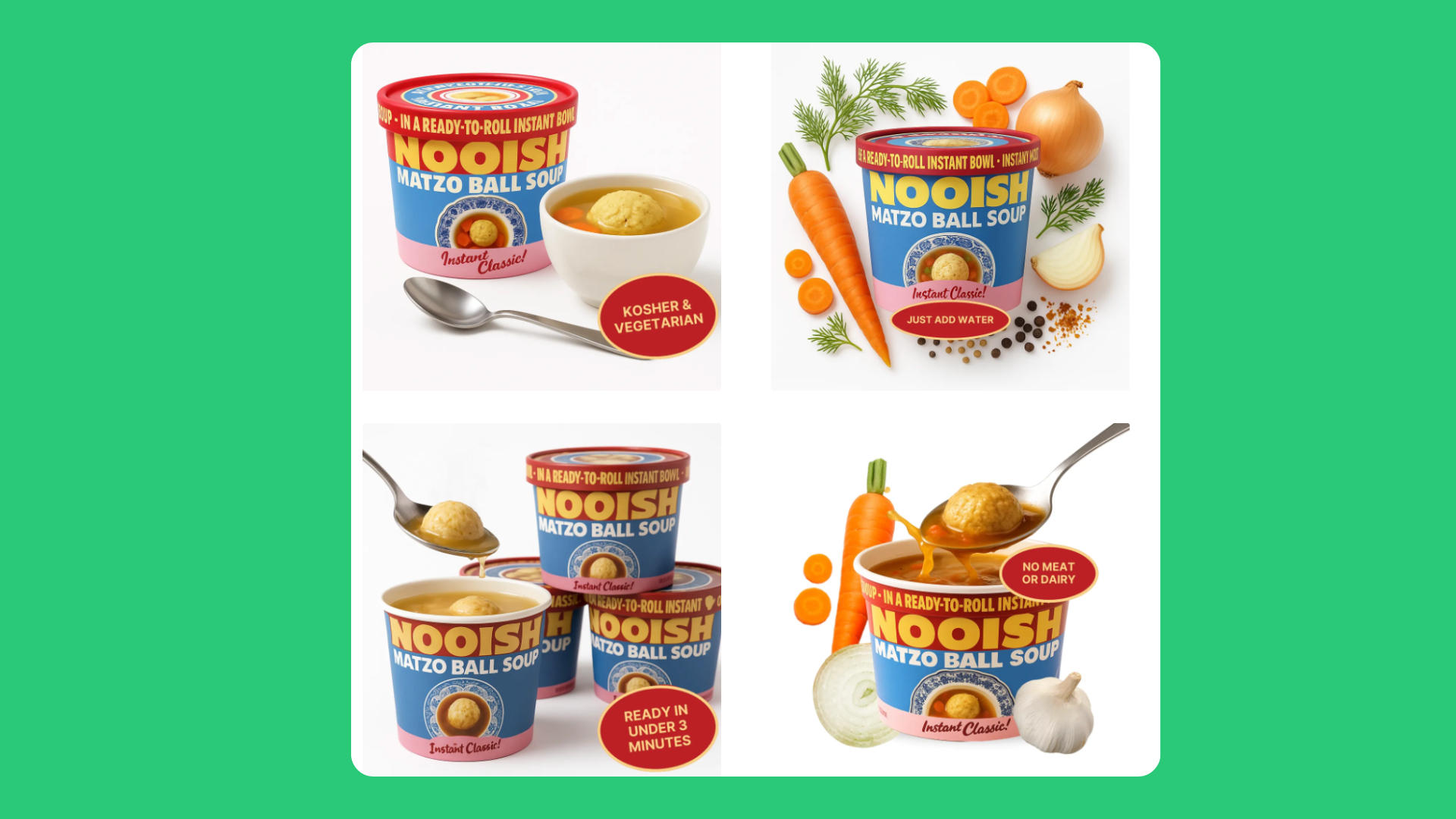
Rather than manually designing every variation, Mindful Goods has trained an AI tool using their library of best-performing images. This allows them to:
- Drop in a client’s product image
- Generate 7+ design variations within 2 minutes
- Ensure all variations include proven elements like keyword callouts, optimal angles, and attention-grabbing visual treatments
“We’ve trained it off of all those images because we know those are our best performing images,” Daniela explains. “It knows all the things that we love like keyword callouts and different orientations and shadows and angles.”
Step 3: Test systematically with PickFu
Here’s where PickFu becomes essential. Mindful Goods runs a minimum of three polls for main image optimization:
Poll 1: Competitor baseline test
Test the current main image against 2-3 top competitors on page one to establish a click-share baseline.
Poll 2: Design variation testing
Test all new design variations against each other to identify the strongest performer.
Poll 3: Competitive validation
Test the winning variation back against competitors to measure improvement in click-share.
“That third test is the part that gets confusing for people,” notes Daniela. “In a lot of cases, you’re not going to beat your competitors because there’s brand recognition factors. What you’re really trying to do is improve the click share. If I was getting 10% of clicks before and I got it up to 20%, that’s a win.”
Check out our step-by-step playbooks for improving your CTR and CVR on Amazon with PickFu!
Real success stories: From concept to conversion
Case study: The vegan snack breakthrough
One of Mindful Goods’ longtime clients, Yes Bar, saw a 15% increase in click-through rate in just two weeks with a simple main image optimization.
The breakthrough came from reading PickFu poll comments carefully. “We realized people kept asking if the product was vegan,” recalls Daniela. “It does say it’s vegan right there on the main image, but it’s so tiny you can’t read it.”

After checking keyword analysis and confirming “vegan” was a top search term, they simply enlarged the vegan callout to make it readable on mobile devices. The result was an immediate CTR boost.
“By enhancing something that the shopper is looking for, are you doing so with the intent to help them or hurt them?” Daniela asks. “In this case, we’re making their life easier. A mom on the go needs to know at a glance – is it vegan? Is it a variety pack? She doesn’t have time to read every detail.”
Multi-million dollar transformations
Two recent case studies show the power of systematic testing across different business sizes:
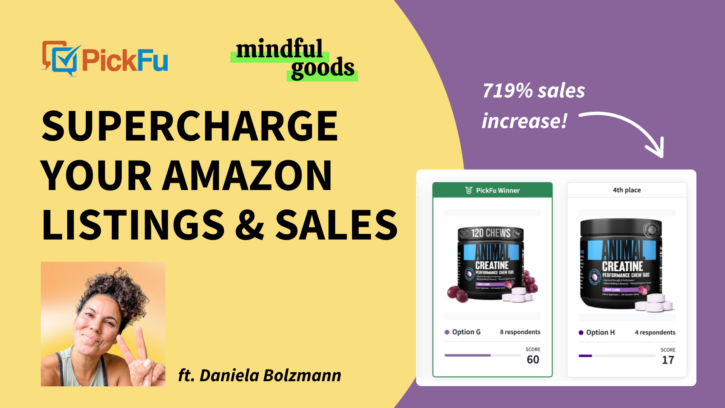
- Animal (established supplement brand): 719% increase in sales
- Blake’s (emerging snack brand): 472% increase in sales

Both brands came to Mindful Goods with the same core problem: their content was getting stale compared to competitors, and their advertising performance was declining.
“They both benefited from really taking an overhaul of the content, taking a data-driven approach, making sure they were testing throughout the entire process with lots of feedback loops,” explains Daniela.
Advanced testing strategies for maximum impact
Analyze demographics for targeted insights
PickFu’s demographic filtering becomes powerful when you understand your target market. Even if you run open polls initially, you can filter results by age, gender, or other factors to see how different segments respond.
“If you realize that for the pink design option, all the younger people love it but everyone else loves the non-pink ones, then who do you want to target?” says Daniela. “You might go with a totally different design based on who you’re targeting.”

Mine poll comments for content gold
While PickFu’s AI summary provides a quick overview, Daniela’s team reads every individual comment to spot patterns and insights.
“The individual comments are where you’re going to find the gems,” she emphasizes. “The AI does a quick snapshot overview, but reading individual comments is where you’ll start noticing pattern repetition and little gems stick out.”

These comments often reveal:
- Language customers use to describe benefits
- Questions that could become product callouts
- Unexpected concerns or confusion points
- Features customers value most
Test at the right scale
For most testing, Mindful Goods uses 30-person polls rather than larger samples. “If you’re not getting the answer you need in 30, that basically is the answer you need,” explains Daniela. “If there’s not a winner in a 30-person poll, then that tells me all of our images are not worthy.”
When there’s no clear winner, they iterate on designs and test again rather than accepting mediocre options.
Adapting testing for different business sizes
Enterprise brands (8-9 figures)
Large brands take a systematic, calendar-driven approach:
- Test modular A+ content elements monthly
- Run seasonal optimization tests
- Continuously optimize successful designs with small tweaks
- Plan testing roadmaps aligned with product launches
Emerging brands
Smaller brands focus on high-impact, foundational testing:
- Front-load testing during initial optimization
- Run annual refresh cycles
- Focus on 80/20 improvements that move the needle
- Test incrementally as resources allow
“If you think about smaller brands, you’re one or two people on the team,” notes Daniela. “You can’t be pulled in 150 directions. You should do the things you know you need to do to move the needle and do them well.”
Testing for products that need explanation
For products where the use case isn’t immediately obvious, creative testing becomes even more critical. Daniela shares an example of testing a shoehorn that looked like a bottle opener: “We uploaded it to PickFu and asked ‘What is this?’ Something like 95% of people had no idea what it was and were guessing random things.”
Solutions for hard-to-understand products:
- Show the product in use with hands/context
- Include packaging with clear explanations
- Test different ways to demonstrate functionality
- Use lifestyle imagery to suggest use cases
- Add text callouts explaining key benefits
Getting started with systematic creative testing
Essential poll templates to try
- Main image competitor analysis – Test your current image against top competitors
- Design variation testing – Compare multiple packaging or branding creative approaches
- Product image stack testing – Optimize your secondary images and their order
Questions that drive actionable insights
- “Which product would you be most likely to click on?”
- “What questions do you have about this product?”
- “Which design makes the product benefits clearest?”
- “What information is missing that would help you decide?”
Building your testing workflow
- Research phase: Create idea boards and design variations
- Initial testing: Use PickFu to validate concepts and gather feedback
- Iteration: Refine designs based on poll insights
- Validation: Test winning concepts against competition
- Implementation: Upload winners to Amazon’s Manage Your Experiments
The data is clear: systematic creative testing delivers results. When 78% of tested creative changes lead to sales increases, testing isn’t optional – it’s essential for Amazon success.
As Daniela puts it: “For us at Mindful Goods, it’s a must. It’s mandatory. It has to be included in our process because we know how important it is.”
Ready to optimize your Amazon creatives with data-driven insights? Start your first PickFu poll today and discover what your customers really think about your product presentation.
Want to learn more about Mindful Goods’ process? Visit their website to see how their team helps Amazon brands achieve remarkable growth through creative optimization.